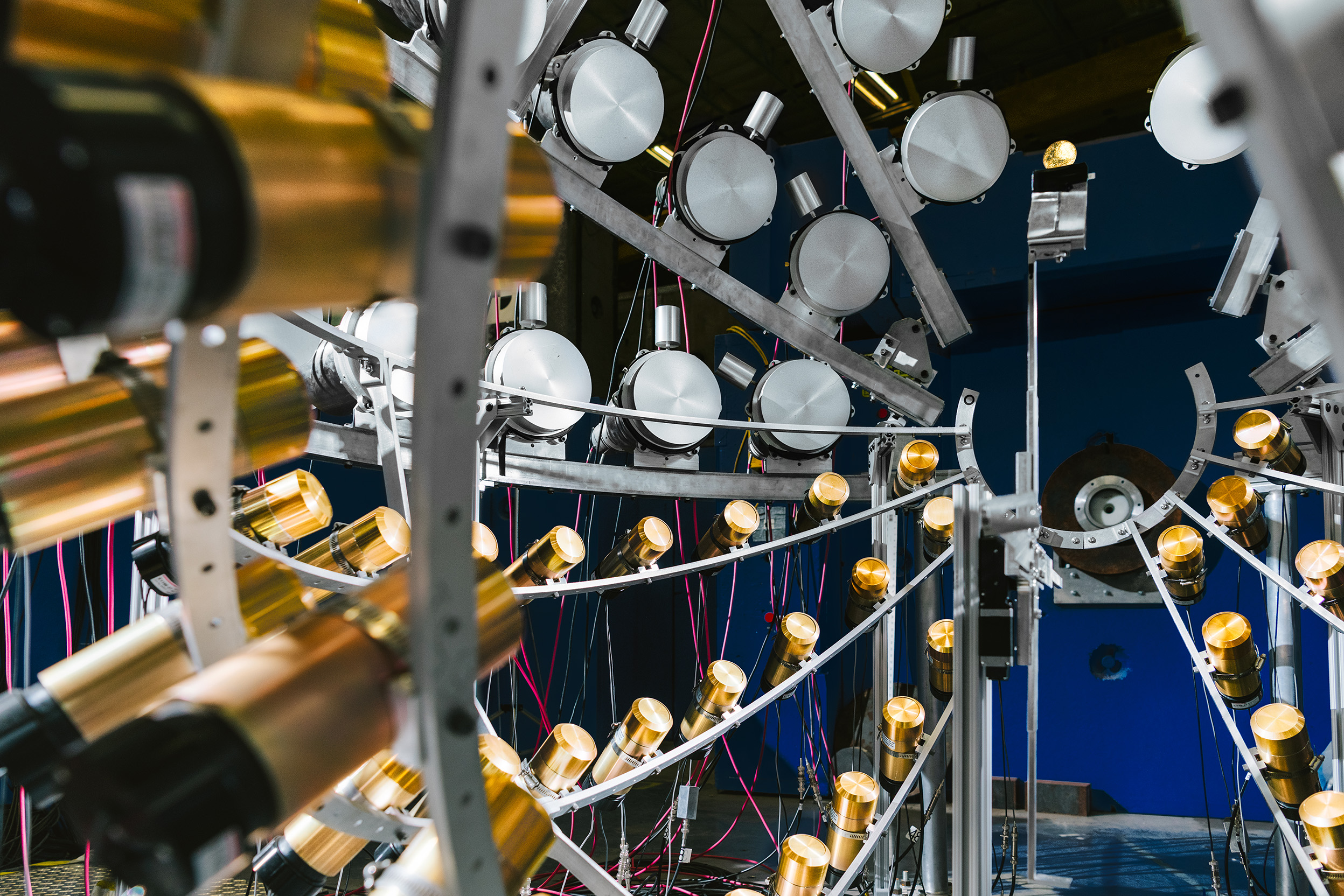
This flight path used for CoGNAC experiments and neutron detector development and calibration.
Target 4 Flight Path 15L (4FP15L) has a neutron beam at an angle of 15 degrees to the incident proton beam that impinges on the spallation source. It is unique among the WNR flight paths in that it has two experimental locations available at distances of 21.5 and 90m from the spallation target.
The rectangular shutter has variable openings in x- and y- dimensions and therefore allows the neutron flux intensity to be varied according to experimental requirements. The shape of the beam spot can also be changed by placing collimator inserts in the neutron beam tube.
This flight path is primarily used for the Correlated Gamma-Neutron Array for sCattering (CoGNAC) experiments at 21.5m, and neutron detector development and calibration at 90m.
In order to minimize room return of neutrons to detectors near the target position, the 21.5m cave has a “false-floor,” such that the concrete floor is 2m below the false floor, and the cave walls are also well removed from the target position. The 90m station allows improved neutron energy resolution for higher neutron energies, due to its long flight path.
CoGNAC
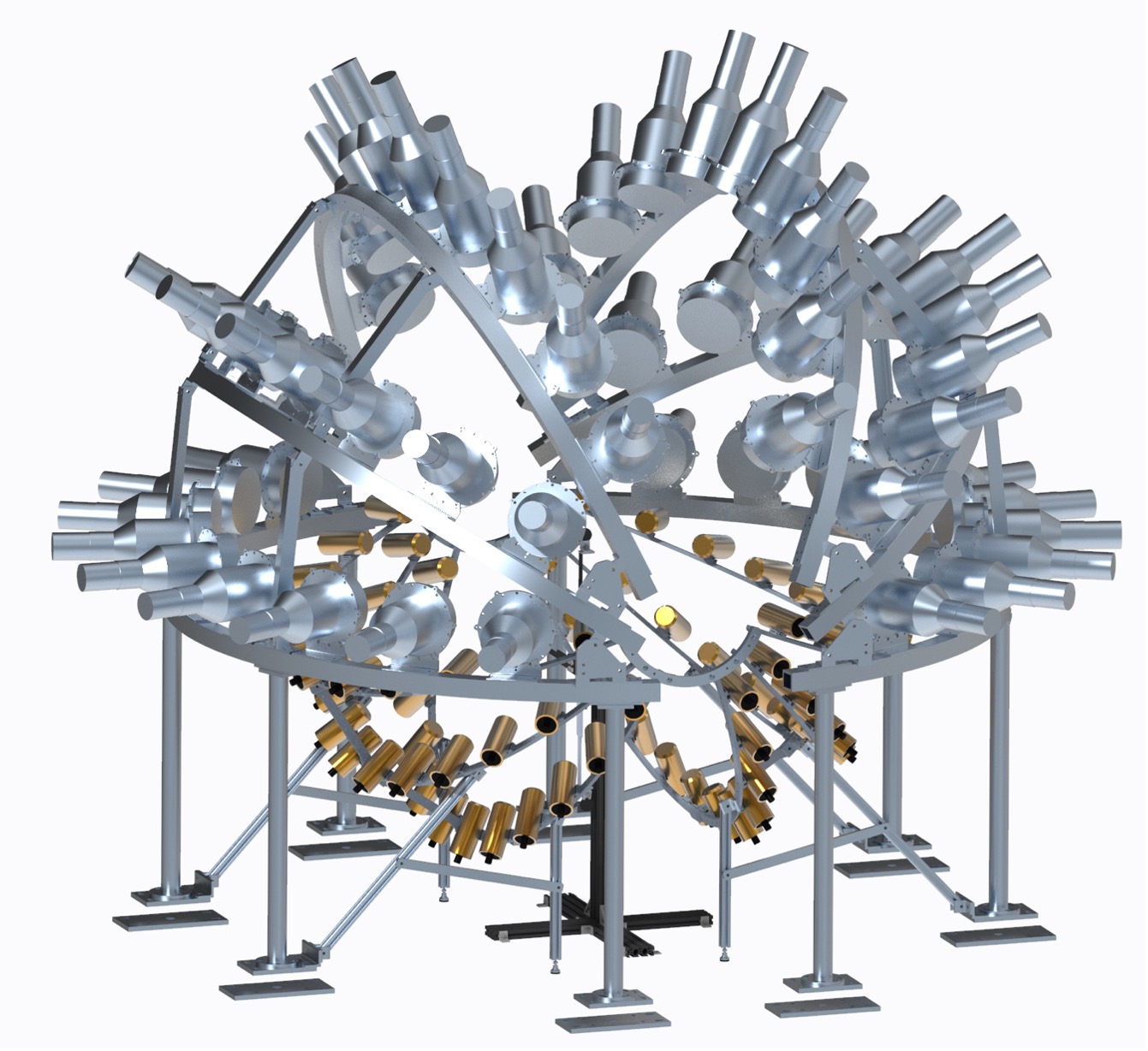
The CoGNAC experimental area is centered 21.5m from the spallation target. It has two arrays of neutron detectors which are utilized simultaneously to extract neutron and gamma-ray nuclear data primarily from neutron scattering reactions. Targets are positioned on a 4-arm rotating target holder, allowing for frequent remotely-controlled alternation between materials of interest, blank background samples, and calibration targets.
The liquid (silver, upper hemisphere in Fig. 1) and CLYC (gold, lower hemisphere) scintillators both measure neutrons and gamma rays with pulse shape discrimination to separate these particles and complementary properties for extracting high-quality nuclear data from reactions of interest.
90m Station
The 90m station is used primarily for neutron detector development and calibration, both for high-energy neutrons with beam. The long flight path is ideal for developing detectors for neutrons with energies above 10MeV, for which the resolution in time of flight, and hence incident neutron energy, is improved with the long flight path.
Beams up to about 10cm or as small as 2mm in diameter are routinely used.