Recent fusion-energy research at Los Alamos National Laboratory is helping bring commercial fusion power reactors, which scientists have been working to develop for more than 70 years, closer to reality. But there’s one place where fusion reactors have long been taken for granted: Hollywood.
For decades, screenwriters have used the concept of fusion reactors to create compelling sci-fi stories. Both Star Wars and Star Trek, for example, feature starships powered by fusion, and movies such as Chain Reaction (1996) and The Saint (1997) use the invention of new fusion-reactor technologies to drive their plots.
Of course, the reactors in Hollywood movies aren’t intended to be wholly realistic. Yet the ways in which these fusion reactors differ from real-world reactors can be instructive. Here, National Security Science revisits three iconic movies in which fusion reactors play a key role, separating fact from science fiction.
Back to the Future Part II (1989)
This sequel to the iconic original sees inventor Dr. Emmett “Doc” Brown (played by Christopher Lloyd) arrive, via his time-traveling DeLorean, in 1985, where he persuades everyman Marty McFly (played by Michael J. Fox) to travel with him to 2015. There, the pair endeavor to stop McFly’s son from making a catastrophic mistake.
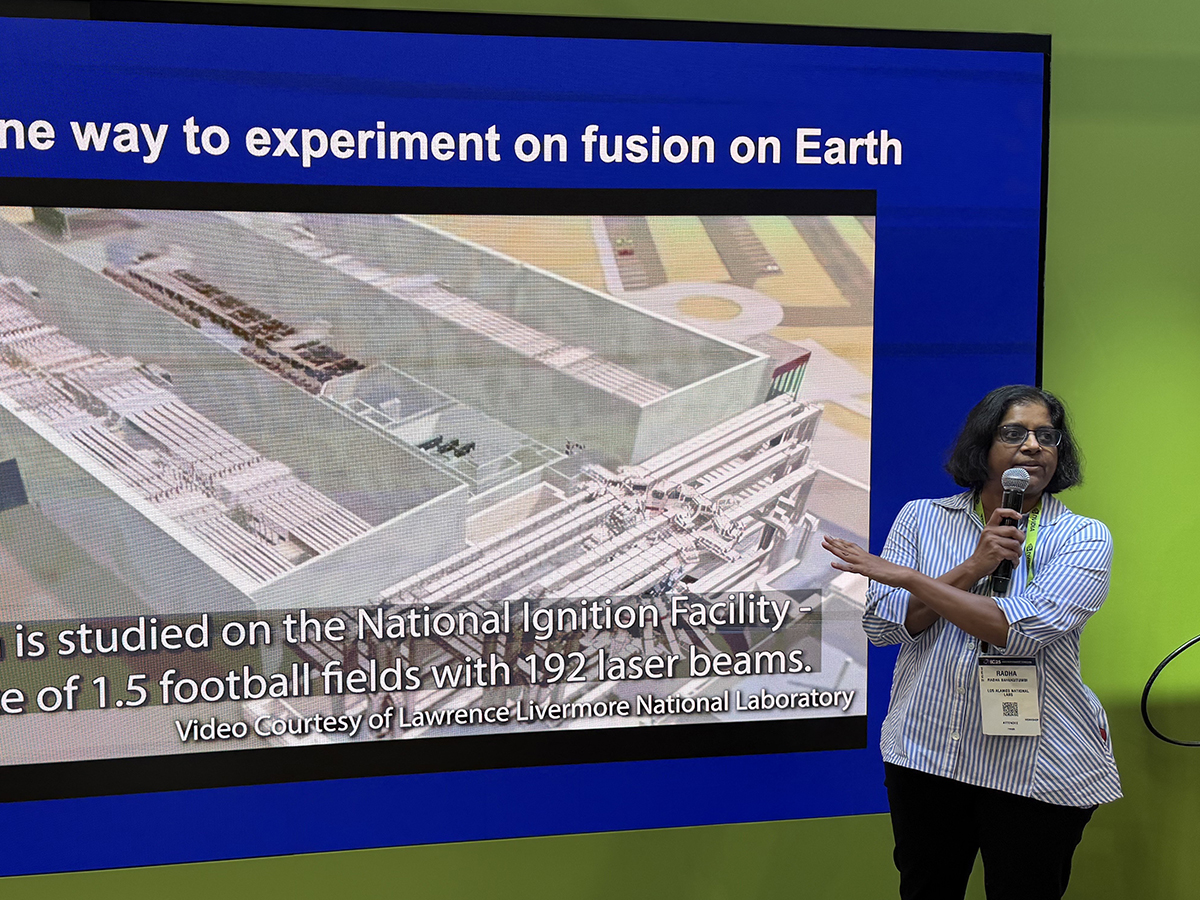
Brown’s DeLorean is powered by a portable fusion reactor with the brand name “Mr. Fusion,” which converts garbage—banana peels and a beer can, for example—into energy. Rather than trash, real-world fusion reactors rely on high-purity hydrogen isotopes, such as deuterium and tritium, for fuel. Currently, researchers at Los Alamos are designing and fabricating tiny capsules containing deuterium and tritium that are bombarded with lasers at the National Ignition Facility (NIF) to produce fusion, answering important questions about the fusion process and informing reactor design.
Unlike NIF and planned fusion reactors, the Mr. Fusion reactor in Back to the Future II appears to use cold fusion—fusion that takes place at near room temperature (rather than at hundreds of millions of degrees Celsius). Although cold fusion was a matter of much discussion for a brief period in the late 1980s, today, the process is thought impossible by most scientists.
Spider-Man 2 (2004)
In Spider-Man 2, nuclear physicist Otto Octavius (played by Alfred Molina) builds a tritium-powered fusion reactor that goes awry during a demonstration. The accident affixes a set of artificial intelligence–controlled robotic arms to Octavius’s back, which turn him into the evil Doc Ock, who embarks on a crime wave as he seeks to rebuild the reactor.
The design of Octavius’ reactor is visually inspired by real-world ideas about magnetic confinement, which involves using magnetic fields to contain a plasma. However, in Spider-Man 2, Doc Ock’s reactor lacks the shielding and other infrastructure that makes such reactors stable and safe to use (for example, by confining the neutrons that would be produced in a fusion reaction, which without shielding could kill onlookers in seconds or minutes).
The reactor in Spider-Man 2 is also much smaller than a real-life reactor would be. Moreover, the reactor involves the creation of a “protostar”—a miniature star that pulls objects into itself via its gravitational field—in a way that no real-life fusion reactor would. Instead, real magnetic-confinement reactors are generally designed to contain plasma in toroidal (donut-shaped) or linear configurations, and they lack strong gravitational fields.
Iron Man (2008)
Early in Iron Man, arms mogul Tony Stark (played by Robert Downey, Jr.) is kidnapped by criminals who order him to build them a missile. Rather than comply, Stark creates a miniature fusion reactor with a palladium core. The reactor is then installed in Stark’s chest, and Stark uses it to power a flying suit of armor, which enables his escape from captivity.
Like the reactor in Spider-Man 2, Iron Man’s reactor draws on ideas about magnetic-confinement fusion (in this case, the reactor appears to be a miniature tokamak—a type of toroidal fusion reactor). Also like in Spider-Man 2, the Iron Man reactor is much too small: Stark says in the film that the reactor in his chest produces three gigajoules of energy per second—a power output that, in the real world, would likely require a building-sized reactor.
Furthermore, real-life reactors don’t rely on palladium to the extent that Stark’s does. Palladium was a notable component in historical cold-fusion research, but it isn’t a major part of modern fusion reactors. However, a team of Canadian researchers did recently find that palladium can modestly boost fusion rates when incorporated into small experimental reactors, pointing toward potential future uses for the element in fusion-reactor design.
In this sense, Stark’s palladium reactor could one day seem more realistic to science-minded viewers—at least when compared with a flying suit of armor. ★