In 1992, physicist Jeff Paisner was serving as deputy associate director of the Atomic Vapor Laser Isotope Separation Programs at Lawrence Livermore National Laboratory when he was asked to help stand up the National Ignition Facility (NIF)—an ambitious capability intended to advance inertial confinement fusion and deepen our understanding of the universe. Despite being on vacation at Disney World with his wife and three-year-old daughter, Paisner accepted the challenge. From 1993 to 1999, he served as NIF’s project manager, overseeing core technology development, systems architecture, overall engineering design, and the early construction phases of NIF.
“The launching of NIF was graced by many miracles spanning people, partnerships, politics, science, technology, and engineering,” says Paisner, who has worked at Los Alamos National Laboratory since 2003.
Many of the “miracles” Paisner recalls were technical (such as adjusting configurations in the face of strong opposition) or political, including securing timely support and approvals from policymakers. Others, however, were environmental—and perhaps unsurprising given the excavation of a 500,000-square-foot facility.
Early in construction, crews unearthed highly toxic polychlorinated biphenyl–laden capacitors. Ironically, the capacitors had been used for Astron, a fusion power device pioneered by physicist Nicholas Christofilos in the 1960s and 1970s. After what Paisner describes as a “rapid and compliant dispositioning” of the capacitors, construction resumed—only to stall again in the fall of 1997, when a rainstorm devastated the site and required extensive repairs to the foundation.
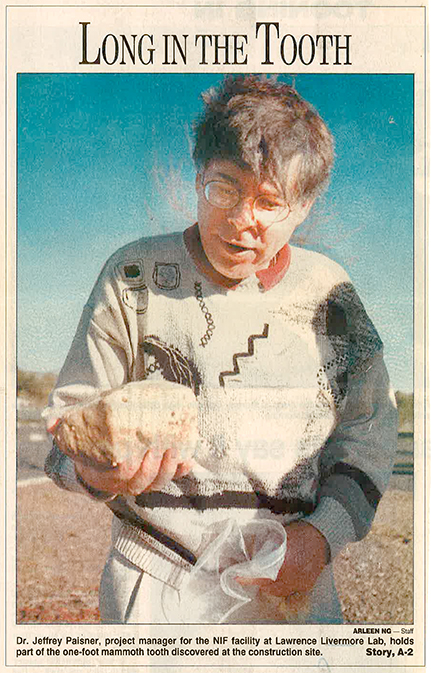
Just months later, construction crews made an even more unexpected discovery: the jawbone of a Pleistocene-era mammoth. “All work was halted and a field paleontologist quickly hired,” Paisner recalls. “Despite an agonizingly slow excavation and preservation process, construction of the building started back up by the New Year and proceeded apace—and, amazingly, on schedule.”
Now, three decades later, and after a career spanning two national laboratories and leadership roles spanning hydrodynamic test programs and subcritical experiments, Paisner looks back fondly on NIF’s early days. “The lightning speed at which NIF was launched is a testament to the project team, partner laboratories, and exceptional leadership at all levels,” he says. “Their incredible teamwork and esprit de corps enabled extraordinarily high productivity. NIF was—and still is—founded on an unwavering commitment to excellence, innovation, and passion for science. I will always feel grateful and proud to have been part of the NIF story.” ★
Read more: Livermore isn’t the only nuclear weapons laboratory to dabble in paleontology. More than 30 years ago, Los Alamos scientists helped detect and date the bones of one of the world’s longest sauropods.