A system based on quantum physics could access far more energy to perform useful work than classical methods allow. The key is knowing how to harness quantum correlations. To reach that conclusion, Los Alamos National Laboratory scientists and collaborators tapped into “quantum steerability”— a phenomenon where operations on one part of an entangled system affect, or steer, the state of another part, even though the parts are completely separated.
The team’s theoretical exploration makes the case for a clear quantum thermodynamic advantage in useful energy extraction, suggesting efficiency benefits for future quantum computing technologies.
Read the paper
Why this matters: Since the 1800s, thermodynamics — the study of energy and entropy flows — has helped engineers design efficient steam engines, batteries, refrigerators and more. Quantum thermodynamics focuses on energy and entropy flows in the microscopic regime, with potential relevance for heat engines, cooling protocols and quantum batteries.
How they did it: In thermodynamics, the definition of “work” is energy that can be used to drive other processes (e.g., to make a microwave or a car function). To understand how much work, or useful energy, can be extracted from quantum systems, the team designed tasks to be undertaken by two agents, Alice and Bob, and compared the maximum extractable energy from classical and quantum scenarios.
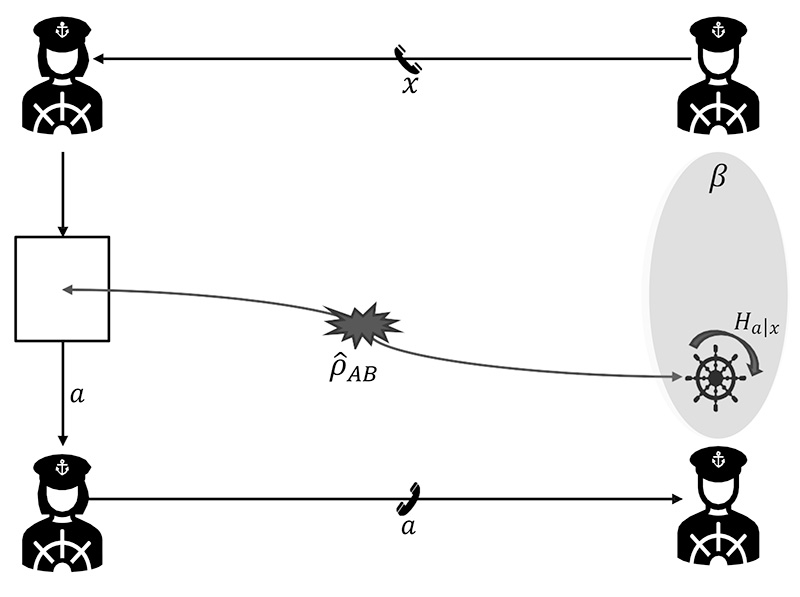
What they found: A system using steerable quantum correlations can extract substantially more energy than if the correlations were classical. The team’s quantifiable result is evidence of the quantum thermodynamic advantage, the ability of quantum systems to outperform classical ones.
What’s next: Further research into the role of steerable correlations could lead to experiments demonstrating efficient energy extraction by exploiting quantum properties.
Funding: U.S. Department of Energy’s Office of Science under quantum computing research projects (FAR-QC and FAR-Qu), and the Beyond Moore’s Law project of the National Nuclear Security Administration’s Advanced Simulation and Computing Program at Los Alamos National Laboratory.
LA-UR-25-32001