
Within the recesses of a Los Alamos National Laboratory facility, a scientist studies a small ceramic pellet through layers of leaded glass. The pellet fits in the palm of a hand, but its purpose is anything but small. It is a plutonium-238 heat source, engineered to power scientific instruments in some of the coldest, darkest environments in the solar system.
The Lab-made pellets have helped energize NASA spacecraft for years, including exploration rovers such as Perseverance that operate on Mars.
Producing these heat sources is a precision manufacturing mission rooted in nuclear stewardship. This work supports deep-space exploration while sustaining one of the nation’s most specialized plutonium capabilities, linking fundamental science directly to mission delivery.
A unique national capability
The Laboratory is the nation’s sole producer of general-purpose heat sources (GPHS), which are also referred to as “clads” — ceramic plutonium-238 fuel pellets encapsulated in multiple protective layers and designed to withstand extreme conditions. GPHS units are core components of radioisotope power systems, including radioisotope thermoelectric generators, which convert heat from radioactive decay into electricity.
The Lab — and its predecessor, the Los Alamos Scientific Laboratory — has been integral to radioisotope power systems since their earliest development. The Laboratory designed the GPHS in the late 1970s and ’80s and assumed responsibility for heat source fabrication in the early ’90s, establishing a legacy that continues today.
“In parallel with GPHS, Los Alamos also developed and manufactured lightweight radioisotope heater units (LWRHUs) in the 1970s, 1980s and 1990s,” said Lab product engineer Nicholas Wozniak. “These much smaller units provide steady warmth to critical spacecraft electronics operating in the extreme cold of space, and some of those legacy units will support NASA’s upcoming Dragonfly mission.”
More recently, the Laboratory has worked to reestablish production of these heater units. The Lab is preparing to resume LWRHU production in support of the European Space Agency’s ExoMars program and the Rosalind Franklin rover.
The mission spans both civil and national security applications: fabricating heat sources for NASA exploration missions, assembling radioisotope thermoelectric generators for defense systems and conducting surveillance to ensure the long-term health of deployed nuclear power supplies.
“We take legacy plutonium material and transform it into something that is safe, robust and mission-ready,” said Alissa Tatro, division leader for the Lab’s Power Supply Production division. “Every step of the process — from material processing through encapsulation and testing — is about reliability, safety and long-term performance.”
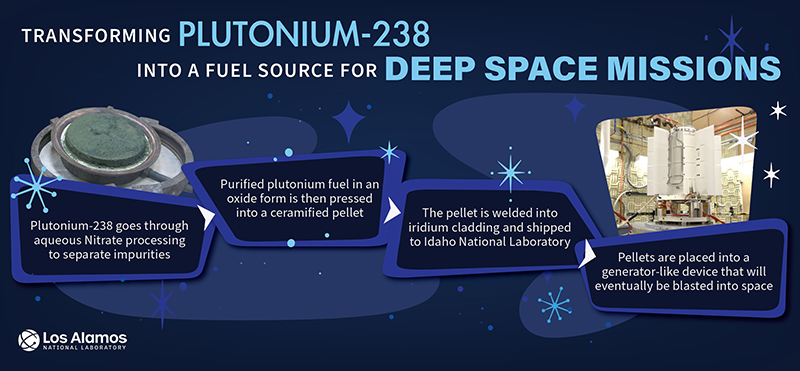
From oxide to flight-ready fuel
The production process begins with plutonium-238 oxide, derived from legacy material or newly produced feedstock. Through aqueous chemical processing, impurities and decay products are removed, yielding a purified oxide powder suitable for fuel fabrication.
That powder is then consolidated to form a dense ceramic pellet. The resulting fuel is designed to minimize spread, meeting essential safety standards necessary for launch authorization.
Each pellet is encapsulated in iridium coating, which was selected for its high heat and corrosion resistance. Each unit goes through a series of inspections and tests, including leak checks and detailed measurement assessments, to ensure it remains intact even in a potential launch accident.
Once certified, heat sources are packaged in multiple containment layers and shipped in safety containers to Idaho National Laboratory, where they are integrated into flight power systems.

Powering Dragonfly
The Lab is currently producing heat sources for NASA’s Dragonfly mission, a rotorcraft lander scheduled to launch later this decade to explore Saturn’s moon Titan. Unlike wheeled rovers, Dragonfly will fly among sites, collecting and analyzing samples from Titan’s surface and atmosphere to study complex organic compounds.
Operating at such a distance from the sun and in Titan’s cold environment requires a power system that provides both electricity and heat. In addition to generating electrical power, plutonium-238 heat sources also produce excess heat as a natural byproduct, which helps keep onboard systems within operating temperatures.
Supporting Dragonfly presents unique challenges. Plutonium-238 continuously loses heat as it decays, meaning delays to launch schedules can require heat sources to be remanufactured to meet mission heat requirements at liftoff. Lab engineers must carefully balance production schedules, facility availability and long-term mission timelines.
Science/Engineering Project Leader Elizabeth Bluhm described the ways in which supporting Dragonfly presents unique obstacles, particularly regarding clads.
“Dragonfly has been a challenging mission, with two launch delays shifting the schedule from the original 2026 target to 2028,” she said. “Production at the Lab began in 2020 in support of the Dragonfly multimission radioisotope thermoelectric generator, but the effort initially relied, in part, on vintage clads produced in 2018 that remained from the Mars 2020 Perseverance mission.”
The Dragonfly mission’s two launch delays total about two years, originally planned for 2026, then pushed to 2027, and now to 2028. As plutonium-238 undergoes radioactive decay, the manufactured fueled clads gradually lose thermal wattage, or heat output, and cool over time.
“Clads produced as early as 2018 will no longer meet the required thermal output by 2028 and must be remanufactured,” Bluhm said. “At this point, it becomes a matter of physics, balancing production timelines and throughputs with shifting launch dates. Clads with higher thermal wattage, hotter units, have a longer effective lifespan and can help offset the thermal inventory shortfall caused by these launch delays.” Oak Ridge National Laboratory supplies this higher-grade, “hotter” Pu-238 oxide, which is blended with the Lab’s existing inventory.
“Without their contribution, meeting mission requirements would not be feasible,” Bluhm said.
As the schedule extended, the manufacturing approach evolved. Over the past year or more, Oak Ridge has increased production, providing Los Alamos with even hotter higher thermal output Pu-238 fuel for Laboratory manufacturing processes.
“Coordinating logistics between the two sites has been complex, but has been ultimately successful,” Bluhm added.
Engineering under constraint
Manufacturing heat sources at Los Alamos’ TA-55 requires coordination across specialized facilities and equipment. The Lab uses highly specialized equipment to apply high heat and pressure to form plutonium fuel into durable ceramic pellets. Production can be at risk if equipment issues arise. To reduce that risk, the Lab is installing additional equipment to ensure there is backup capacity.
That focus on reliability extends beyond equipment. Close coordination across teams and functions is essential.
“Recent reorganization has helped bring the work together in a more mission-focused way,” Tatro said. “Integration matters when you’re balancing safety, schedule and national priorities.”
Beyond radioisotopes
While radioisotope systems remain essential for deep-space missions, the Laboratory is also contributing to the future of space power. The Lab supports development of advanced conversion technologies — such as higher-efficiency thermoelectric systems — and small nuclear reactor concepts capable of delivering power for future lunar or planetary infrastructure.
These efforts rely on close partnerships with NASA, the Department of Energy, Idaho National Laboratory, Oak Ridge National Laboratory and industry. New reactor-based production pathways for plutonium-238, currently under development at partner laboratories, are expected to strengthen long-term supply and reduce risk for future missions.
Science serving mission
For the engineers and scientists, the work sits at the intersection of discovery and national security.
“I really enjoy our mission,” Tatro said. “It’s important for science, but it’s also important for security. We’re applying nuclear expertise in a way that protects the nation while enabling exploration that could shape humanity’s future.”
From carefully controlled operations at TA-55 to spacecraft bound for the outer solar system, the Lab continues to deliver nuclear solutions with precision, safety and purpose by powering exploration one heat source at a time.
LA-UR-26-23621