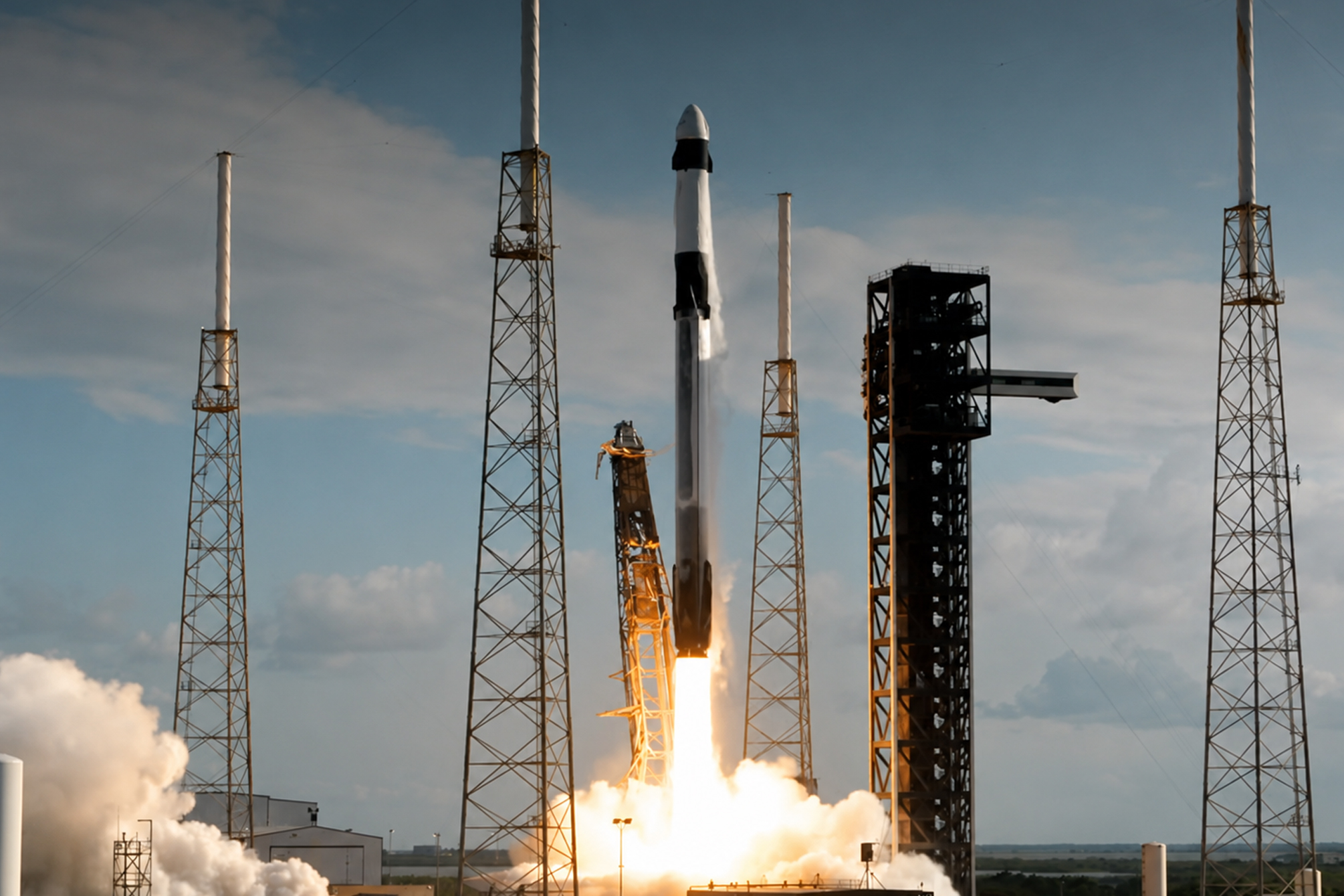
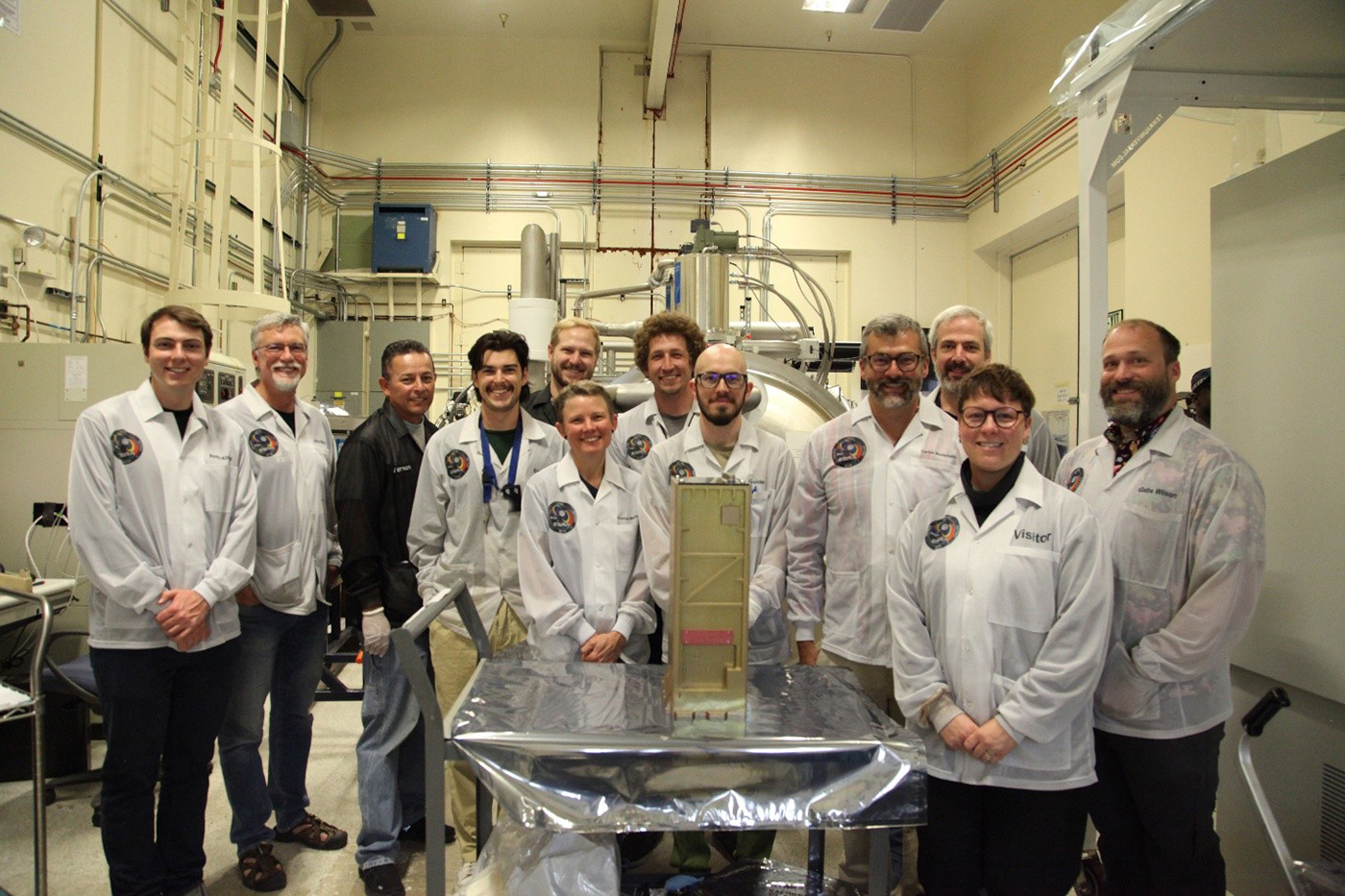
The Autonomous Ion Mass Spectrometer Sentry (AIMSS) team at Los Alamos National Laboratory celebrated the launch of their space flight payload to the International Space Station on May 15. The AIMSS payload was launched as a part of the Department of Defense’s Space Test Program Houston-11 mission onboard SpaceX’s 34th Dragon Commercial Resupply Services (CRS-34) mission.
“During this project, the team demonstrated extraordinary determination, ingenuity, resourcefulness, and technical excellence that exemplifies the core values within the Intelligence and Space Research division,” said Carlos Maldonado, AIMSS principal investigator. “As with all our efforts within Global Security, this would not have been possible without the ‘same team same fight’ mentality across the directorate.”
Notably, this is one of the fastest payload development efforts since the Vela satellite era in the late 1950s. From project kickoff to hardware delivery, the AIMSS team accomplished this feat in 22 months.
Advancing national security and science
The team will use AIMSS to make ion mass composition observations in low Earth orbit to advance national space security and support scientific discovery. The AIMSS payload features a simple robust design allowing for reduced cost, rapid build and integration, high-mass resolution, and real-time alerts to provide high-quality science and contamination monitoring data for space-based assets. AIMSS distinguishes between natural space phenomena and spacecraft-generated contamination through ion species identification—a capability critical for both scientific discovery and astronaut safety.
Key innovations on AIMSS include a tunable front-end sensor enabling operation across extreme ion density variations, high-mass resolution for precise ion identification, autonomous real-time processing and alerts, and modular design for rapid integration. Successfully demonstrated on the ISS, AIMSS represents a paradigm shift in accessible space instrumentation—combining research-grade performance at timescales and costs that enable production and deployment at scale.
Understanding space weather
Space weather describes the environmental conditions between Earth and the sun, including particles, fields, and plasma that can affect assets in space and on Earth. Weather on Earth has many components including rain, temperature, extreme wind, ice, lightning, and other factors. Weather in space is even more complicated because the environment consists of a complex collection of charged particles, sparse numbers of neutral molecules, and ever-changing magnetic and electric fields. Satellites in space are subject to this extremely harsh environment, and space weather is studied in part because of the disruptions it can cause to electronics systems in satellites.
The AIMSS payload will advance discovery science related to the near-Earth space weather by providing invaluable ion composition measurements, such as the distinction between nitrogen and oxygen ions. This makes it possible to validate modern space weather models.
Additionally, AIMSS will measure contamination caused by space station leaks, venting events, and spacecraft thruster plume impingements, which result in surface contamination, changes in material thermal properties, sputtering, and erosion. The AIMSS payload will also monitor spacecraft charging levels (when spacecraft accumulate electrical charges), ensuring astronaut and space system safety by enabling spacecraft operators to mitigate hazardous conditions and to determine root cause in the case of a spacecraft discharge anomaly.
About the launch
AIMSS successfully launched May 15 as a part of SpaceX’s Falcon 9 launch of the CRS-34 mission for NASA to the International Space Station from Space Launch Complex 40 at Cape Canaveral Space Force Station in Florida.
CRS-34 is the sixth flight for the Dragon spacecraft supporting this mission. After an approximately 36-hour flight, Dragon autonomously docked with the orbiting laboratory May 17.
LA-UR-26-24174