Electrochemical deposition, or electroplating, is a common industrial technique that coats materials to improve corrosion resistance and protection, durability and hardness, conductivity and more. In new research published in the Journal of The Electrochemical Society, a Los Alamos National Laboratory team has developed generative diffusion-based AI models for electrochemistry, an innovative electrochemistry approach demonstrated with experimental data.
“Electroplating is central to material development and production across many industries, and it has particularly useful applications in our production capabilities at the Laboratory,” said Los Alamos scientist Alexander Scheinker, who led the AI aspect of the work. “The generative diffusion-based AI model approach we’ve established has the potential to dramatically accelerate electrodeposition development, creating efficiencies by reducing the need for extensive physical experiments when optimizing new materials and processes.”
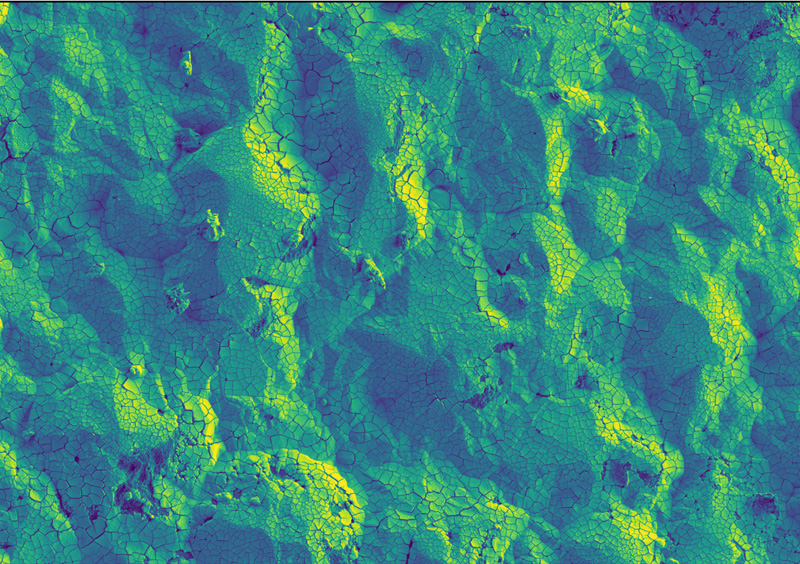
Electroplating is a complex process involving many coupled parameters — solvents, electrolytes, temperature, power settings — making process optimization heavily reliant on time-consuming trial and error. The team trained its AI model on parameters and on the electron microscope images those settings produced, building the model’s capability to predict the structure, form and characteristics of electrodeposited materials.
Rhenium samples train AI model on crack formation
The research team’s model used data from experiments on the electrodeposition of rhenium through pulse and pulse-reverse waveforms, techniques that use specialized electrical signal patterns for electroplating and surface treatment. Adaptable to other electrodeposition, electropolishing or corrosion methods, the process can — with various degrees and combinations — fine-tune the grain structure and morphology of the material; create a smoother, higher quality surface; and add corrosion protection.
Rhenium is a heavy, dense transition metal with the second-highest melting point (after tungsten), lending it utility in alloys in high-temperature settings such as jet engines, and with low-temperature superconductivity in emerging fields like interconnects in quantum computers. The AI modelers worked with the Lab’s Sigma team, steered by experts Dan Hooks and Michael McBride, leveraging Sigma’s advanced metallurgical capabilities to prepare 57 rhenium samples for training or test data. The samples were imaged at high resolution with a scanning electron microscope.
The team trained a highly accurate variational autoencoder (VAE) network, a type of AI network that uses neural networks to compress and reconstruct data, to compress the images down by a factor of 64 to optimized latent representations, or simplified models of the data. They then trained a generative diffusion AI model, which learned to map processing parameters to their corresponding latent representations, from which the VAE was able to reconstruct the images.
Looking specifically at crack formation on the rhenium electroplating, the team demonstrated that the resulting model is able to quantitatively match surface roughness and the crack formation for unseen data sets and provide information for which process variables mattered most to achieve that result; the model proved able to extrapolate with accuracy even with a small data set. The researchers plan to build on their proof-of-principle work, applying this success to other processes. The proof-of-principle research offers potential for using their AI model in materials discovery, optimization and real-time guidance of electrochemistry experiments.
Paper: “Conditional Latent Diffusion for High-Resolution Prediction of Electrochemical Surface Morphology.” Journal of The Electrochemical Society. DOI: 10.1149/1945-7111/ae36fb
LA-UR-26-22112