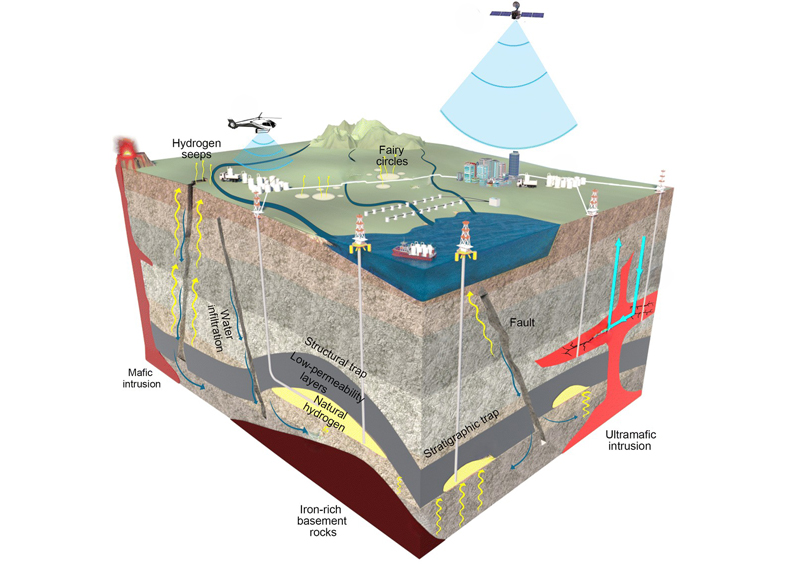
A team including Los Alamos National Laboratory researchers recently published a comprehensive review of key aspects of subsurface (or geologic) hydrogen, including resource potential, subsurface dynamics, geophysical exploration, production techniques, and pipeline transportation, thus identifying crucial areas of future research. The prestigious Royal Society of Chemistry’s Energy and Environmental Science journal highlighted the work.
“Geologic hydrogen holds immense potential due to its global distribution and favorable geologic settings,” said Mohamed Mehana, research scientist at Los Alamos and coauthor of the paper. “However, industrial-scale extraction of geologic hydrogen faces considerable barriers. Unlocking this resource will require targeted investment, technological innovation and collaboration among governments, industry, and academia.”
Hydrogen is a versatile resource with important roles in industrial manufacturing and energy integration. In the study, the authors reviewed what is known about where geologic hydrogen may form, how it moves and accumulates, and how it might be produced and transported.
If geologic hydrogen can be found and produced reliably, it could support national energy dominance goals. Accessing geologic hydrogen could also build on existing subsurface science and engineering approaches used for energy and resource development, provided safety, environmental impacts and economics are well understood.
The team found that geologic hydrogen could be more abundant than previously assumed, but confirmed, well-characterized reservoirs are still limited. Current prospecting often depends on indirect indicators, such as rock types and fault networks, so resource estimates remain uncertain. The team also noted that “stimulated” production could expand opportunities, but likely requires accelerating chemical reactions far beyond natural rates, which is not yet demonstrated at field scale. Finally, many technoeconomic assumptions remain untested, and infrastructure challenges — especially leakage risk and material compatibility – must be addressed to enable safe, cost-effective production and transport.
Moving forward, the authors emphasized the need for targeted field studies, improved monitoring and integrated modeling to validate production rates, reduce uncertainty in resource assessments, and strengthen environmental and economic evaluations.
Paper: “Geologic hydrogen: a review of resource potential, subsurface dynamics, exploration, production, transportation, and research opportunities.” Energy & Environmental Science. DOI: 10.1039/D5EE02910D.
Funding: Los Alamos National Laboratory Directed Research and Development, Center of Space and Earth Sciences and Department of Energy, Office of Hydrocarbons and Geothermal Energy Office (formerly the Office of Fossil Energy and Carbon Management).
LA-UR-26-22102