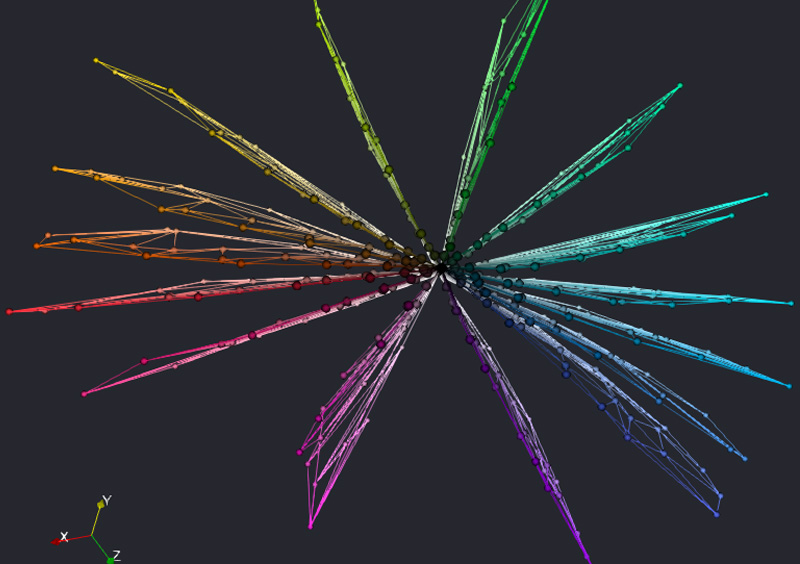
Research on the perception of color differences is helping resolve a century-old understanding of color developed by Erwin Schrödinger. Los Alamos scientist Roxana Bujack led a team that used geometry to mathematically define the perception of color as it relates to hue, saturation and lightness. Presented at a visualization science conference, their work formalizes Schrödinger’s model of color, decisively establishing the perception of the color attributes as an intrinsic property.
“What we conclude is that these color qualities don’t emerge from additional external constructs such as cultural or learned experiences but reflect the intrinsic properties of the color metric itself,” Bujack said. “This metric geometrically encodes the perceived color distance — that is, how different two colors appear to an observer.”
In formalizing the definitions of perceptual attributes, the researchers provide the final piece of the puzzle that helps realize Schrödinger’s dream of a closed model able to define hue, saturation and lightness only from the geometric property of highest color similarity.
Fine-tuning color perception models
Humans have three cones with which to distinguish color — centered around red, blue and green — and that characteristic establishes three dimensions of color spaces, or organizations of color. Bernhard Riemann, the 19th-century mathematician, first suggested that these perceptual spaces are not straight but curved; in the 1920s, Schrödinger defined the perceptual attributes of hue, saturation and lightness, derived from a metric of color perception in the Riemannian model of color perception.
Schrodinger’s definitions have provided a century-long framework for understanding color attributes, but as the Los Alamos team worked on algorithms for scientific visualizations, they found shortcomings in the underlying mathematics. Those question marks presented an opportunity to evolve the mathematical understanding of color perception.
Schrödinger’s definitions of hue, saturation and lightness are based on the location of a color relative to the neutral axis — the line of grays connecting black to white — but he did not provide a definition for this axis. This lack of an underlying basis makes his derived constructions crumble: Without a defined neutral axis, the construction is formally undefined. The team’s most significant challenge, and the biggest fix it offers to Schrodinger’s theory, was to, for the first time, define the neutral axis solely based on the geometry of the color metric. To do so, they had to work outside of the Riemannian model, a significant breakthrough in the mathematics of visualization.
Two other valuable corrections were found. The team was able to correct for something called the Bezold-Brücke effect, in which a change in light intensity induces a perceived change in hue, by using the shortest path, not just a straight line, in their geometric understanding of color perception. The team also used the shortest path in a non-Riemannian space to address the phenomenon of diminishing returns in color perception.
Advancing visualization science
Presented at the Eurographics Conference on Visualization, the team’s work is a culmination of a project on color perception that has also yielded a groundbreaking 2022 paper in the Proceedings of the National Academy of Sciences.
Understanding color perception is an important component of visualization science, a critical capability that informs many useful endeavors. A scientifically precise model of color perception could add value to industries where photography, video, visualization and more are essential. In addition, visualizations help scientists interpret data, enabling efficient and useful modeling for a wide range of applications, including national security sciences. The team’s research lays the groundwork for future modeling of color in non-Riemannian space.
The paper: “The Geometry of Color in the Light of a Non-Riemannian Space.” 2025 Eurographics Conference on Visualization. DOI: 10.1111/cgf.70136
Funding: This work was supported by the Laboratory Directed Research and Development program at Los Alamos and by the National Nuclear Security Administration’s Advanced Simulation and Computing program.
LA-UR-26-20435