Scientists at Los Alamos National Laboratory have developed a way to use neutrino detection as a diagnostic tool to better understand the inner workings of a nuclear weapon. In research published in the Review of Scientific Instruments, the proposal investigates the feasibility and scientific possibilities for deploying an inverse beta decay (IBD) neutrino detector for nuclear weapons diagnostics.
“With the great improvements in neutrino detection technology, the idea of using neutrinos as a diagnostic has come full circle,” said Richard Van de Water, lead researcher on the article. “Because they’re produced so prolifically in a test event and in a pulsed fission reactor, neutrinos could offer a novel and complementary diagnostic tool for national security science. Our calculations and experimental plans will advance this critical capability.”
The researchers’ investigation included calculations based on a hypothetical nuclear yield, exploring the production of anti-neutrinos, the antimatter counterpart of neutrinos. The paper also describes a proof-of-principle project in which an IBD detector placed near a pulsed fission reactor could provide critical real-condition testing and knowledge for accurate simulations.
Proving a feasible concept
The researchers’ first goal was to prove the feasibility of using anti-neutrinos to diagnose nuclear weapons, which unleash a single, prompt fission event that is difficult to replicate in non-testing settings. (Nuclear testing ended in the United States in 1992.) The key process in their calculations of such events is inverse beta decay, a nuclear reaction where electron anti-neutrinos produced in a blast pass through all the intervening matter and then weakly scatter off the protons in a neutrino detector.
A weapons detonation generates particles with a known independent yield distribution — how many particles, with what amount of energy, over a certain period of time. By calculating the anti-neutrino spectrum resulting from an event, folding it with anti-neutrino cross sections (the known probability that anti-neutrino interactions will occur), the team was able to produce results for the inverse beta decay interaction rates in an IBD neutrino detector at a safe standoff distance of up to a few kilometers away.
This information offers an assurance of the feasibility of neutrino detection and diagnostics related to fission events. The analysis also informs the proof-of-concept detector at a pulsed fission reactor proposed as a way to deploy and refine the capability in the absence of weapons testing.
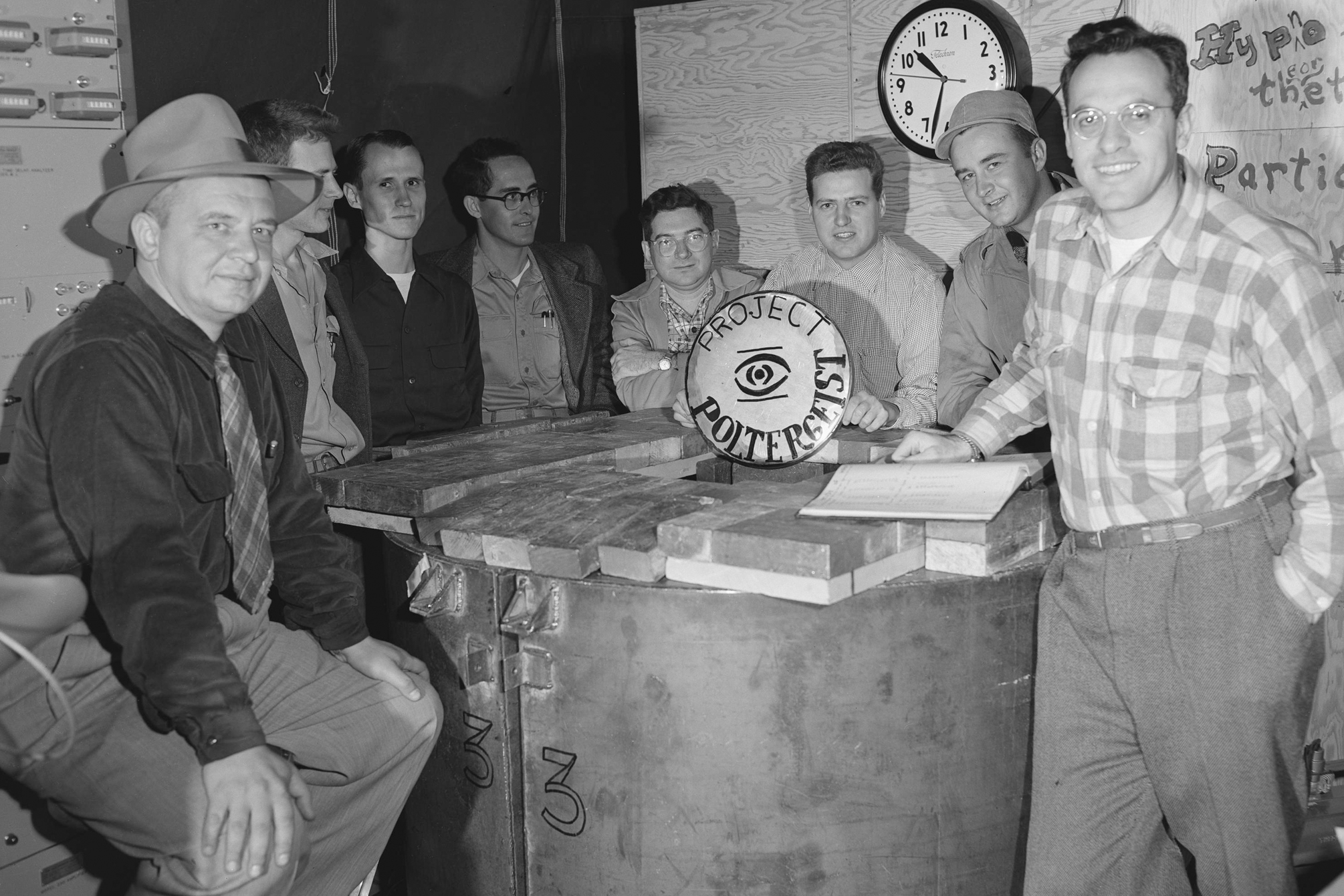
Notably, Los Alamos physicists Clyde Cowan and Frederick Reines, pioneers of neutrino research, first proposed using a nuclear weapons test to provide the necessary conditions for detecting the neutrino. For practical reasons, they went on to use a nuclear reactor; the “Project Poltergeist” experiment confirmed the neutrino’s existence in 1956 and helped earn Reines the Nobel Prize in 1995. (Cowan died in 1973.)
Pulsed reactor for neutrino detection and other science
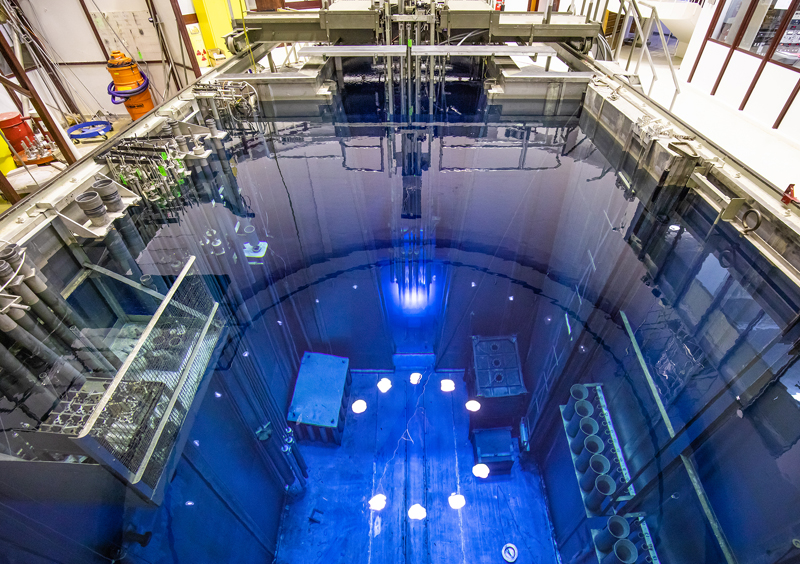
A controlled experimental setup would allow researchers to test and measure their calculations in real-world conditions. The paper describes a plan to deploy a small IBD detector near a pulsed reactor, such as the TRIGA reactor at Texas A&M University. A pulsed reactor produces repeatable bursts of fission energy.
The team’s research suggests that the pulsed reactor detector can offer data comparable to that which could be gathered and analyzed with a nuclear weapons test. That information includes constraints on fission databases, equilibrium assumptions and yield errors — all useful for understanding the mechanics of a fission event. Furthermore, anti-neutrinos from a fission burst have never been measured before, so they would provide first measurements of anti-neutrino energy and time spectrum.
An initial concept calls for a detector based on the Coherent CAPTAIN-Mills experiment at the Los Alamos Neutron Science Center, which successfully developed constraints in the search for accelerator-produced dark matter and axion particles. The proposed νFLASH detector (“ν” is the Greek symbol for the letter “nu” and represents neutrino physics) would be designed and assembled at Los Alamos and shipped to the reactor site. Initial simulations conducted based on the CCM detector have demonstrated feasibility for the νFLASH detector.
The detector experiment offers the prospect of additional science outcomes. The energy ranges and short pulse time structure may prove ideal to test for sterile neutrino oscillations, for axions or axion-like particles, or for the mystery of the anomaly in anti-neutrino spectrum measurements found with some reactor-based experiments.
The paper: “Novel application of neutrinos to evaluate U.S. nuclear weapons performance.” Review of Scientific Instruments. DOI: 10.1063/5.0263319
LA-UR-25-31073