
The One Component Plasma Model
The One-Component Plasma model, or more simply “the OCP,” is a reference model in the study of strongly coupled Coulomb systems that plays a conceptual role similar to that filled by the hard-sphere model in the theory of neutral fluids.
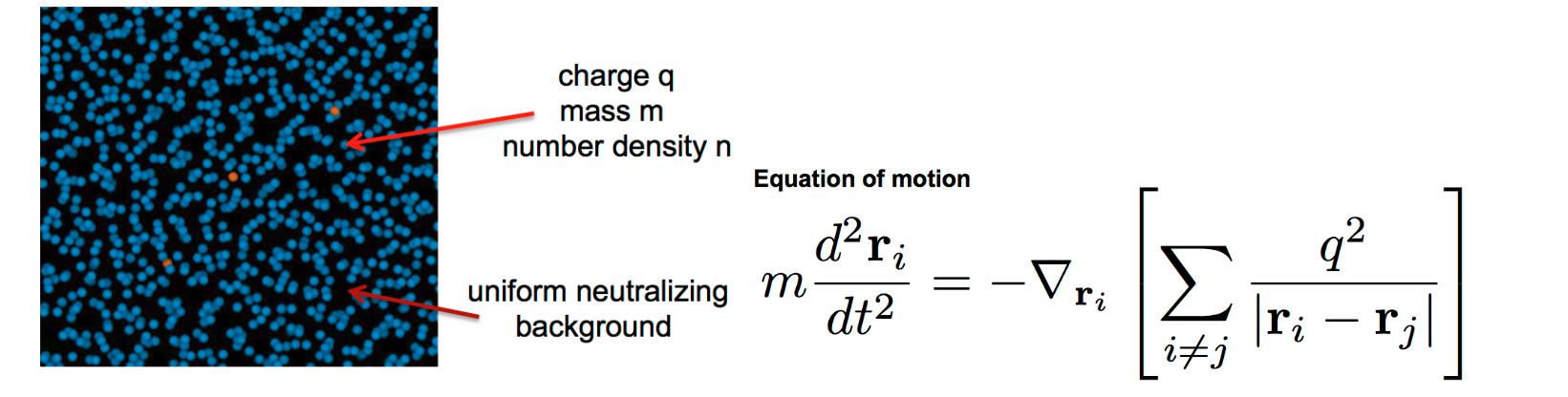
The OCP consists of a system of identical, electrically charged point particles interacting exclusively through the Coulomb potential and immersed in a rigid, uniform background of opposite charge to ensure overall charge neutrality.
The particle dynamics is governed by the laws of classical non-relativistic mechanics (the quantum counterpart of the OCP is called the “jellium model” and is used as a first approximation to the conduction electron fluid in metals and dense plasmas, ignoring the details of the underlying discrete ionic subsystem).
A single parameter
A very attractive feature of the OCP is that its physical properties in or near equilibrium can be fully characterized by a single dimensionless parameter, the so-called "Coulomb coupling parameter"'

Being the ratio of the mean potential energy per particle to the mean kinetic energy per particle , measures the level of non-ideality of the system, i.e., the degree to which many-body interactions affect the properties of the ensemble of particles. As discussed below, by varying , the OCP exhibits the various faces of strong coupling effects on the plasma properties.
The Phase Diagram
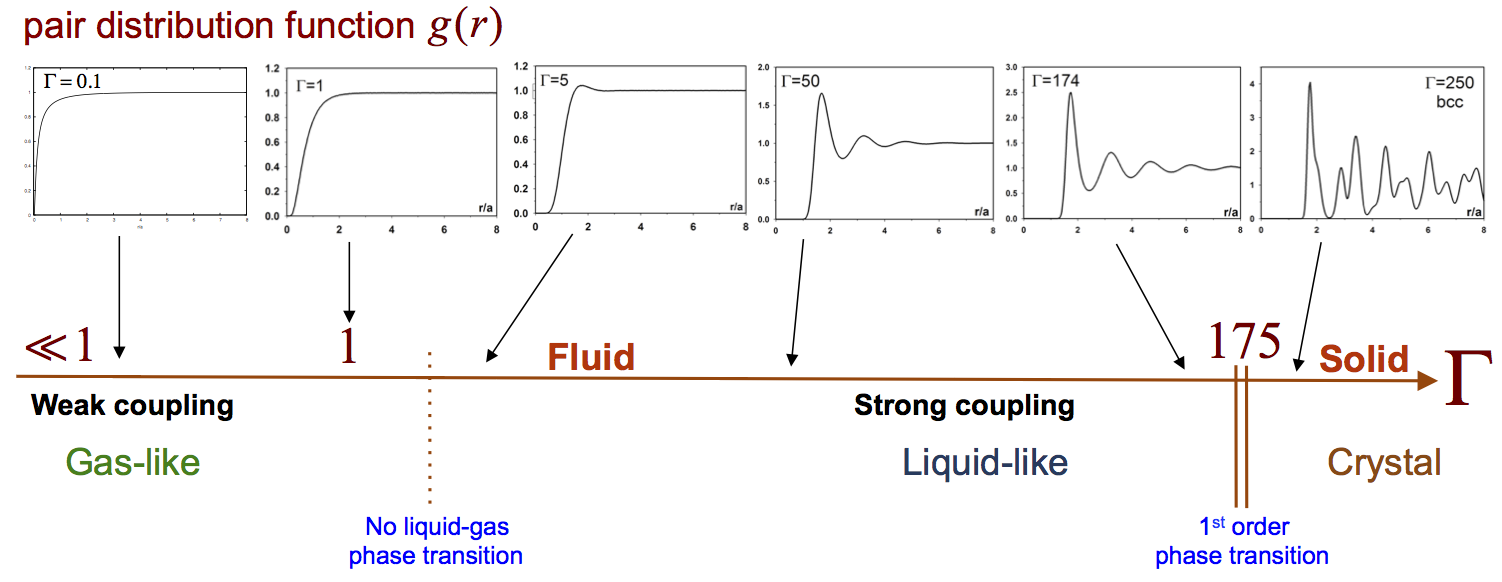
As increases, the OCP shows transitions from a nearly collisionless, gaseous regime for continuously through an increasingly correlated, liquid-like regime to the Wigner crystallization into a lattice near
At low , particle configurations are highly disordered, and particles undergo only occasional binary collisions. The pair distribution function , which characterizes the modulation of the local density around a given particle as a function of the distance from this particle, is smooth and rapidly vanishes for small because of the repulsions between the particles.
This structure is characteristic of a dilute gas phase.
As the coupling increases, positions of neighboring particles are more and more correlated, leading to a modulation of extending over a few interparticle distances. This short-range order is characteristic of the liquid phase.
The minima may be associated with shells of neighbors, but the oscillations are rapidly damped, showing the gradual smearing out of short-range order. At , the short-range order grows spontaneously into full long-range order, characteristic of a periodic crystalline structure.
Particle dynamics
Strong-coupling effects not only affect the static properties like the and the equation-of-state of plasmas but also significantly influence their dynamical properties. The movies below illustrate how the particle dynamics varies as increases.
[Image diagram spans vertically to include each bullet]
At low , particles undergo only occasional binary collisions. Traditional plasma physics, which deals with weakly-coupled plasma with , breaks down at .
The dynamics increasingly resembles that of a dense gas: particles cruise through the entire system less and less easily as they undergo an increasingly larger number of deflections that hamper their mobility.
The particles' mobility decreases as particles have an increasingly more difficult time to dodge by their direct neighbors.
Crossover from the gas to the liquid regime.
Strong interparticle interactions give rise to the cage-effect, whereby each particle finds itself trapped for some period of time in the cage formed by its immediate neighbors, rebounding until it overcomes the energy barrier and diffuses to a neighboring cage.
The OCP is crystallized into a BCC lattice. Particles oscillate anharmonically around their equilibrium position in the crystal.
Effect of particle dynamics on transport properties: shear viscosity
In a fluid, transport of momentum occurs not only by the bodily movement of particles but also by the action of interaction forces at a distance.
At small coupling, the former mechanism is predominant and, like in a gas, the OCP viscosity increases with temperature and behaves as predicted by traditional weakly coupled plasma theory based on the binary collision picture between charged particles when .
A large coupling , the viscosity decreases with increasing temperature (or lowering density) according to an Arrhenius-like relation , which is a direct consequence of the cage-effect: owing to pronounced structural correlations, each particle finds itself trapped for some period of time in the cage formed by its immediate neighbors, rebounding against it until it overcomes the energy barrier and diffuses to the neighboring cage.
At intermediate coupling, , the two momentum transport mechanisms contribute with similar magnitude, resulting in a shallow minimum near . This intermediate regime is particularly challenging to the theory.


Meet the Team
Los Alamos brings together experts from diverse backgrounds, including plasma physics, dynamic fluid flows, and computational sciences. Join us to tackle complex challenges in energy research, astrophysics, and inertial confinement fusion.