DOE/LANL Jurisdiction Fire Danger Rating:
Dense Matter Theory Banner
  1. LANL Home
  2. Engage with LANL
  3. Lab Organizations
  4. X Computational Physics
  5. XCP-5: Materials and Physical Data
  6. dense matter theory
  7. dense matter research

Electronic & Ionic Structure

Applied methods for predicting the electronic and ionic structure of dense matter

Methods and applications explained

Researchers at Los Alamos National Laboratory have developed (and continue to develop) a number of methods to predict and understand the electronic and ionic structure of dense matter.  These include, for example, Orbital-Free Density Functional Theory, average atom methods, and Multiple Scattering Theory. These approaches enable accurate and efficient modeling of material behavior under extreme conditions.
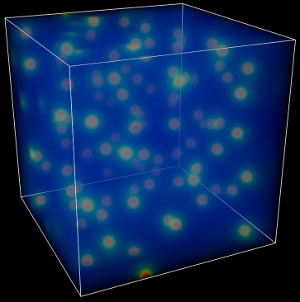
 

  • The One Component Plasma Model

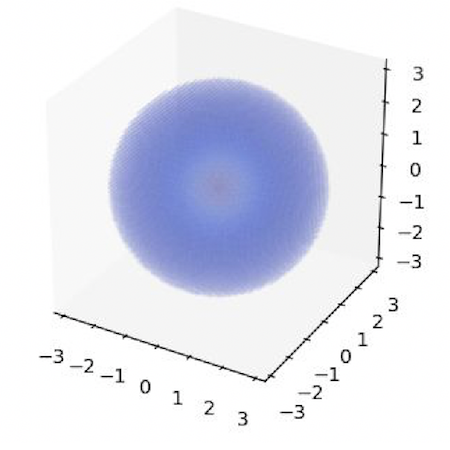
    Like the hard-sphere model in the theory of simple liquids, the one-component plasma (OCP) is the reference model in the study of strongly coupled Coulomb systems. Despite its apparent simplicity, the OCP captures the characteristic features of strong Coulomb interactions in plasmas.

    • View
  • Finite Temperature Orbital-free Density Functional Theory

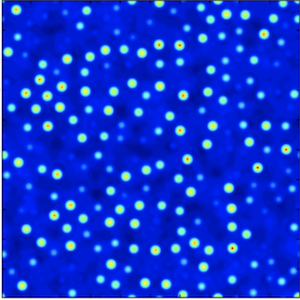
    Density functional theory is a formally exact description of a many-body quantum system through the density alone. In practice, approximations are necessary, and here we describe our recent efforts toward an approach that is fast and accurate.

    • View
  • Tartarus Average Atom Model

    Average atom models are inexpensive but reasonably accurate models use for calculating the material properties of dense plasmas.

    • View
  • Pseudo-Atom Molecular Dynamics

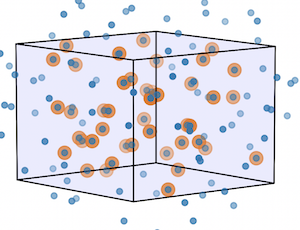
    PAMD extends the average atom concept to include averaged ionic structure. This gives access to an ab initio effective ion-ion potential that can be used in molecular dynamics and kinetic theory.

    • View
  • Multiple Scattering Theory

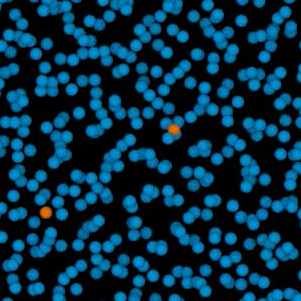
    MST is a method that allows us to solve the Kohn-Sham DFT equations for a high temperature, disordered dense plasma without using pseudopotentials.

    • View

Meet the Team

Los Alamos brings together experts from diverse backgrounds, including plasma physics, dynamic fluid flows, and computational sciences. Join us to tackle complex challenges in energy research, astrophysics, and inertial confinement fusion.

Meet the Team