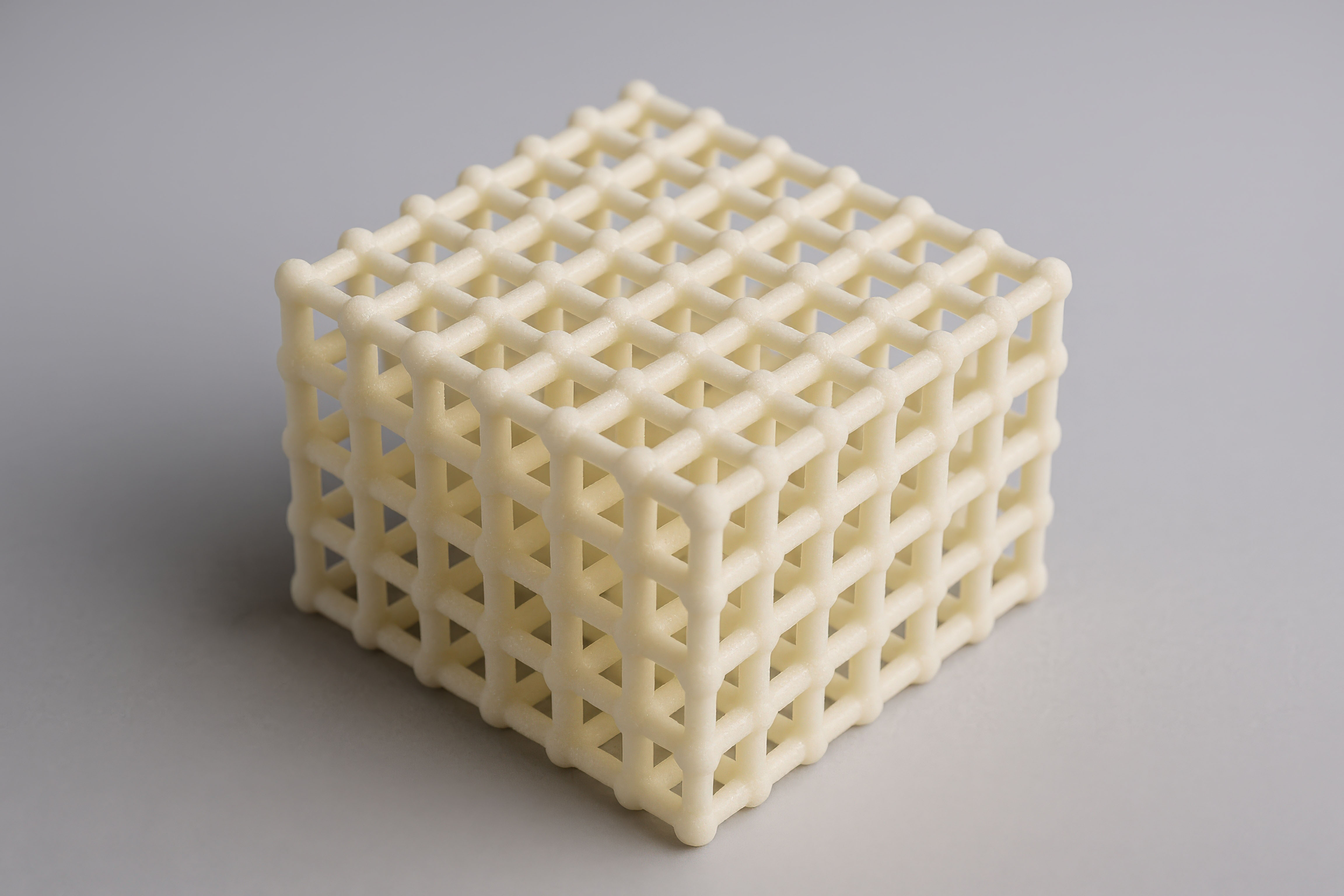
Designing materials to achieve specific mechanical properties often requires repeated testing and refinement. T3tris helps accelerate this process by generating material designs based on the performance users want to achieve.
Using thousands of examples that link a material's internal structure to its performance, the system generates new designs that can be manufactured and evaluated. This approach reduces the time and effort associated with conventional trial-and-error design while giving researchers more design options to explore.
Key Features
- Performance-driven design: Creates material designs based on the mechanical properties users want to achieve.
- Shape and performance control: Balances mechanical performance with desired structural characteristics.
- Design flexibility: Provides multiple design options for the same performance target, supporting design exploration.
- Ready for additive manufacturing: Produces designs that can be fabricated using commercial stereolithography (SLA), a type of 3D printing.
- Rapid design generation: Quickly creates new design candidates, enabling faster design iteration.
Experimental Validation
The capability was evaluated using computer simulations and physical testing. Selected AI-generated designs were 3D printed using stereolithography (SLA), a type of 3D printing that creates highly detailed parts from liquid resin, and then tested under compression. The results showed that the AI-generated designs performed as intended and closely matched the predicted mechanical behavior.
Market Applications
- Defense: Protective equipment, armor components, and energy-absorbing structures.
- Aerospace and Automotive: Lightweight structural materials.
- Biomedical Engineering: Orthopedic implants, tissue scaffolds, and soft robotics.
- Packaging: Shock-absorbing materials and protective structures.
- Materials Research and Development: Programmable mechanical materials.
How It Works
T3tris uses a generative AI model trained on examples that link a material's internal structure to its mechanical performance. The system is built on a conditional variational autoencoder (cVAE), a type of generative AI model that creates new designs based on user-defined performance requirements and can account for both mechanical performance and structural characteristics.
Instead of starting with a material design and testing how it performs, the system starts with the desired performance and generates candidate material designs that meet those requirements. This inverse design approach helps researchers explore multiple solutions while reducing the need for trial-and-error design.