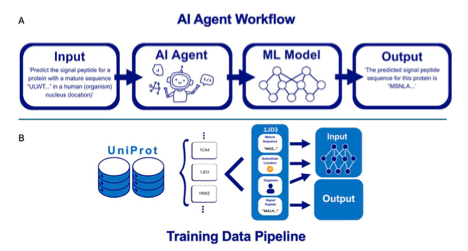
Proteins carry out many of the body's essential functions, but they can only do their job if they reach the right place inside or outside a cell. Many proteins rely on signal peptides to get there. Typically, a signal peptide is a short sequence segment at the beginning of a protein that acts like a built-in address label, helping direct the protein to the location where it is needed.
Predicting the right signal peptide for a specific protein remains challenging. Existing software can identify known signal peptides or determine whether a protein already contains one, but it cannot predict which signal peptide is best suited to produce the desired protein expression and cellular location.
Researchers provide the protein they want to study, where they want it to go to a specific compartment in a cell, and the organism. SignalGen predicts the signal peptide best suited for those conditions, giving researchers a stronger starting point before laboratory testing. SignalGen is even critical for AI designed de novo proteins as it would require a signal peptide.
Value Proposition
Many medicines, vaccines, and biotechnology products rely on proteins reaching the right cellular compartment or secretion outside a cell. Whether a protein gets there in enough quantities depends on its signal peptide or leader sequence.
Scientists can identify many existing signal peptides, but predicting which one will work best for a specific protein remains difficult. SignalGen uses generative AI to predict the signal peptide most likely to guide a protein to the right location. To make that prediction, it considers the protein, where it needs to go, and the organism it comes from. This approach gives researchers a new way to improve protein expression for medicines, vaccines, and biotechnology products.