DOE/LANL Jurisdiction Fire Danger Rating:
  1. LANL Home
  2. engage
  3. collaboration
  4. feynman center
  5. tech and capability search
  6. hydrogen getters

High-Capacity Hydrogen and Hydrogen Isotope Getters

Hydrogen-scavenging materials that protect sealed systems, electronics, and critical infrastructure from hydrogen-induced degradation

technology Snapshot

Overview

Even small amounts of hydrogen can damage sensitive equipment over time. As hydrogen accumulates inside sealed environments, it can corrode metals, weaken structural materials, degrade electronic components, and, in some applications, create explosion hazards. Preventing that buildup is essential for maintaining the reliability and safety of many high-value systems.

Hydrogen getters are materials built into sealed devices and systems to remove hydrogen before it can accumulate. Like a moisture absorber, they remove an unwanted gas. Instead of trapping water, however, they chemically react with hydrogen and lock it away permanently. Depending on the application, a getter may take the form of a pellet, coating, thin film, powder, or printable material.

Many commercially available getters rely on zirconium-based materials that offer limited hydrogen storage capacity, require activation before use, or operate effectively only within a narrow temperature range. Some also depend on costly vacuum-deposition manufacturing processes that limit design flexibility.

Los Alamos researchers have developed a new class of hydrogen getters designed to overcome these limitations. The materials capture hydrogen and its isotopes, including deuterium and tritium, across a broad range of operating conditions without requiring activation while offering significantly higher storage capacity and greater flexibility for manufacturing and product integration.

Value Proposition

Hydrogen can quietly build up inside sealed devices and industrial systems, shortening equipment life and creating safety risks. Los Alamos National Laboratory has developed a new class of high-capacity hydrogen getters that permanently remove hydrogen before it causes damage. Compared with conventional getters, this technology stores more hydrogen, operates across a wider range of conditions, and can be manufactured in multiple forms for easy integration into commercial products.
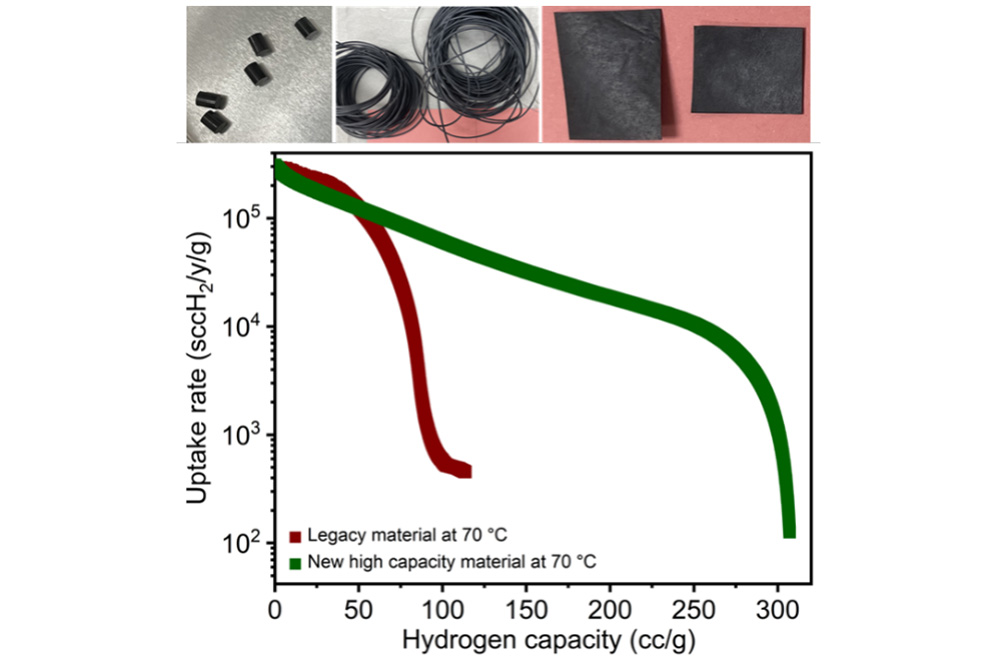
Hydrogen uptake rate decreases as getter materials fill with hydrogen. Compared with a conventional getter (brown), the LANL high-capacity getter (green) maintains rapid hydrogen capture over a much larger storage capacity.

Advantages

  • Stores significantly more hydrogen than many conventional getter materials.
  • Permanently removes hydrogen, improving long-term reliability in sealed systems.
  • Operates across a broad temperature range without activation.
  • Captures hydrogen even at pressures well below atmospheric levels.
  • Selectively removes hydrogen in mixed-gas environments.
  • Hydrogen uptake rates can be tailored to specific applications.
  • Compatible with polymers and available as films, coatings, pellets, powders, strands, and printable pastes for flexible product integration.
  • Reduces projected material and manufacturing costs compared with many zirconium-based getter technologies.
  • Scalable manufacturing supports applications ranging from miniature electronics to large industrial systems.

Technology Description

The getter materials chemically react with hydrogen and its isotopes to form stable compounds that permanently lock the hydrogen inside the material, providing long-term protection for sealed devices and industrial equipment.

The technology is based on a novel organic alkyne chemistry. Alkynes are carbon-containing molecules that readily react with hydrogen, allowing the material to store substantially more hydrogen than many conventional getter systems.

Unlike many commercial getters, these materials operate without activation and continue to perform across a broad temperature range. They also selectively capture hydrogen in the presence of gases such as helium, nitrogen, argon, and methane, making them well suited for complex industrial and vacuum environments.

The hydrogen capture rate can be tailored by adjusting the catalyst formulation for specific operating conditions. Hydrogen capture has also been demonstrated at pressures well below atmospheric conditions, expanding the range of potential applications.

The materials are compatible with polymers and other common manufacturing materials, allowing them to be incorporated into films, coatings, pellets, powders, strands, adhesives, foams, and printable pastes.

Market Applications

  • Semiconductor and microelectronics packaging
  • Hermetically sealed electronics
  • Aerospace and defense
  • Medical devices
  • Nuclear material storage and processing
  • Vacuum and gas purification systems
  • Cryogenic equipment
  • Oil and gas infrastructure
  • Scientific instrumentation
  • High-reliability industrial systems

On This Page

Overview

Advantages

Technology Description

Market Applications

Published: 2026-07-16

LA-UR-26-25730

Technology Readiness Level:

4 - Component Prototypes Tested in a Controlled Environment

Contact

  • Licensing
  • Los Alamos National Laboratory
  • licensing@lanl.gov
Download PDF

Connect With Our Innovators

Get Connected

Access Our Technical Expertise

Our Expertise

Explore Ways to Partner With Us

Ways to Partner

Los Alamos National Laboratory

P.O. Box 1663

Los Alamos, NM 87545

(505) 667-5061

At The Lab

  • Business Opportunities
  • Jobs
  • Organizations
  • Research Library
  • User Facilities

Information

  • Emergency
  • Ombuds
  • Reading Room
  • Resources
  • Science Museum

For Employees

  • AskIT
  • LANLInside
  • MyMail
  • Training
DOE White Seal
  • Terms of Use/Privacy

Managed by Triad National Security, LLC for the U.S. Dept. of Energy’s NNSA

Copyright 2026 Triad National Security, LLC. All Rights Reserved.

Learn about the Department of Energy’s Vulnerability Disclosure Program