Autonomous Robot Control Hierarchy (ARCH)
A universal software system that removes the need to rebuild robotic software for every new platform or task.
technology Snapshot
Overview
Robots are increasingly used to perform repetitive, hazardous, and time-sensitive tasks, improving safety and operational efficiency. However, most robotic systems remain difficult to adapt because they are tightly tied to specific hardware and require extensive reprogramming for each new configuration.
ARCH was developed at Los Alamos National Laboratory to support autonomous radiation surveying, where multiple sensors, high data throughput, and reliable real time operation were required. During development, a key challenge emerged: even minor hardware changes required significant code rewrites, slowing progress and limiting system flexibility.
ARCH addresses this problem by providing a common software foundation that works across different robotic platforms and sensor configurations. Instead of treating each robot as a one-off system, ARCH allows developers to reuse and adapt existing capabilities for new applications.
Value Proposition
ARCH removes one of the biggest barriers in robotics: the need to repeatedly rewrite software when hardware changes.
Today, building a working robot often requires months of custom coding and specialized expertise. Even small changes, such as switching a sensor or using a different robot, can require rewriting large portions of code. This repeated integration effort slows development, increases cost, and limits scalability.
ARCH eliminates this bottleneck by allowing both hardware and software components to be reused across different robots, sensors, and tasks. Systems can be built, modified, and redeployed quickly without starting from scratch.
This enables faster deployment, lower development costs, and more flexible use of robotics across a wide range of applications.
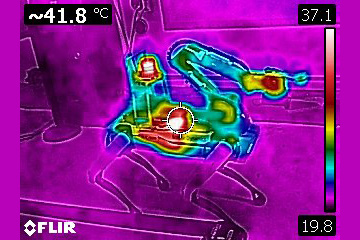
Advantages
- Eliminates repeated code development when changing sensors or robotic platforms
- Enables reuse of autonomous behaviors across different systems
- Reduces development time from months to significantly shorter cycles
- Allows rapid adaptation to new tasks and environments
- Supports integration of multiple sensors and best-in-class devices
- Enables multi-robot coordination and scalable deployments
- Simplifies development by reducing reliance on low-level programming
Technology Description
ARCH is a modular software system built from reusable components that address and connect sensors, robotic platforms, algorithms, and tasks.
Each component works in a consistent way, allowing developers to combine and reuse them to create new robotic capabilities without rewriting large portions of code.
The system includes:
- A library of device interfaces that allows different sensors and robots to be used without device-specific programming
- Built-in algorithms for navigation, mapping, and autonomous operation
- Ready-to-use autonomous routines that can be applied across different systems
- Support for multiple robots operating and coordinating within a shared system
- Tools for building custom user interfaces for monitoring and control
Because of this structure, a program developed for one robot can be deployed on another platform, such as a quadruped, wheeled robot, or drone, with minimal modification.
Market Applications
ARCH is applicable across industries requiring flexible and scalable robotic automation, including:
- Radiation detection and hazardous environment monitoring
- Industrial inspection and maintenance
- Defense and security operations
- Environmental mapping and surveying
- Logistics and warehouse automation
- Research and development platforms