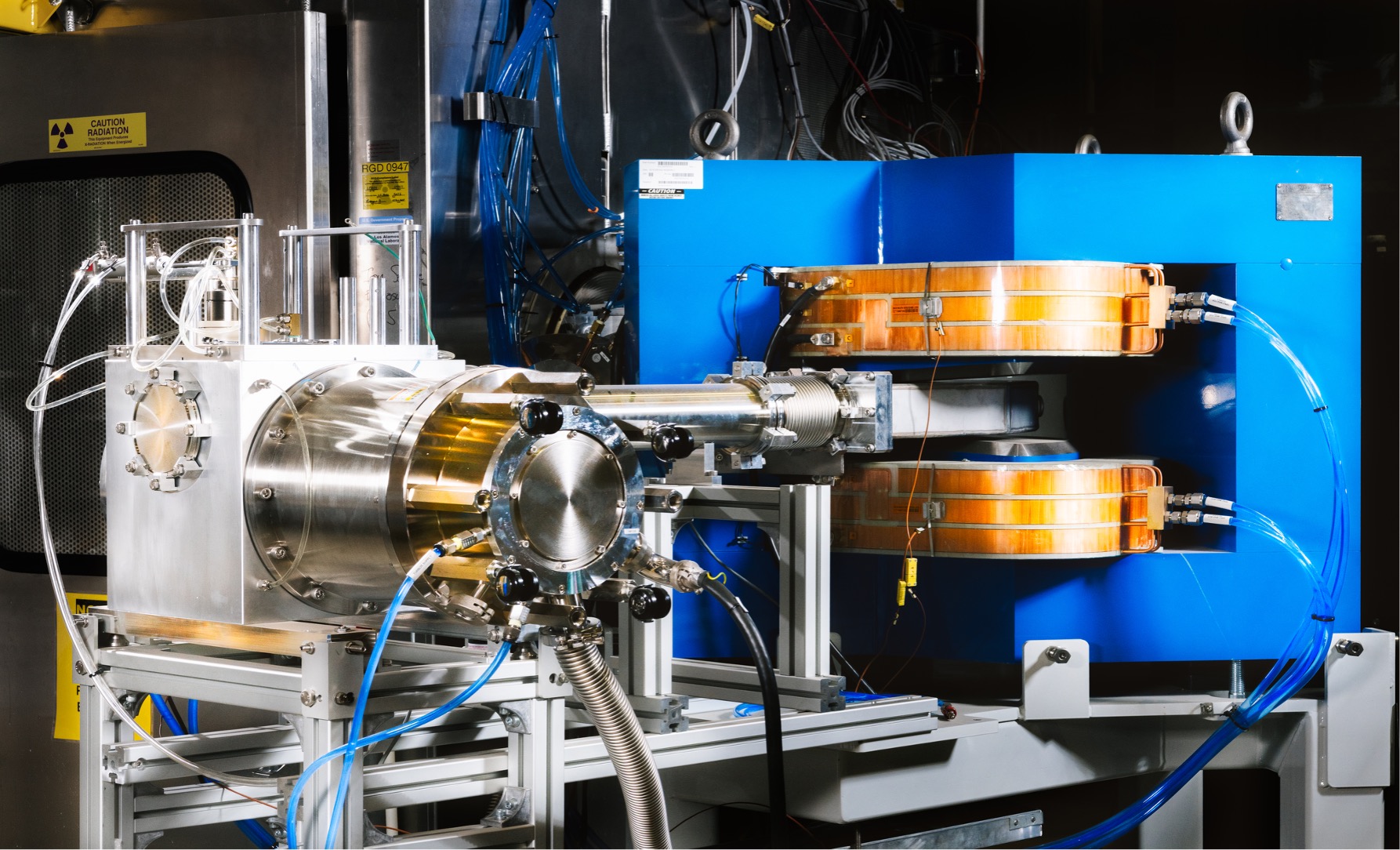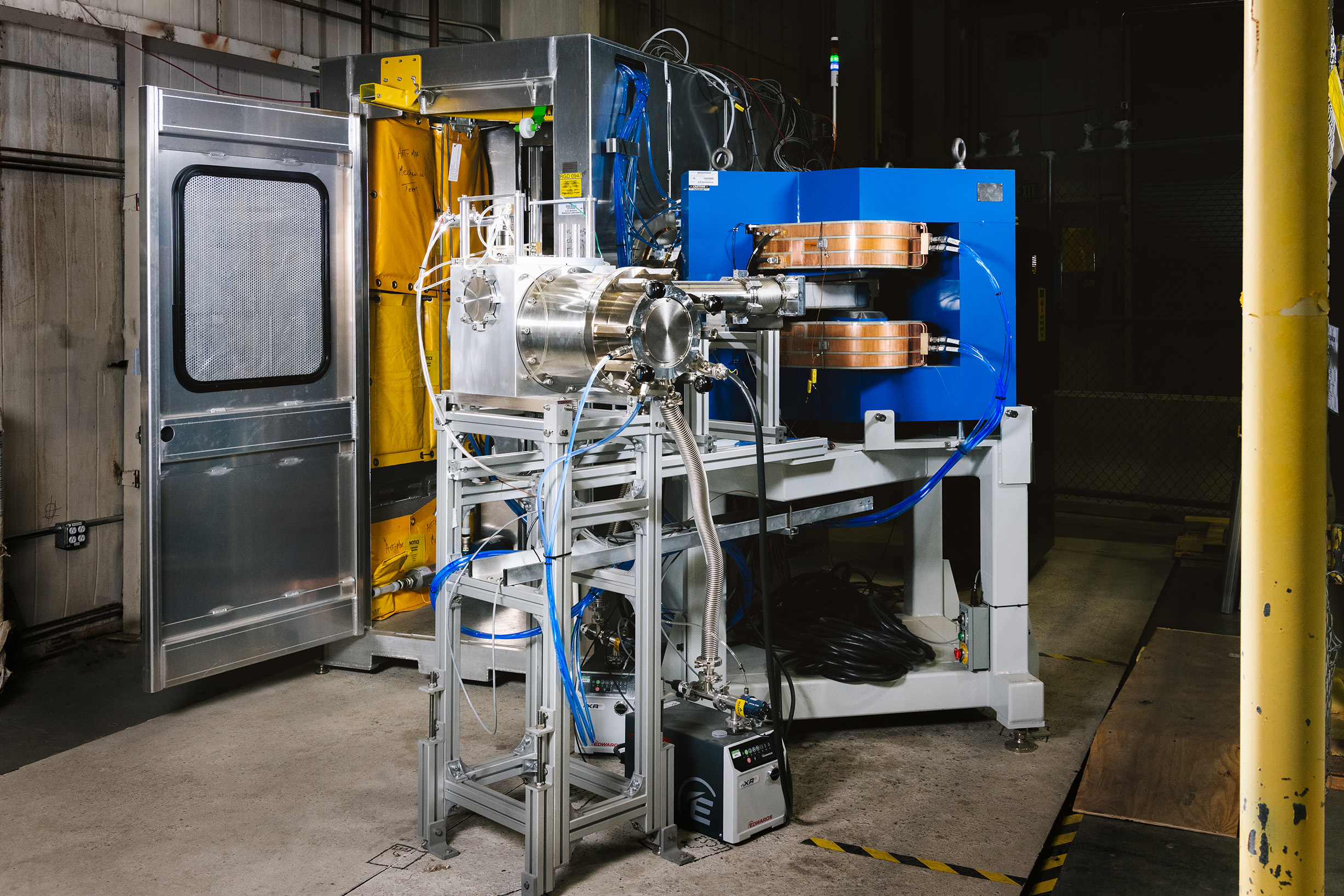
ASTRA supports beam development, experimental target testing, and mission-relevant-research collaboration across the LANSCE mesa.
The facility for Applications of Special Technologies for Research with Accelerators (ASTRA) in Area A at the Los Alamos Neutron Science Center (LANSCE) supports beam development, experimental target testing, and mission-relevant-research collaboration across the LANSCE mesa. The Low-Energy Heavy Ion Source (LEHIS) serves as the instrumental core of this agile facility. During May of 2025, installation efforts for the LEHIS were performed by a multidisciplined team from P-3, AOT-Ops: TESTeam, and AOT-AE. Beam commissioning activities were conducted by members of the D-Pace ion source group alongside the LANL installation team, achieving 9 mA of Kr+ beam at 50 keV.
The successful installation of the LEHIS at the ASTRA Facility represents one of the first steps to return science to Area A (an experimental facility capable of hosting MW-class beams), and the LEHIS will directly support the LANSCE Modernization Project (LAMP) and LANSCE experimental end station modernization efforts. The LEHIS will be used to produce intense 78Kr+ beams for the Neutron Target Demonstrator project, a groundbreaking LDRD-DR effort to demonstrate neutron reactions in inverse kinematics and motivate a future Neutron Target Facility (NTF) in Area A for LANSCE experimental end station modernization. The LEHIS will also be employed in a study of the optimal ion source technology for LAMP H+ beam production.
The ASTRA Facility offers a research space that is independent from LANSCE frontend operations, where staff in nuclear physics, ion source development, accelerator physics, materials science, isotope separation, and radioisotope production can work together to solve NNSA-science questions. Hence, the ASTRA Facility and LEHIS will support the workforce, technical expertise, and facility development efforts necessary to successfully execute next-generation LANSCE experimental end station modernization activities extending into the 2030s and beyond.