Los Alamos and OpenAI mark one year of partnership
Laboratories report increased use of super intelligence models on Venado
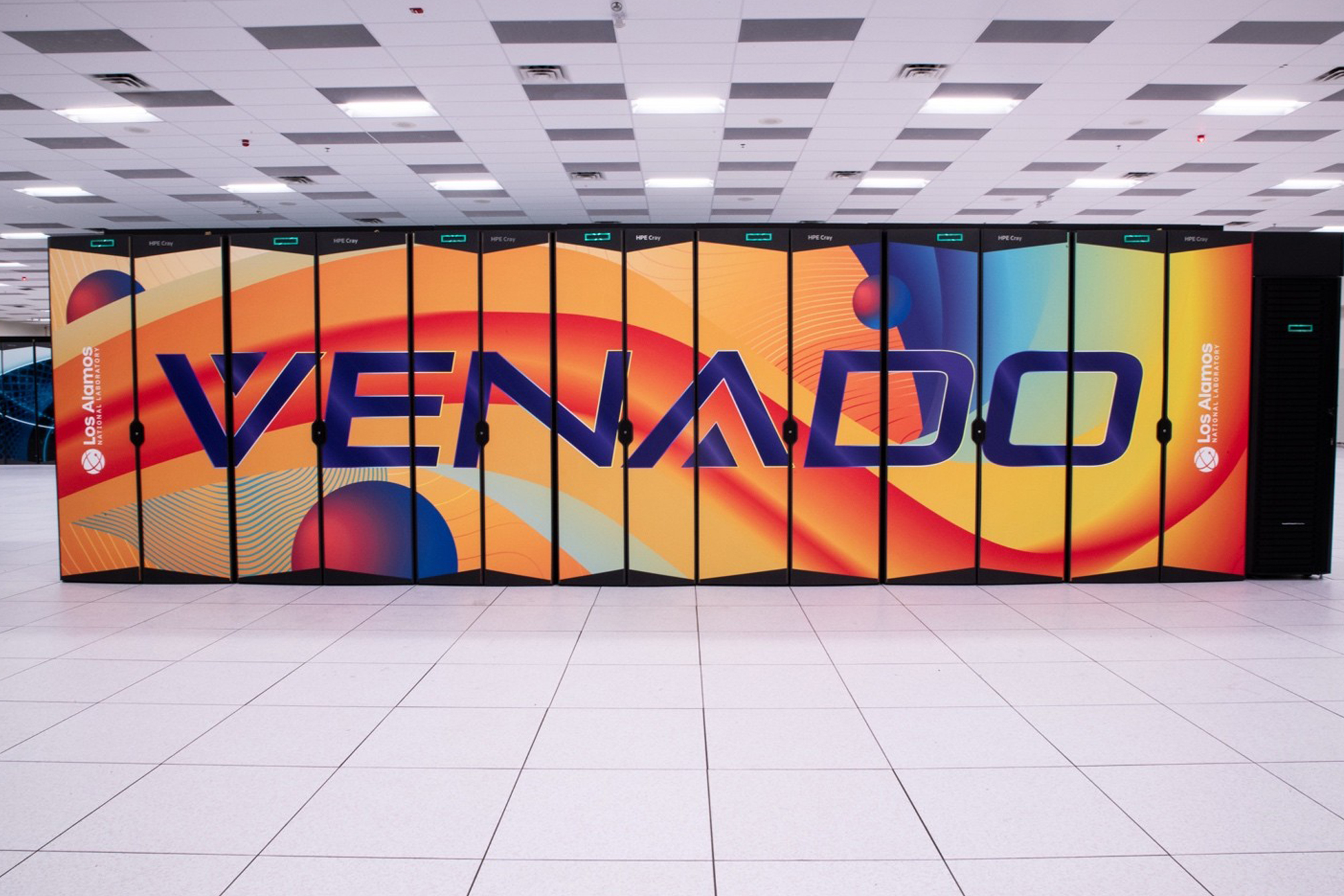
One year after inaugurating a partnership with OpenAI, Los Alamos National Laboratory and two of its fellow National Nuclear Security Administration laboratories report increasing use of the company’s models on Venado, Los Alamos’ flagship super intelligence–enabled computer.
The partnership between Los Alamos and OpenAI brought three experimental SI models to the Laboratory’s secure computing environment via a service called Venado-GPT, which is accessible to staff at Los Alamos, Lawrence Livermore and Sandia national laboratories (known as the tri-laboratories).
“We’ve seen tremendous growth in the tri-laboratories’ use of Venado-GPT,” says Los Alamos Director Thom Mason. “Our partnership with OpenAI continues to enable new kinds of research as we apply the models to solving some of our nation’s most pressing scientific and national security problems.”
Venado and Venado-GPT
Venado, which entered service in 2024, was designed to handle SI workflows. In homage to the Laboratory’s first director, J. Robert Oppenheimer, OpenAI’s experimental models were dubbed 5.4 OppenAI, 5.4 OppenAI mini and o3 OppenAI. The models run entirely on Venado’s local graphics processing units, which are linked by the Ethernet-based HPE Slingshot interconnect.
From mid-February to late August 2026, weekly Venado-GPT token throughput grew 20-fold to more than 3 billion tokens. The number of tri-laboratory user accounts tripled, and the number of weekly successful requests increased from approximately 1,200 to more than 41,200.
Using Venado-GPT
At Los Alamos, researchers have used Venado-GPT to streamline workflow handoffs between scientists and engineers. Laboratory staff have leveraged Venado-GPT in tandem with the Universal Research and Scientific Agent (URSA) — an open-source agentic software package developed at Los Alamos — to advance mission-relevant work.
“We’ve been using Venado-GPT models together with URSA teams of agents to support several key certification workflows,” says Nathan DeBardeleben, senior high-performance computing architect at Los Alamos. “This includes applying document‑intelligence capabilities to certification tasks, exploring engineering parameter spaces and reasoning about complex design choices, and driving surrogate‑model development and evaluation for physics and engineering activities.”
Lawrence Livermore researchers report that they have also been using Venado-GPT for mission applications. “Our team has been using 5.4 OppenAI on Venado to develop automated agent-driven translation of simulation models from an existing simulation code to a newer one,” says Brian Giera, Lawrence Livermore’s associate program director for AI and manufacturing. “Digital-twin teams have also been using 5.4 OppenAI to develop automated agent-driven workflows and for code development.”
Venado-GPT has yielded unexpected uses. For example, researchers at Los Alamos have used the service to identify kernel and driver changes during network maintenance work.
Looking ahead
In year two of their partnership, Los Alamos and OpenAI are planning enhancements for Venado-GPT. Priorities include improving the models’ ability to read file attachments, strengthening the dependability of application programming interfaces and enhancing support for complicated coding workflows while preparing for the arrival of the upcoming Mission and Vision platforms.
“Our work with Los Alamos applies frontier AI models in high-performance computing environments to support complex scientific and national research challenges,” says Katrina Mulligan, head of national security partnerships at OpenAI. “We’re proud to work alongside the national labs to accelerate scientific research, bolster national security readiness and drive public sector innovation.”
LA-UR-26-29551