DOE/LANL Jurisdiction Fire Danger Rating:
  1. LANL Home
  2. engage
  3. collaboration
  4. feynman center
  5. tech and capability search
  6. real time polymer cure monitoring system

Real-Time Polymer Cure Monitoring System

An integrated measurement of chemical evolution and mechanical properties

technology Snapshot

Overview

Polymers such as epoxies, adhesives, coatings, and composite matrices undergo complex transformations as they cure. Determining when a material has fully developed its required mechanical properties can be challenging, particularly when relying on time-based estimates or post-process inspection.

Inaccurate cure assessment can result in inconsistent performance, unnecessary delays, excess energy usage, or premature material failure. A reliable, in-place monitoring approach provides greater confidence in process outcomes and material readiness.

Value Proposition:

This technology enables real-time, non-destructive monitoring of polymer curing, providing direct insight into when a material has reached its desired performance state. By correlating chemical transformation with stiffness development, the system improves process control, reduces material waste, minimizes rejected parts, and enhances manufacturing consistency across a wide range of polymer-based systems.

 

AI-generated Adobe Stock image of polymer hardening, used for illustration purposes only

Advantages

  • Real-time, in-place monitoring during processing
  • Non-destructive evaluation
  • Direct linkage between chemical change and mechanical performance
  • Improved process control and reproducibility
  • Reduced scrap and rework
  • Applicable across a broad range of polymer and composite materials

Technology Description

Los Alamos researchers developed an integrated monitoring platform that tracks curing progression in real time without disrupting the material or process.

The system uses ultrasonic measurements to continuously evaluate changes in material stiffness as curing advances. A controlled acoustic signal passes through the polymer, and changes in sound speed provide a direct indicator of structural development. Because sound propagates faster as the material stiffens, these measurements offer a clear, continuous measure of cure state.

This acoustic monitoring is aligned with complementary chemical-state measurements, enabling correlation between molecular evolution and bulk mechanical performance. Automated data acquisition allows continuous monitoring at user-defined intervals, supporting both laboratory development and scalable manufacturing environments.

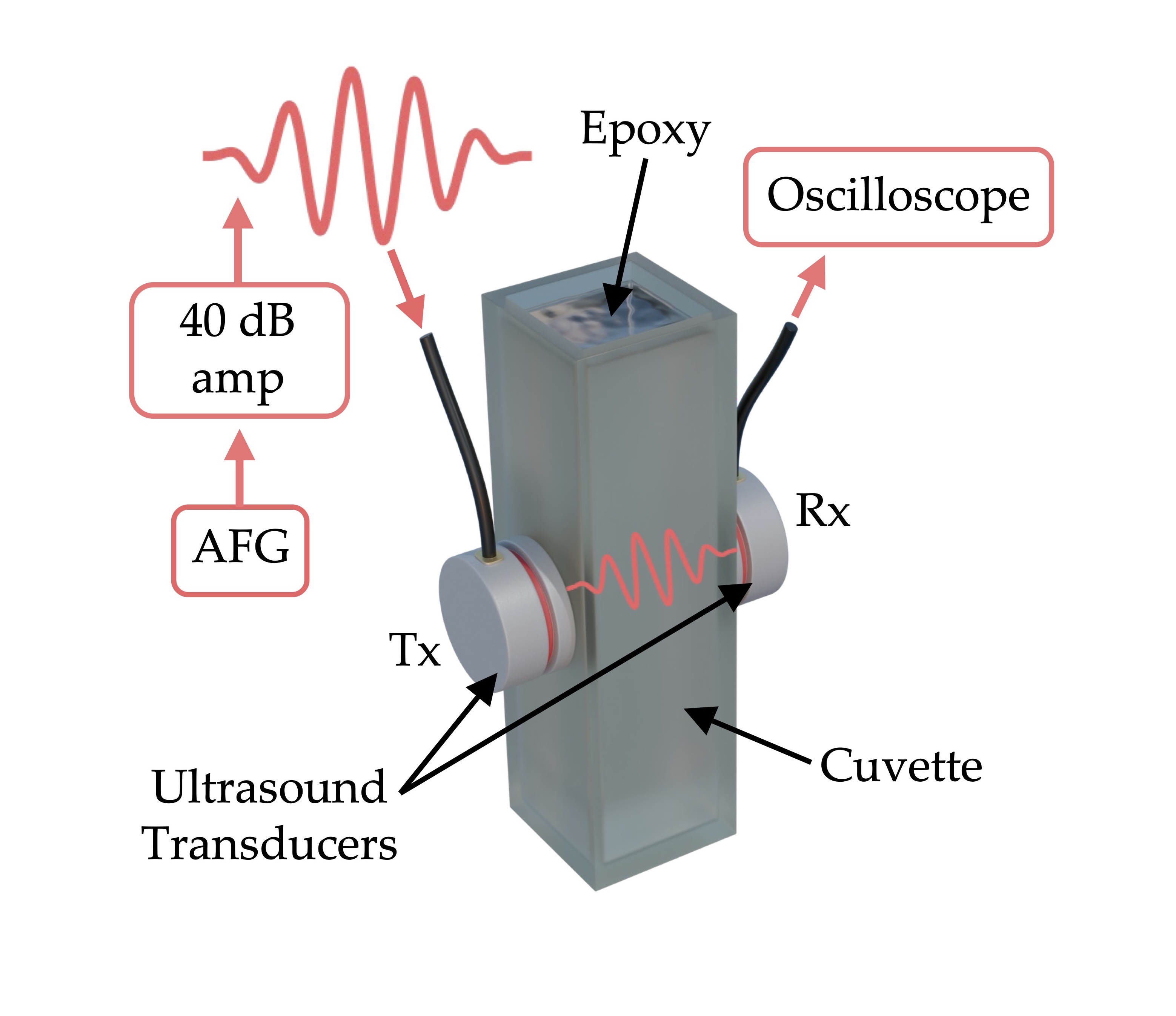
The monitoring approach is not limited to a specific mold geometry or laboratory configuration. While the schematic illustrates testing within a cuvette, the system can be implemented across varying mold sizes and types, integrated into flowing or actively mixed materials, or applied directly during manufacturing processes. This enables characterization during adhesive bonding, coating application, composite layup, or other in-place curing scenarios where no mold or cuvette is used.

Market Applications

  • Polymer and composite manufacturing
  • Adhesive and coating formulation
  • Advanced materials development
  • Quality assurance and process optimization
  • High-performance structural materials
  • Industrial production environments requiring cure verification


S167716 Diagrams V2 [37]
This schematic shows an ultrasound system used to monitor epoxy curing in real time. A function generator and power amplifier create a controlled sound pulse, which is converted into an ultrasonic wave by a transmitting transducer (Tx). The wave travels through the epoxy sample, which is contained in a small mold (cuvette), and is detected on the other side by a receiving transducer (Rx). An oscilloscope records how the signal changes over time, allowing us to calculate the speed of sound in the material.  While the schematic illustrates a cuvette-based configuration, the monitoring approach can also be adapted to different mold geometries, flowing materials, or in-place manufacturing processes where the polymer is curing during application or assembly.


On This Page

Overview

Advantages

Technology Description

Market Applications

Published: 2026-03-25

26-21226

Application Area

Sectors:Advanced Materials & Manufacturing

Areas:Advanced Manufacturing, Energy Technology Manufacturing, Sensing

Industries:Aerospace, Plastic Production and Recycling, Plastic, Chemical Suppliers, Automotive, Additive Manufacturing

Markets:Aerospace, Devices and Instruments, Plastic, Plastic Production and Recycling, Chemical, Chemical Suppliers

Partnership Opportunities

LANL is seeking a partner to commercialize the Real-Time Polymer Cure Monitoring System through a technical collaboration under a CRADA or a license agreement to develop a commercial prototype and leverage LANL’s intellectual property.

  • Cooperative Agreement
  • License

Technology Readiness Level:

3 - Component Prototypes Built and Proof-of-Concept Testing Completed

IP Information

Patent Number: Pending

S Number: S-167716.001

Contact

  • Licensing
  • Los Alamos National Laboratory
  • licensing@lanl.gov
Download PDF