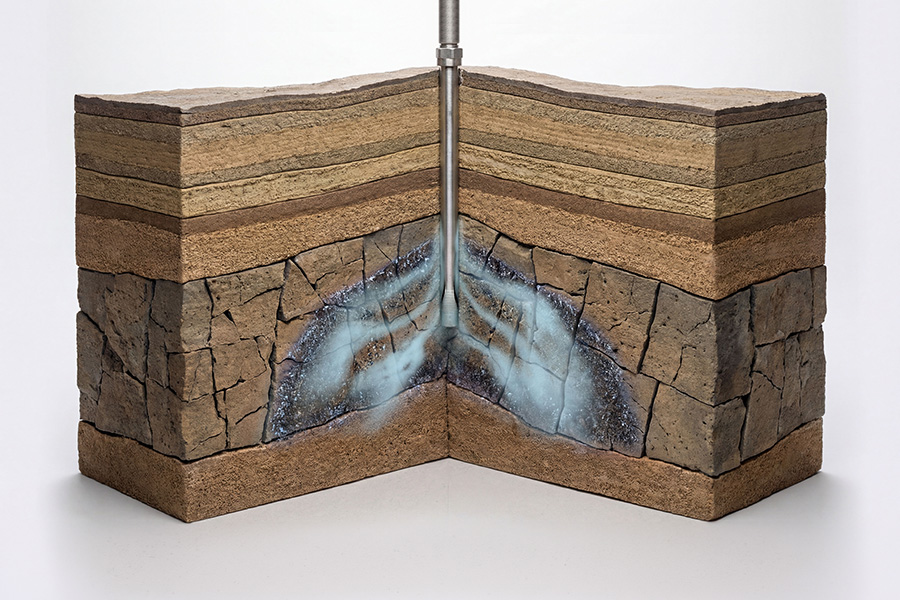
Oil and gas recovery increasingly relies on stimulation and production strategies that involve complex interactions between rock deformation, fractures, and fluid flow underground. Conventional modeling approaches often simplify or separate these effects, which can limit their ability to accurately predict performance in fractured or geologically complex reservoirs.
Los Alamos National Laboratory has developed an integrated recovery modeling capability that captures these interactions in a single framework. Building on LANL’s long-standing expertise in fracture modeling, fluid–structure interaction, and high-performance computing, the capability enables realistic simulation of modern improved oil recovery (IOR) workflows in challenging geological environments.
Value Proposition
This capability enables predictive, physics-based modeling to support modern improved oil recovery (IOR) and related oil and gas production processes in fractured and geomechanically complex reservoirs. By combining explicit fracture mechanics, fluid–structure interaction, and fully coupled thermo-hydro-mechanical (THM) processes, the capability supports improved recovery strategies, reduced operational risk, and a deeper understanding of reservoir behavior during stimulation and production.
Key benefits include realistic simulation of fracture evolution, reservoir connectivity, and multiphase flow across spatial and temporal scales relevant to modern IOR and unconventional resource development.
Advantages
- Models fractures, fluid flow, and rock deformation together in a single environment
- Explicitly models fracture initiation, propagation, interaction, and fragmentation
- Supports complex fluid behavior, including multiple fluid phases and chemical interactions
- Applies across pore-scale to reservoir-scale simulations
- Enables evaluation of recovery performance, uncertainty, and operational tradeoffs
- Is designed for complex subsurface conditions where conventional reservoir simulators are limited
Market Applications
- Oil and gas exploration and production
- Improved and enhanced oil recovery (IOR/EOR)
- Hydraulic fracturing and reservoir stimulation services
- Unconventional and fractured reservoir development
- Subsurface energy and georesource industries
- Engineering and geoscience research organizations
Legacy and Available Software
HOSS (T4728)
HOSS enables physics-based simulation of fracture-driven oil and gas recovery processes, including reservoir stimulation and production in complex geological settings. It explicitly models how fractures form, grow, and interact with fluid flow and rock deformation within a unified simulation environment. The software supports multiphase fluids and fully coupled thermo-hydro-mechanical (THM) processes relevant to modern improved oil recovery (IOR).
HOSS 2025 (T5054)
HOSS 2025 is a reengineered simulation framework that advances the HOSS architecture with enhanced solid mechanics, adaptive fracture modeling, and improved numerical performance. It integrates Finite-Discrete Element (FDEM) and Material Point Method (MPM) approaches within a unified structure, enabling simulation of extreme deformation, evolving fracture networks, and complex material behavior in subsurface systems.
HOSS Fluid-Structure Interaction (C20003)
This version extends HOSS with a dedicated fluid–structure interaction solver for transient pressure waves and fracture-fluid coupling. It enables simulation of dynamic fracture propagation and pressure-driven processes important in hydraulic fracturing and coupled THM reservoir applications.
MUNROU-ISF (C13171)
MUNROU-ISF is a combined finite-discrete element (FDEM) code designed for high-fidelity fracture and fragmentation modeling in solid materials. It supports large-scale 2D and 3D simulations with advanced contact, plasticity, and fracture algorithms, and incorporates fluid effects within fractured media.
InyanCC: Rock Control Center (C21066)
InyanCC is a multiphysics integration framework that links solid mechanics, fluid flow, heat transfer, and related solvers within a single computational environment. For oil and gas applications, it enables long-term coupled simulation of fractured reservoirs and stimulation-driven recovery processes across scales.
IP Information
The following U.S. patents support the Oil & Gas Recovery Capability:
- U.S. Patent 10,275,551 – Integrated Solver for Fluid Driven Fracture and Fragmentation (S-133043.001)
- U.S. Patent 12,135,925 – Libraries-based Explicit Fracture and Fragmentation Framework (S-133673.001)
- U.S. Patent 11,893,329 – Fluid-Structure Interaction Solver for Transient Dynamics of Fracturing Media (S-133779.001)