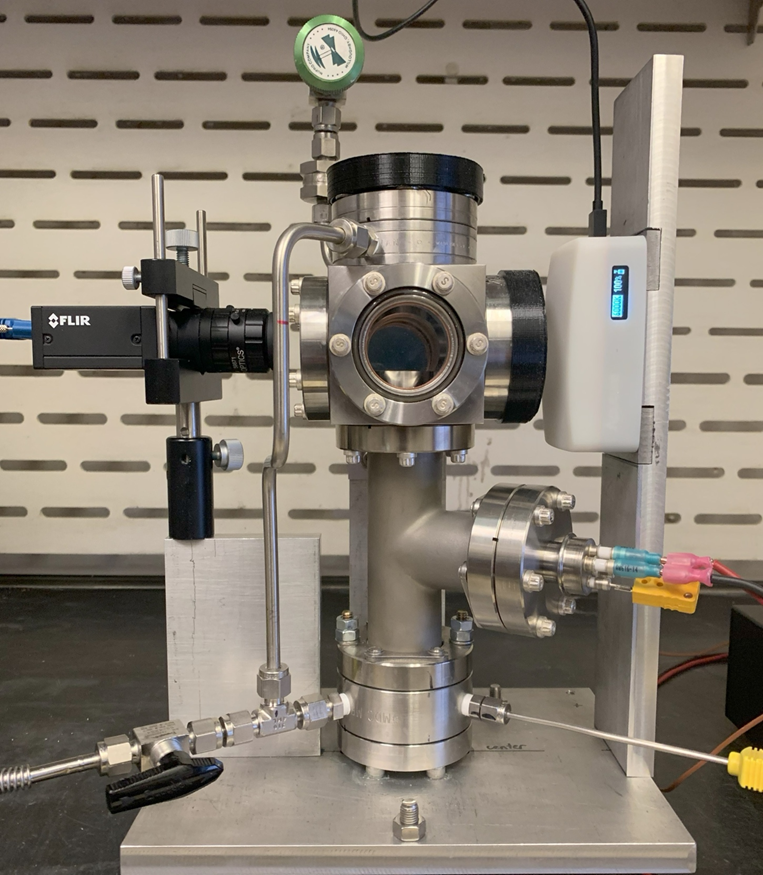
The Compact Modular Furnace from Los Alamos National Laboratory gives researchers a practical way to perform extreme-temperature testing of molten salts and metals in a glovebox-compatible, tightly controlled environment. By combining a small footprint, interchangeable components, optical access and the ability to isolate heat directly at the sample, it enables safer and more flexible experiments that would normally require much larger, more expensive equipment. The furnace design supports rapid setup for a range of materials studies, including contact angle measurement, compatibility testing and thermal cycling, while helping teams work with highly reactive substances without exposing them to air or moisture. The result is a versatile platform that expands what can be studied, shortens experimental turnaround and brings high-performance thermal testing into a form that is easier to deploy and use. The furnace can be heated using resistive heating elements to reach up to 750°C in vacuum or inductive heating elements to melt high temperature samples such as refractory metals.
Compact Modular Furnace
A glovebox-compatible furnace for safely testing molten salts and metals at extreme temperatures
technology Snapshot
Overview
Advantages
- Small enough to fit in constrained lab setups, including gloveboxes
- Helps protect sensitive materials from air and moisture
- Allows researchers observe samples while they are being heated
- Flexible enough to support different kinds of experiments
- Can reduce the need for multiple separate instruments
- May lower setup cost compared with larger, specialized systems
Technology Description
This invention addresses the difficulty of studying highly reactive materials under extreme heat while keeping them isolated from air and moisture. The Compact Modular Furnace provides a way to run controlled experiments on molten salts and metals in a compact setup that can fit inside a glovebox, which is important because these materials can be unsafe or unusable in ordinary open-air equipment. The furnace system can be isolated from the glovebox atmosphere to allow introduction of process gases, high vacuum or to prevent fumes from contaminating the glovebox environment. It also allows researchers to observe the sample during testing, so they can measure behavior such as wetting, compatibility and thermal response without interrupting the experiment or exposing the material to the environment. By combining a small footprint, adaptable parts and a design that concentrates heat where it is needed, the system reduces the need for large, specialized furnaces and makes advanced testing more practical, flexible and efficient.
The Compact Modular Furnace solves the problem of having to choose between precise high-temperature testing and a controlled, contamination-free environment. It gives researchers a way to heat and observe sensitive materials without exposing them to air, moisture or other conditions that can distort results or damage the sample. It also addresses the limitations of large, inflexible furnaces by offering a smaller, easier-to-configure setup that can be adapted for different experiments and measurement tools. Protecting sensitive equipment such as cameras and spectrometers from extreme heat conditions. In practice, that means scientists can study molten salts and metals more safely, with less equipment costs and with better access to the kinds of measurements needed to understand how these materials behave under extreme conditions.
Market Applications
- Nuclear Energy (materials testing, reactor component development, heat-resistant systems)
- Fusion Energy (high-temperature materials screening, containment studies, component durability)
- Solar Energy (thermal materials evaluation, coatings testing, high-heat performance studies)
- Advanced Materials Research (compatibility testing, wetting behavior, extreme-environment studies)
- Laboratory Instrumentation (specialized testing setups, environmental control systems, sample observation tools)
- Industrial R&D (rapid prototyping, thermal cycling, materials qualification)
Published: 2026-05-13
26-23234
Application Area
Sectors:Advanced Materials & Manufacturing
Areas:Advanced Manufacturing, Energy Technology Manufacturing, Renewable Energy
Industries:Devices and Instruments, Nuclear Power, Power Generation
Markets:Fusion R&D, Nuclear Reactors
Technology Readiness Level:
5 - Component Prototypes Tested in an Operational Environment
IP Information
Patent Number: Pending
S Number: 195784
Contact
- Licensing
- Los Alamos National Laboratory
- licensing@lanl.gov

Connect With Our Innovators

Access Our Technical Expertise
