Glass Components Fabricated via Aerosol Jet Printing
An additive manufacturing method for micron-scale glass component fabrication
technology Snapshot
Overview
Micron-scale glass components are widely used in optical, photonic, and micro-fabricated systems. These components are commonly produced through grinding, polishing, and milling processes that require tight tolerances and specialized equipment. As device architectures become more compact and geometrically complex, these approaches can constrain design flexibility and integration.
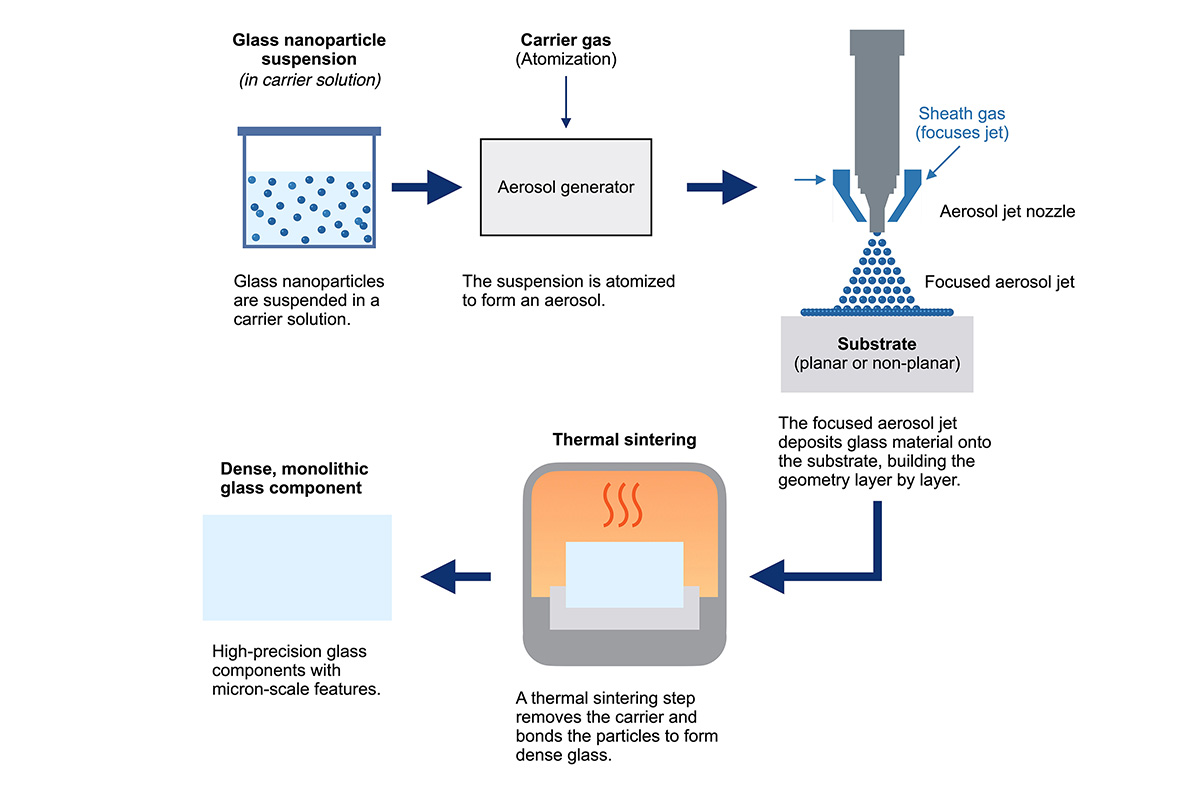
Los Alamos researchers developed an additive manufacturing process that builds glass components layer by layer using aerosol jet printing. Glass particles suspended in an aerosolizable carrier solution are deposited onto a substrate and then sintered to form monolithic glass structures. This approach enables controlled fabrication of small glass features without bulk glass melting or post-fabrication machining.
Value Proposition
This technology enables the fabrication of micron-scale glass components using an additive manufacturing approach. Conventional fabrication methods rely on subtractive machining, which can limit achievable geometries and increase processing complexity at small scales. By depositing glass material directly into its final geometry and sintering it into a dense structure, this method provides an alternative pathway for producing small, high-precision glass features.
Advantages
- Enables additive fabrication of micron-scale glass components
- Reduces reliance on precision subtractive glass machining
- Supports complex geometries and embedded glass features
- Compatible with multiple glass compositions and substrates
- Integrates with existing aerosol jet printing platforms
Technology Description
The method uses aerosol jet printing to deposit fine glass particles or sol-gel-based materials with micron-scale resolution. Deposition conditions are adjusted to build glass features to a specified thickness and geometry. After deposition, the printed material is sintered to remove the carrier and bond the particles into a dense glass component.
Demonstrations show that the process can produce continuous, monolithic glass features on planar substrates. The method supports multiple glass compositions and allows components to be fabricated directly in their final configuration.
Market Applications
This additive glass fabrication method is relevant to technologies that require small, high-precision glass components, including:
- micro-optics and micron-scale lenses
- optical waveguides and photonic interconnects
- optical filters and coatings
- glass-to-metal seals and microfluidic structures
- photonic and optical packaging platforms
These and related applications benefit from increased flexibility in the fabrication of glass features at small scales.