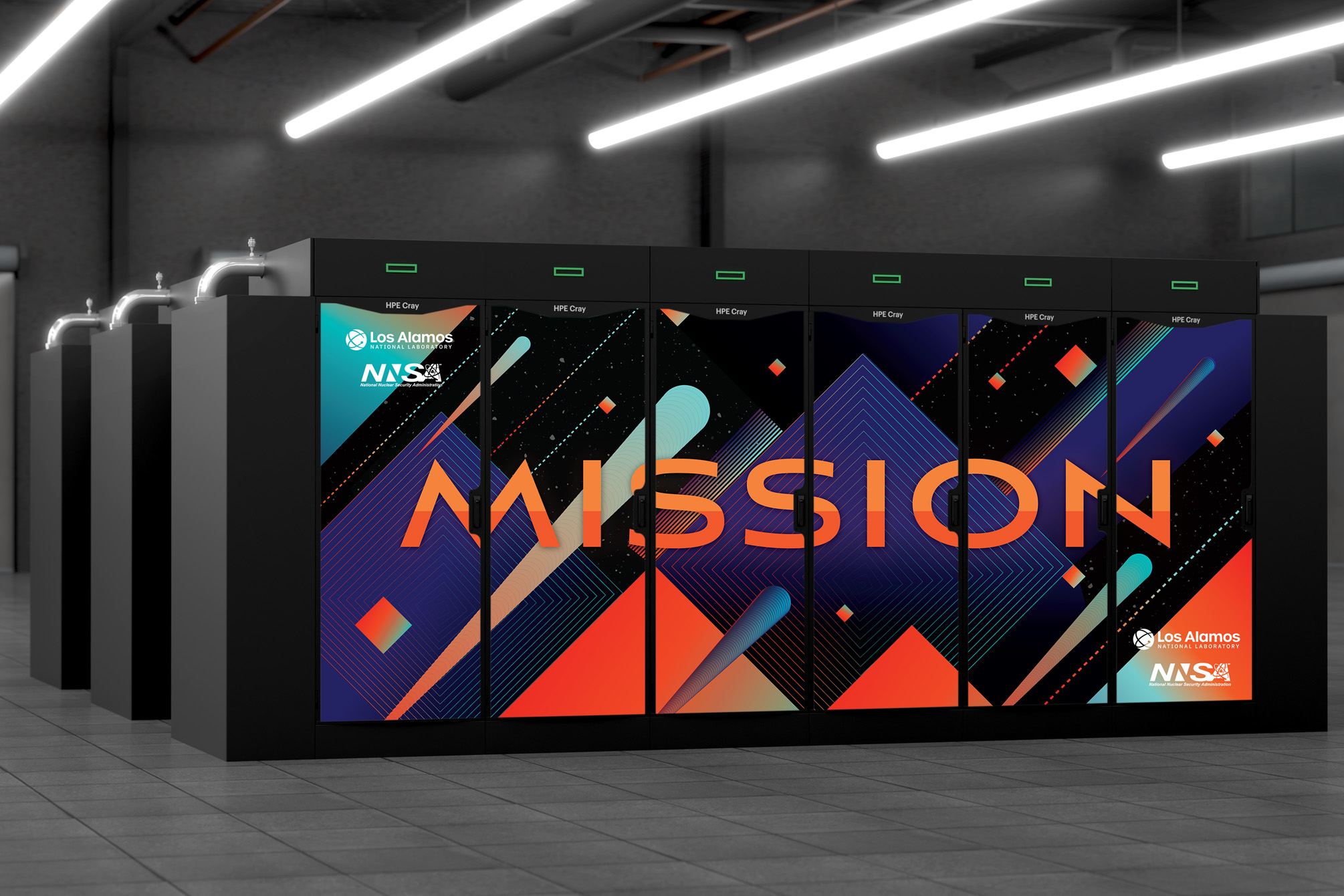
Mission will be critical to the success of these NNSA missions. Mission will support current and future simulation codes and will tackle some of the largest-scale 3D simulation workloads in support of the stockpile modernization mission. These large-scale simulations are known as “hero”-class simulations, and Mission will reduce these hero simulations’ time-to-completion from months to days. Additionally, Mission will provide the ability to run multiple of these hero-class simulations simultaneously. Vastly reduced time-to-solutions, combined with the ability to run multiple large-scale simulations, will dramatically improve NNSA’s ability and agility to manage the stockpile.
In 2027, Crossroads (ATS-3) will be nearing the end of its useful lifetime. Mission will replace Crossroads and will be the first NNSA HPC system in the post-exascale era providing a large portion of the simulation resources for the NNSA ASC tri-lab community of Lawrence Livermore National Laboratory (LLNL), Los Alamos National Laboratory (LANL), and Sandia National Laboratories (SNL).
Mission will support a diverse set of applications spanning the analysis of manufacturing defects, changing material properties as a result of the use of new materials with both current and new manufacturing techniques, the analysis of the impact of combined environments, aging defects, and potentially alternate delivery vehicles. New and emerging workloads, including digital engineering and machine learning (ML), will also be enabled by Mission.
Numerous architectural advancements in Mission's system design will support the NNSA Office of Defense Programs mission needs. Mission will be designed with the following architectural advancements and major project goals:
- Overcoming the memory wall—continued memory bandwidth performance improvements for tri-lab applications
- Improved efficiency—programmer productivity, energy usage, and increased processor utilization
- Architectural diversity—ensuring that the high-performance computing ecosystem remains vibrant with multiple advanced technology solutions
- Time-to-solution—advancing strong scaling improvements to tackle the most pressing challenge of major improvements in time-to-solution for NNSA’s largest and most complex stockpile simulations
Achieving these goals will enable weapons designers, analysts, and computational scientists to make more routine use of today’s hero-class simulations in support of the stockpile modernization certification and assessments to ensure that the Nation’s nuclear stockpile is safe, secure, and reliable.
Mission Timeline
- Draft Technical Specification - September 2023
- RFP release – September 3rd, 2024
- Award NRE/Build subcontract - Q3 FYE
- System Delivery - late 2026/early 2027
- Acceptance - August/September 2027