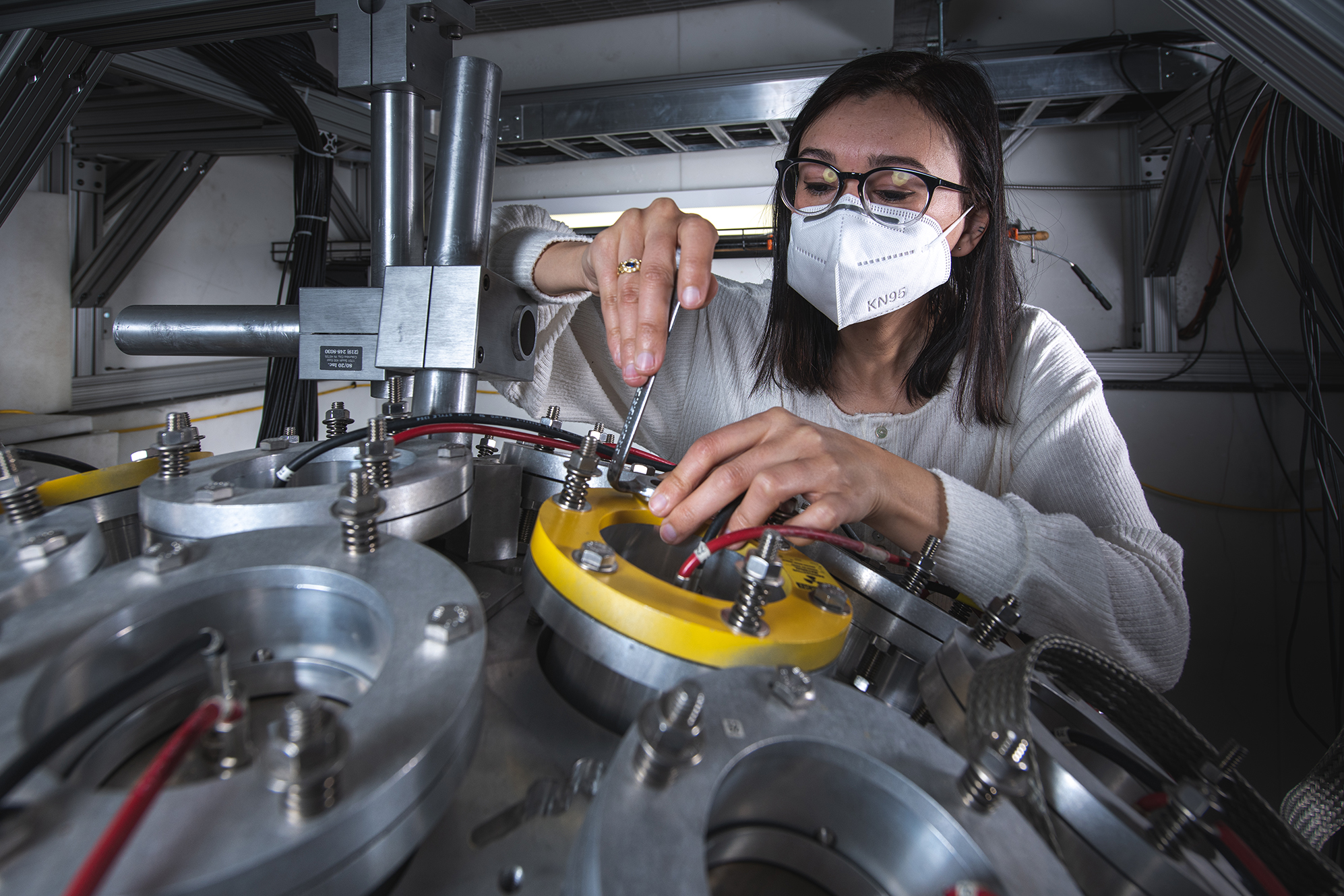
DANCE utilizes a liquid mercury shutter to control the neutron beam transmission from the target
DANCE is a 4π detector array that consists of up to 160 elements of barium fluoride crystals. It is designed to study capture reactions on small quantities of radioactive isotopes (down to 1 mg or up to 1 Ci), which are of interest to studies in nuclear astrophysics.
DANCE is located on the 20m neutron flight path 14 (1FP14) at the Lujan Center. The neutrons are produced via spallation reactions caused by an 800 MeV proton beam hitting a tungsten target with typical beam currents of 100 uA.
Instruments Specifications
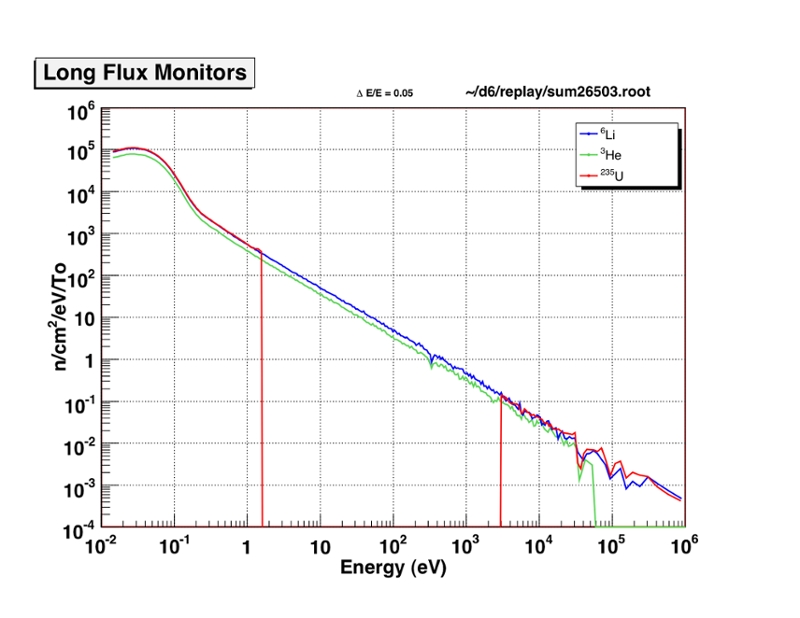
Flight Path 14 views the upper-tier water moderator. It is configured with very tight collimation to produce a 0.7 cm diameter beam spot at the target location at 20.25 meters with minimal beam penumbra. The measured beam flux at the neutron monitor location (approximately 22.60 m) with 100 microamps of proton beam is shown below.
DANCE is designed as a high efficiency, highly segmented 4π BaF2 detector for calorimetrically detecting gamma-rays following a neutron capture.
For practical reasons the detector modules do not really cover the entire solid angle. The design of the detector is such that a full 4π array would consist of 162 crystals of four different shapes, each shape covering the same solid angle.
Two of the 162 crystals are left out in order to leave space for the neutron beam pipe. Depending on the experiment, one crystal can be replaced by a sample changer mechanism, which makes it possible to exchange up to 3 samples without closing the beam shutter and breaking the vacuum of the beam pipe.
Thus the full array is designed to host 159 or 160 out of 162 possible BaF2 crystals. The dimensions of the bare crystals are designed to form a BaF2 shell with an inner radius of 17 cm and a thickness of 15 cm.