DOE/LANL Jurisdiction Fire Danger Rating:
  1. LANL Home
  2. Science & Engineering
  3. Periodic Table

Understanding the Periodic Table

The periodic table is designed to be explored, not memorized. As you navigate the table, look for patterns and relationships between the elements.

The periodic table is more than just a chart of element names and numbers. Its layout reveals patterns in how elements behave. Scientists use these patterns to understand how elements are related and predict their properties or even to discover new elements!  By understanding how the table works, you can gain a deeper understanding of matter and the physical rules that shape the universe.
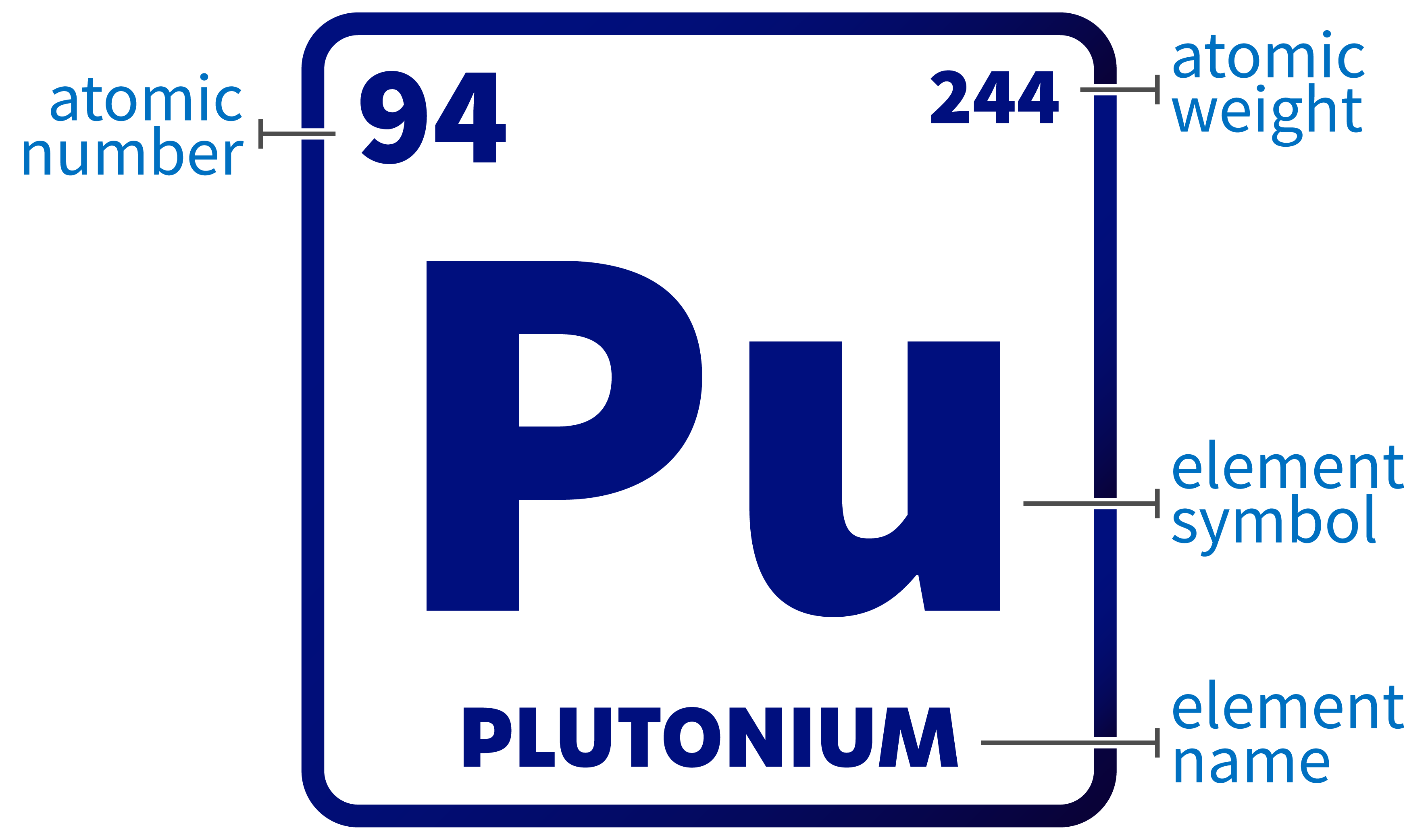
Diagram of a plutonium element entry labeled to identify its atomic number, 94; atomic weight, 244; chemical symbol, Pu; and element name, plutonium.
Each periodic table entry displays the element’s atomic number, atomic weight, chemical symbol, and name.

Each element is represented in a square featuring its symbol, atomic number, atomic mass, and sometimes other information about the atom.
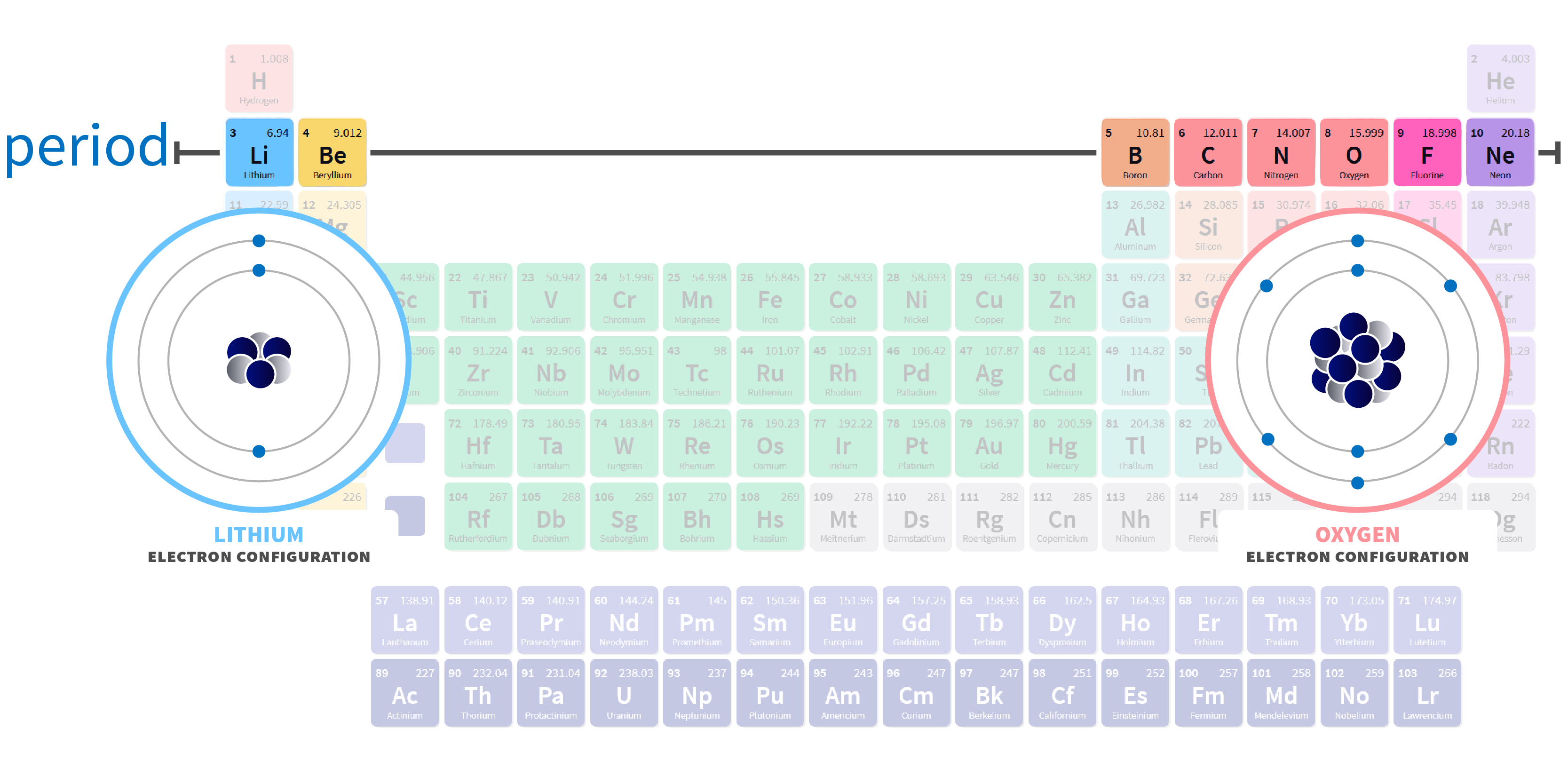
Color-coded periodic table with a horizontal marker identifying a period. Enlarged diagrams of lithium and oxygen show that both elements have electrons occupying two shells, but different numbers of protons and neutrons, reflecting increasing atomic number moving right across the period.
Horizontal rows in the periodic table are called periods. Atomic number increases from left to right across each period; lithium and oxygen are both in period 2 and have electrons occupying two shells.

Elements are arranged left to right in rows called periods. What changes as you move from left to right across a row? You’ll notice that the number increases by one with each element. In this way, elements are arranged by increasing atomic number, a number that reflects how many protons are in the element.
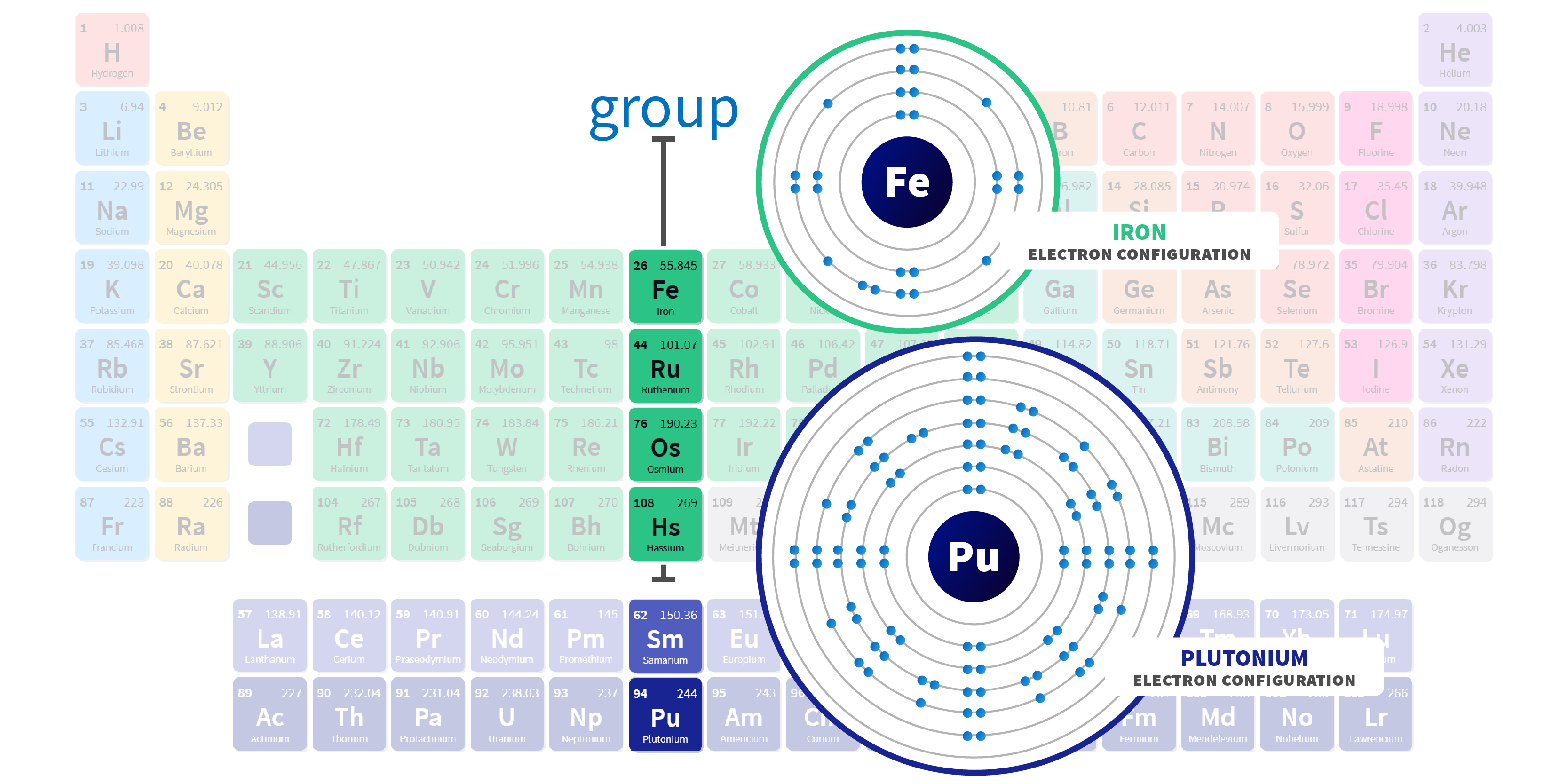
Color-coded periodic table with a marker identifying the column containing iron, ruthenium, osmium, and hassium. Enlarged electron diagrams show iron with four occupied shells and plutonium with seven; both have two electrons in their outermost shell.
The vertical columns of the periodic table are called groups. Iron, ruthenium, osmium, and hassium make up group 8. Samarium and plutonium align beneath this column because the f-block is displayed separately, but they are not members of group 8. Although iron and plutonium both have two electrons in their outermost shell, electron count alone does not always determine an element’s group.
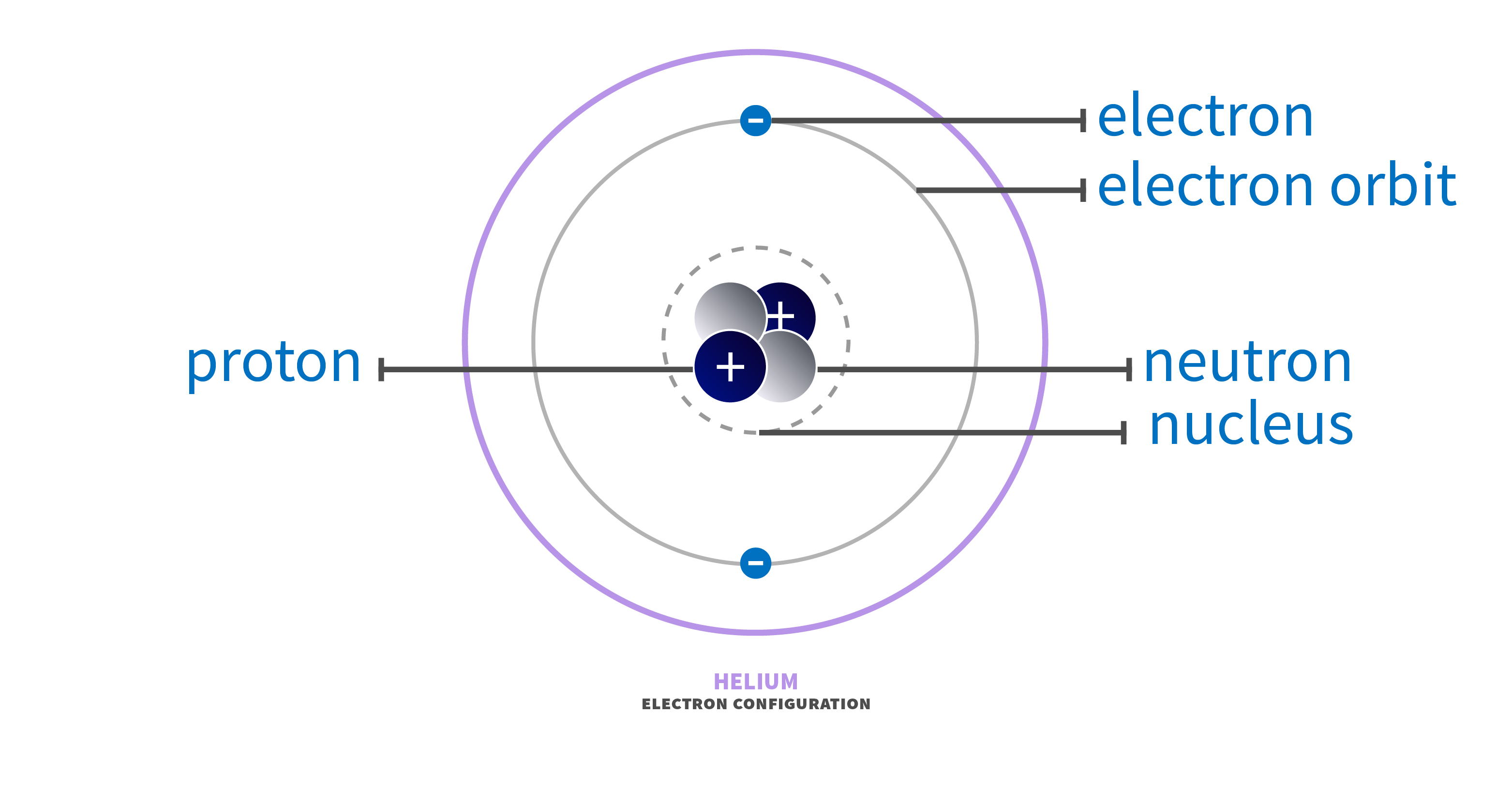
Labeled diagram of a helium atom showing two negatively charged electrons on an electron orbit and a nucleus containing two positively charged protons and two neutrons.
An atom consists of a nucleus containing protons and neutrons, surrounded by electrons occupying energy levels, or shells.

Looking at the columns, elements are arranged by group or family. Elements in the same group often act the same way and have similar properties. The reason here isn’t as obvious. It's actually based on how their electrons are arranged.  

For main-group elements, atoms in the same group have the same number of electrons in their outermost shell, even though the total number of electrons and occupied shells increases as you go down the column. These outermost electrons are called valence electrons and play a major role in how atoms interact and form chemical bonds. Fun fact: the patterns are more complex for transition metals and  f-block elements because electrons from lower shells may also participate bonding. It's part of why plutonium chemistry is so weird!
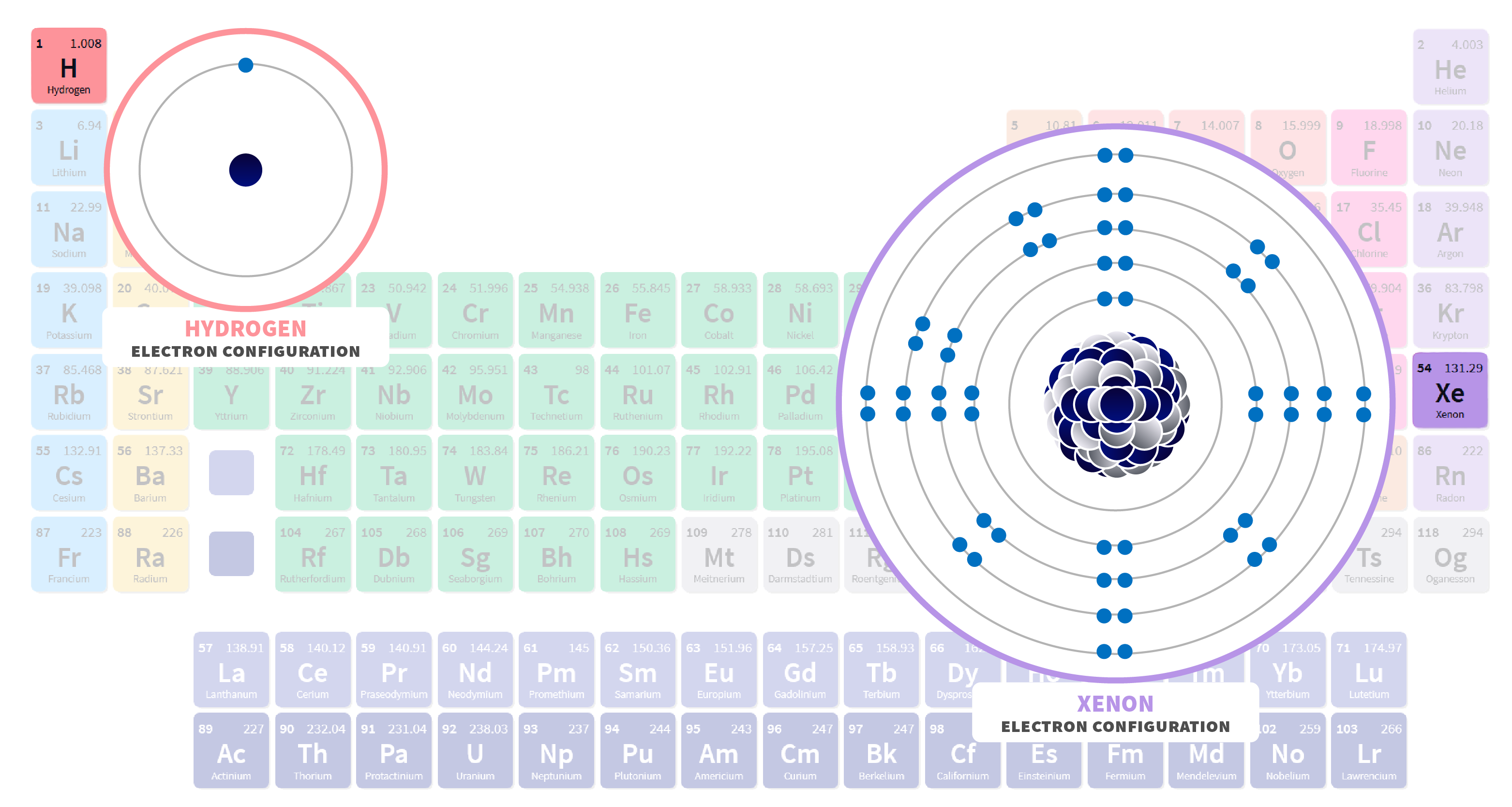
Color-coded periodic table with enlarged electron-configuration diagrams for hydrogen and xenon. Hydrogen has one electron in one shell, while xenon has 54 electrons distributed across five shells, including a full outermost shell containing eight electrons.
Electron configurations become more complex as atomic number increases. Hydrogen has one electron in a single shell, while xenon has 54 electrons distributed across five occupied shells, including a full outermost shell containing eight electrons.

If an atom’s outer shell is full (like xenon), the element is very stable and unlikely to interact. If the outer shell is not full (like hydrogen), the atom can gain, lose, or share electrons to become more stable, making it more likely to bond with other atoms.

The key idea: Every pattern on the table comes from the structure of atoms—how they’re built. That structure determines their function—how they behave.

But wait! Mendeleev didn’t know about protons, neutrons, and electrons when he built the periodic table. We didn’t understand atomic structure until Ernest Rutherford’s gold foil experiment in 1911—over forty years later! Mendeleev created a table that worked without knowing why it worked. By trusting the patterns, he discovered the rules before modern chemistry explained the reason for the rules.

There are many patterns that manifest across the periodic table. Properties, like atomic size, reactivity, electronegativity, and ionization energy, all follow predictable trends that reflect the physics and forces acting on atoms. As you explore the table, consider how tiny changes inside atoms can lead to big differences in an element's properties that you can actually see and touch, like color, luster, hardness, and density.

Together, these patterns show how the periodic table is one of the most powerful tools in science—allowing us to organize a huge amount of information into a logical structure. When you learn how to read this map, the periodic table becomes a guide through matter, revealing relationships, trends, and rules that replace memorization with understanding and even prediction.
Want to Play with Protons?

Explore cutting-edge research opportunities shaping the future of science, technology and national security.

Career Searcharrow_forward

About this Resource

The Los Alamos Periodic Table began in 1992 as a passion project by Robert Husted, then a graduate research assistant in Chemistry division. It became the first interactive periodic table on the internet.

In 2011, Chemistry division's Maida Trujillo, Dave Hobart, and Josh Smith redesigned and updated the resource, expanding information about the elements' histories, properties, and uses and introducing classroom resources and activities.

The current redesign, led by Brittany St.Jacques, builds on their work, preserving a trusted educational resource while introducing new features designed around how people access information today.  

Chemistry division proudly carries this resource forward as part of its commitment to science education, connecting the elements to everyday life and the frontiers of Los Alamos science to spark curiosity and inspire the next generation of scientists.

Los Alamos National Laboratory

P.O. Box 1663

Los Alamos, NM 87545

(505) 667-5061

At The Lab

  • Business Opportunities
  • Jobs
  • Organizations
  • Research Library
  • User Facilities

Information

  • Emergency
  • Ombuds
  • Reading Room
  • Resources
  • Science Museum

For Employees

  • AskIT
  • LANLInside
  • MyMail
  • Training
DOE White Seal
  • Terms of Use/Privacy

Managed by Triad National Security, LLC for the U.S. Dept. of Energy’s NNSA

Copyright 2026 Triad National Security, LLC. All Rights Reserved.

Learn about the Department of Energy’s Vulnerability Disclosure Program