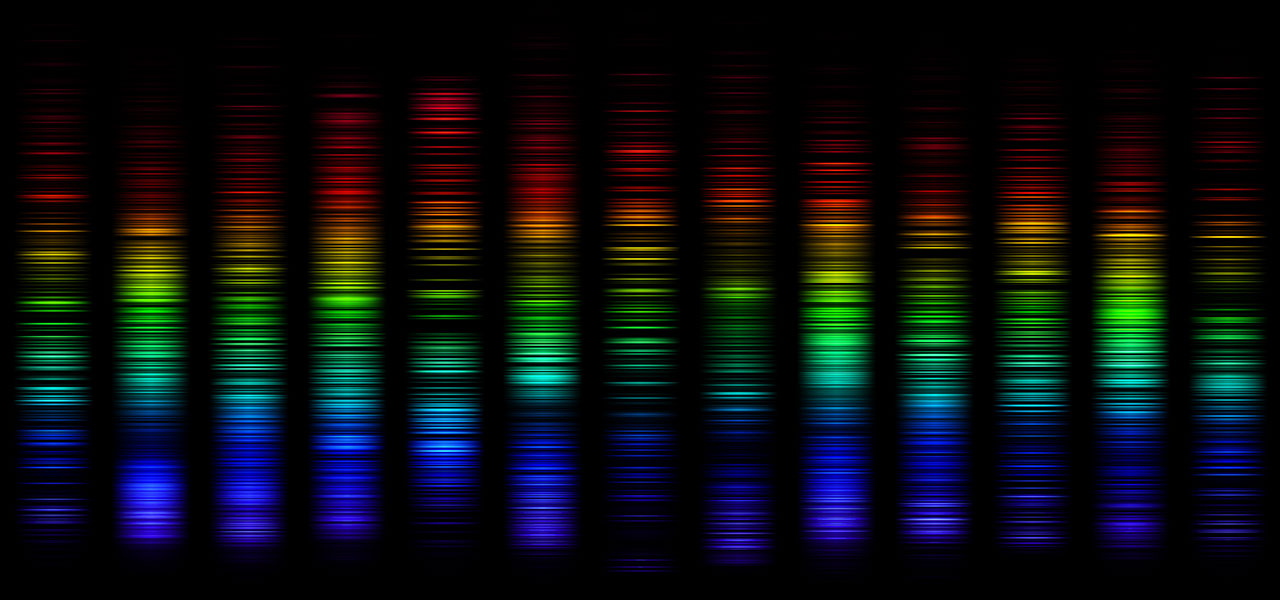
The mid-1800s was a period of intense activity in the search for new elements. This was especially the case for scientists working with the elements that we now call the lanthanides, or rare earth metals. But the process of discovering these elements was challenging because the rare earth metals all behave so similarly! These similarities made it hard for researchers to split the elements apart, and to tell if they’d found a new element, or two, or even more!
Identifying the elements got a lot easier after 1859, when Robert Bunsen and Gustav Kirchhoff invented the spectroscope. Bunsen and Kirchhoff figured out that by burning a substance and examining the light produced in the process (like a colorful fingerprint), it was possible to figure out what the substance was made of.
Back in 1841, Swedish chemist Carl Mosander had found what he thought to be two new elements in a sample of the mineral cerite. He called these two supposed elements “lanthanum” and “didymium.” However, in 1885, one of Robert Bunsen’s students—Austrian chemist Carl Auer von Welsbach— succeeded in splitting up didymium into two elements. He then used spectroscopy to prove that these elements were in fact distinct, and he named the elements neodidymium (meaning “new didymium”) and praseodidymium (“green didymium”). The name “neodidymium” was then modified to “neodymium,” which is what we call the element today.