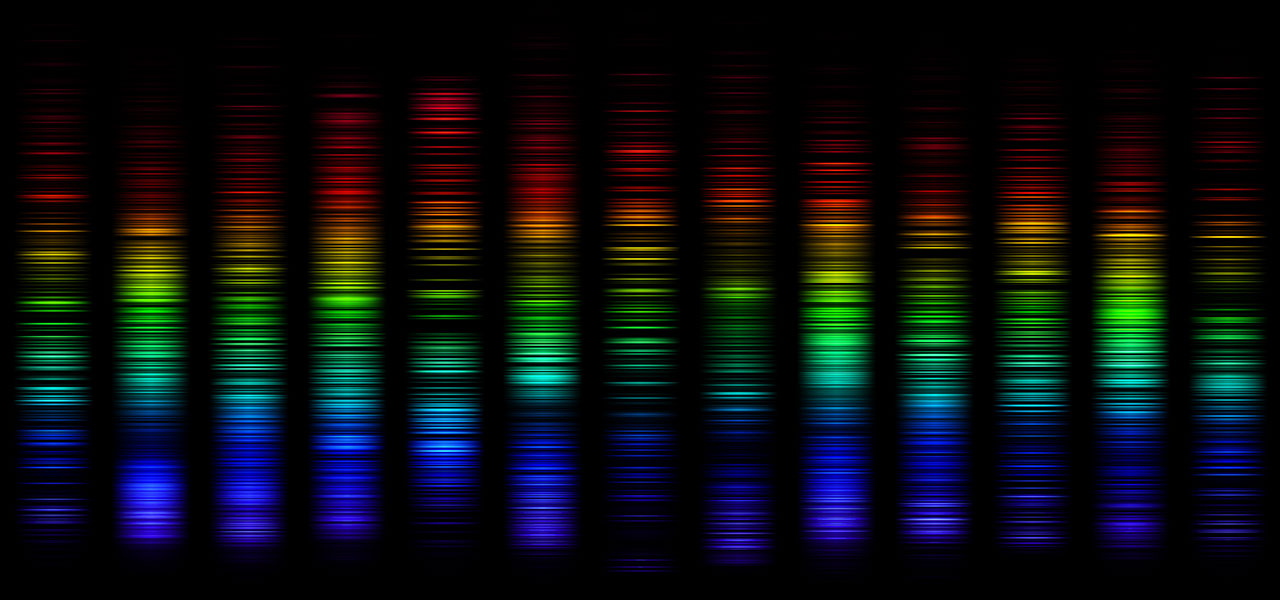
Robert Bunsen (the German chemist who invented the Bunsen burner) and Gustav Kirchhoff (a German physicist best known for his work on electrical circuits and “blackbody” radiation from heated objects) discovered cesium together by flame spectroscopy.
Spectroscopy is a method of chemical identification based on the specific colors (wavelengths) of light emitted or absorbed by an element. It was done with a spectroscope, which Bunsen and Kirchhoff invented one year earlier. Their spectroscopic observations of flames from evaporated mineral water from Dürkheim, Germany, included a combination of several prominent blue lines (specific shades of blue) that had not been seen by spectroscopy before. Bunsen and Kirchhoff concluded that there was a new element present and named it after the latin word caesius, which means bluish gray. Cesium was the first element to be discovered by spectroscopy.
While spectroscopy made it possible for Bunsen and Kirchhoff to identify cesium, their efforts to isolate the element were unsuccessful. It was first isolated in 1882 by Swedish chemist Carl Setterberg.