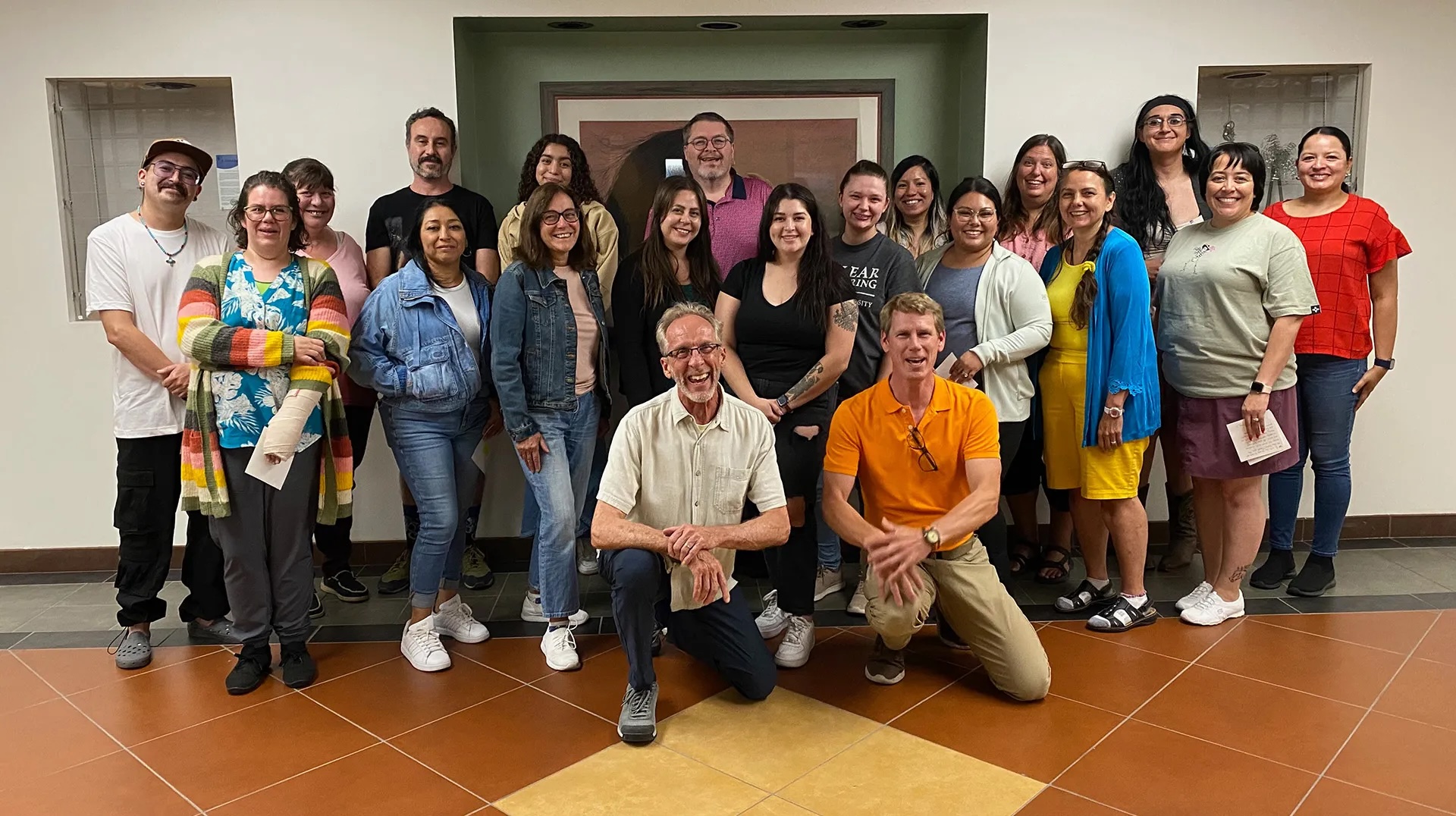
“We used to hear things like, ‘I hate math, I can’t do math,’ or scarier yet, ‘I can’t teach math’,” says Florence Storey, a first-grade teacher leader at Blanco Elementary in Bloomfield, NM. “I don’t hear those things anymore.”
The reason for the change is the work the school has done with the Math Teacher Leader Network (MTLN), a program developed by the Laboratory’s Math and Science Academy to help strengthen teachers’ knowledge and skills for teaching mathematics and building systems to continuously improve their practice.
Originally launched in 2018 by the Laboratory's Math and Science Academy (MSA), the program has evolved into a comprehensive three-year professional development initiative that fosters the development of mathematics teacher leaders and supports effective mathematics teaching and learning in participating schools.
Building mathematical expertise
Currently, the four education experts with the MSA work with seven schools in five districts across Northern New Mexico, focusing on four key pillars: enhancing teachers' mathematics content knowledge, improving pedagogical approaches, developing leadership skills, and implementing systems for continuous improvement.
The MTLN offers professional development out of the classroom, and MSA staff also spend time with the teachers and principals in their schools, helping them hone their skills, and observing them as they implement their new approaches.
"Collaboration is a key part of the program,” says Zach Leonard of the MSA. “We're seeing teachers develop a much deeper understanding of mathematical concepts and how to effectively teach them."
The program also helps participating teachers earn an elementary math specialist endorsement from the New Mexico Public Education Department and they can also go on to complete a master's degree in mathematics teacher leadership.
Expanding the program’s impact
The program's effectiveness has drawn attention beyond Northern New Mexico. The MSA team has presented their methodology and results at regional and national conferences.
Participating teachers have also spoken about the program's impact at meetings of their local school boards, and state education officials have expressed interest in adopting the approach more widely.
As the program continues to evolve, the MTLN maintains its focus on the ultimate goal: improving students' mathematical learning, thinking and reasoning skills through enhanced teacher expertise and leadership.