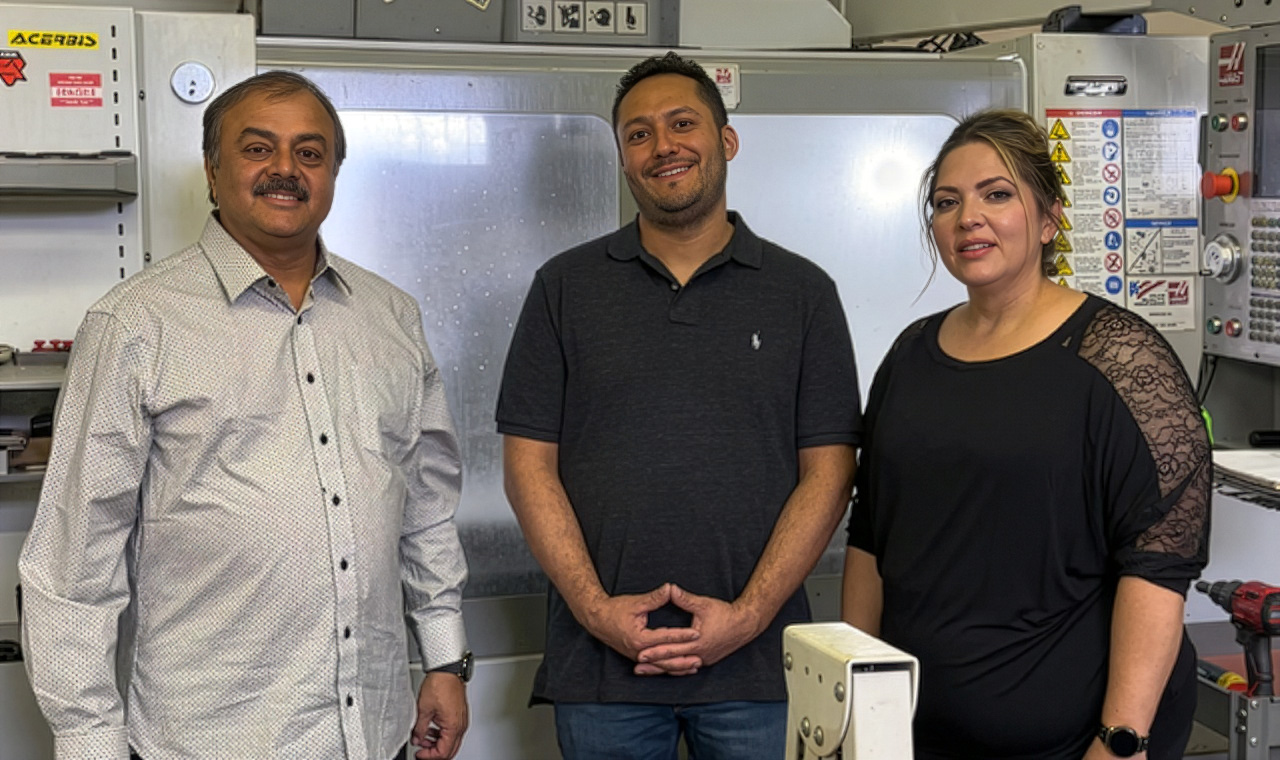
If, as the proverb goes, it takes a village to raise a child, then it definitely takes a community to grow a business. That, and in some cases a loan from the Regional Development Corporation for a wire electrical discharge machining (EDM) system.
Built on the hard work and dedication of founders Elizabeth Vigil and Jose Rosales, JREV Enterprises is a thriving machine shop in Española, delivering custom high-precision components to clients including Los Alamos National Laboratory, Sandia National Laboratories, KALTRON Pulsed Power Systems and the City of Española.
JREV’s success (and the story of its wire electrical discharge machining system) shows how with help from the Laboratory, the RDC plays a key role in strengthening the business ecosystem that benefits the whole Northern New Mexico community.
A word to the wise
The RDC’s support for JREV starts with their support for one of JREV’s customers, KALTRON Pulsed Power Systems. Founded by Kalpak Dighe, KALTRON grew out of technology developed at the Laboratory, and was supported in its early days by the Laboratory’s Richard P. Feynman Center for Innovation.
KALTRON fabricates and assembles high-energy capacitive modules designed to replace legacy products used by the government laboratories, aerospace companies, and branches of the military.
Loans from the RDC helped KALTRON to build a new test facility that doubled its testing capacity and its speed in delivering products.
When KALTRON became a JREV customer, Dighe suggested JREV see how the RDC could help them. JREV successfully applied for loans in 2023 and again in 2025 through the Technology & Manufacturing (TEAM) Fund, using the 2025 award to purchase the wire electrical discharge machining (EDM) system.
Funded partly by Laboratory operator Triad, the TEAM Fund offers no-interest loans up to $20,000 to manufacturing and technology-based companies in Northern New Mexico that are on track to add jobs, grow revenues, and attract additional funding/investment.
“The EDM system we bought produces intricate, high-tolerance parts that traditional machining methods cannot produce,” says Vigil. “This will help foster innovation, support local scientific advancements, and promote collaboration between industry and research sectors.”
The machine enhances JREV’s ability to support customers like KALTRON, and Dighe appreciates the benefits of having a local partner to work with to evaluate, iterate and finalize designs of the items his firm needs.
“If we didn't have local manufacturers in the area, this process could take a lot of time: weeks, actually. Having a local manufacturer here saves everybody costs,” he says.
The Mentor-Protégé Program: A mark of success
Helped by the RDC, business is looking good for JREV, a fact underlined by them being accepted into the Laboratory’s Mentor-Protégé Program, in which the Lab mentors promising small businesses to help them strengthen their capabilities and competitiveness. Participants in this U.S. Department of Energy initiative gain access to institutional knowledge, technical guidance, and opportunities to pursue Laboratory contracts, positioning them for long-term success.
"You are taken under the wing of Los Alamos National Laboratory to be mentored in the business processes of how government organizations operate,” says JREV’s Vigil. “You gain better knowledge of how to compete for contracts with government agencies.”
As well as highlighting the valuable role played by the RDC in supporting both JREV and KALTRON, the story behind the RDC’s award to JREV also shows how embedded the Laboratory is in the regional economy.
The interconnected parts look like this: technology transfer from the Laboratory helped KALTRON (which is also supported by the RDC), KALTRON becomes a JREV customer and suggests they reach out to the RDC for support, Laboratory operator Triad helps fund the RDC’s loan to JREV, and the Laboratory also does business with both KALTRON and JREV, and also further helps JREV through its Mentor Protégé program.
It sounds complicated, but it also sounds like a rich environment for growth and innovation.
“The network of connections between the Laboratory, the RDC and these businesses is a great example of how support for economic development initiatives benefits the companies, the Laboratory and the whole community,” says Pat Vanderpool, executive director of the RDC. “That’s how you strengthen the region’s business ecosystem.”
For more insights, here’s the RDC’s success story video on JREV and KALTRON.