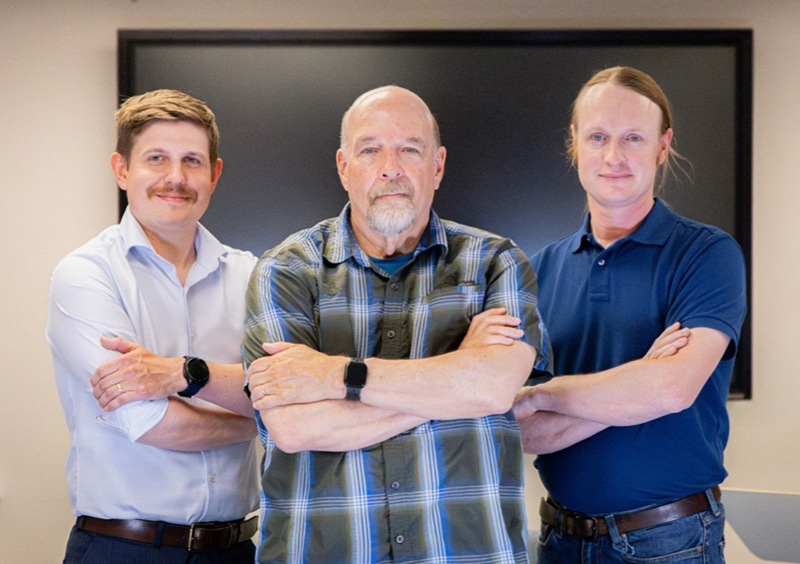
For graduate students interested in high-performance computing, few problems today can be solved in isolation. Modern scientific challenges demand collaboration across disciplines — researchers working together to design software and algorithms that run efficiently on the world’s most powerful machines.
That philosophy is at the heart of Los Alamos National Laboratory’s Co-Design Summer School, a 10-week, hands-on program that brings together a small cohort of graduate students each summer to work on a single, real-world scientific computing challenge.
“All the simple problems have been solved already,” said Christoph Junghans, former Co-Design Summer School lead and group leader in the Applied Computer Science group. “Now we need all this variety of background to solve the complicated problems.”
Watch this video about the school
Training scientists for cross-discipline work
The program’s model — six to seven students, multiple mentors and one shared problem — has remained consistent since its early years. Founded in 2011 by now-retired computer scientist Al McPherson, students work side by side in a single shared space: an old security vault that now serves as the Summer School’s main collaboration room.
“By just throwing students in one room and have them talk to all these different mentors,” Junghans said, “they will learn all the languages.”
Today, the Summer School is led by Julien Loiseau, a staff scientist in Applied Computer Science whose own path through the program mirrors the pipeline it was designed to create.
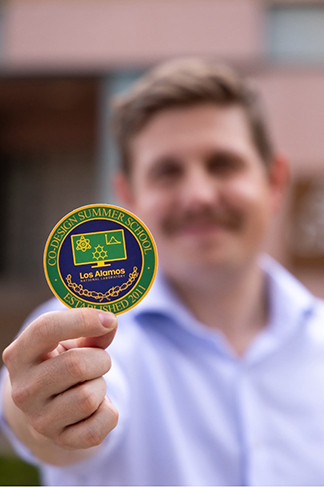
Loiseau first arrived at the Laboratory in 2016 as a graduate student from France, eager for his first opportunity to work at a U.S. national lab.
“I was so curious about being able to come in the U.S. for the first time, seeing a big laboratory,” Loiseau said. “It was like a dream, basically.”
That summer, he found himself working closely with students from very different technical backgrounds, all contributing to the same project.
“I was in the room with physicists, with mathematicians, with other computer scientists,” he said. “How do I talk to a physicist? How do I talk to astrophysicists? They have their own language. … That’s what I learned during the Summer School — how to communicate, how to work in big projects with more people.”
After returning for additional internships, Loiseau joined the Lab as a postdoctoral researcher and later converted to staff. He eventually returned to the program as a mentor, and then as its lead — a progression Junghans says reflects the program’s long-term impact.
“We prepare our people pretty well for what it’s going to be when you work at the Lab,” Junghans said. “You’re not going to work on one project. You’re not only doing physics. You’re going to work on all of this.”
Learning by doing it together
Each summer, students collaborate on a focused technical challenge tied to Laboratory mission needs. While the specific topic changes from year to year, the structure remains the same: a shared code base, real production-level software and constant collaboration.
“In all the layers of the development, they have to be interacting with each other,” Loiseau said. “The physicist will come with a method, the mathematician will help make it work with the solver, and then the computer scientist will implement it efficiently on the machine.”
Students are expected to deliver tangible results by the end of the program. Many cohorts produce conference posters, peer-reviewed papers and open-source code contributions.
“A good outcome is that they’re able to produce a good paper and present it,” Loiseau said. “But what they really take back home is this advantage of being able to work together; understanding how to communicate and work in groups.”
Building a pipeline to Los Alamos
That experience benefits the Lab, as well. According to Junghans, the program consistently converts participants into postdoctoral researchers and staff members.
“Our school has by absolute numbers and relative numbers some of the most conversions,” he said. “I think the reason why is really that we prepare people very well for being a postdoc or a staff member at the Lab.”
Loiseau’s commitment to mentoring was formally recognized earlier this year, when he received the 2025 Distinguished Mentor Award. For him, the reward is seeing how students grow after leaving the program.
“We had a student who was in the Summer School who came back and gave a talk here,” he said. “I could really see how he changed — way more mature. … It’s wonderful to see these changes and see how they’re able to communicate and do their work at the Lab.”
The Summer School also evolves alongside the rapidly changing computing landscape. Students gain experience working on heterogeneous systems and emerging architectures, while exploring new tools as appropriate.
“We use AI as one of the many tools in our toolbox,” Junghans said. “It’s a big tool right now, but it’s one tool among many.”
For students considering whether to apply, Loiseau offers simple advice.
“Go for it,” he said. “The Lab is just a magical place. You’re in a small town here with all these Ph.D. people. You can go to a talk about plasma physics, then astrophysics, then something completely different. You’re part of a group, and you’re doing amazing work that will help you, but also help the Lab.”
How to apply
The Co-Design Summer School is open to graduate students at an accredited program computer science, applied mathematics, physics and related fields. The focus for 2026 is “Advancing scale-bridge simulations in high-explosive applications using HARD at Scale.” The program runs for approximately 10 weeks during the summer. Applications are due by Jan. 10. More information about eligibility, the annual research focus and how to apply is available at https://lanl.github.io/cdss.
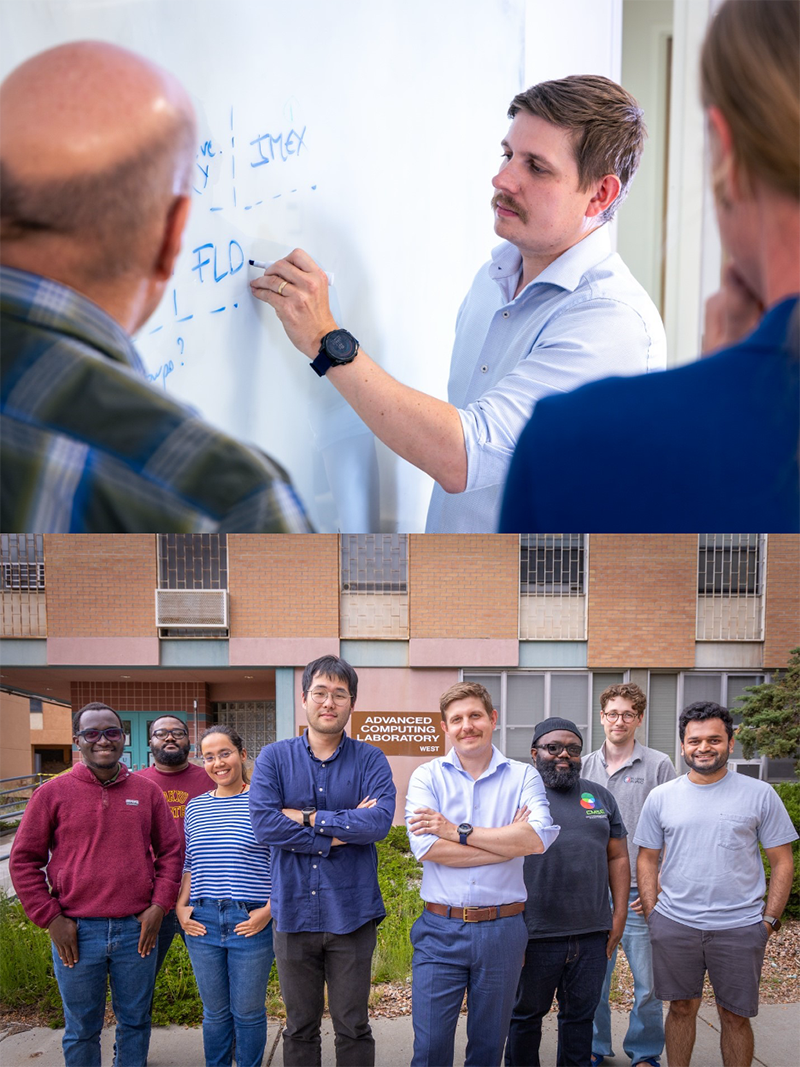
Above: Last year’s Co-Design Summer School students in front of the Theoretical building.
LA-UR-25-32191