Working wonders with molecules and Super Intelligence
From curing cancer to purifying plutonium, this process delivers results
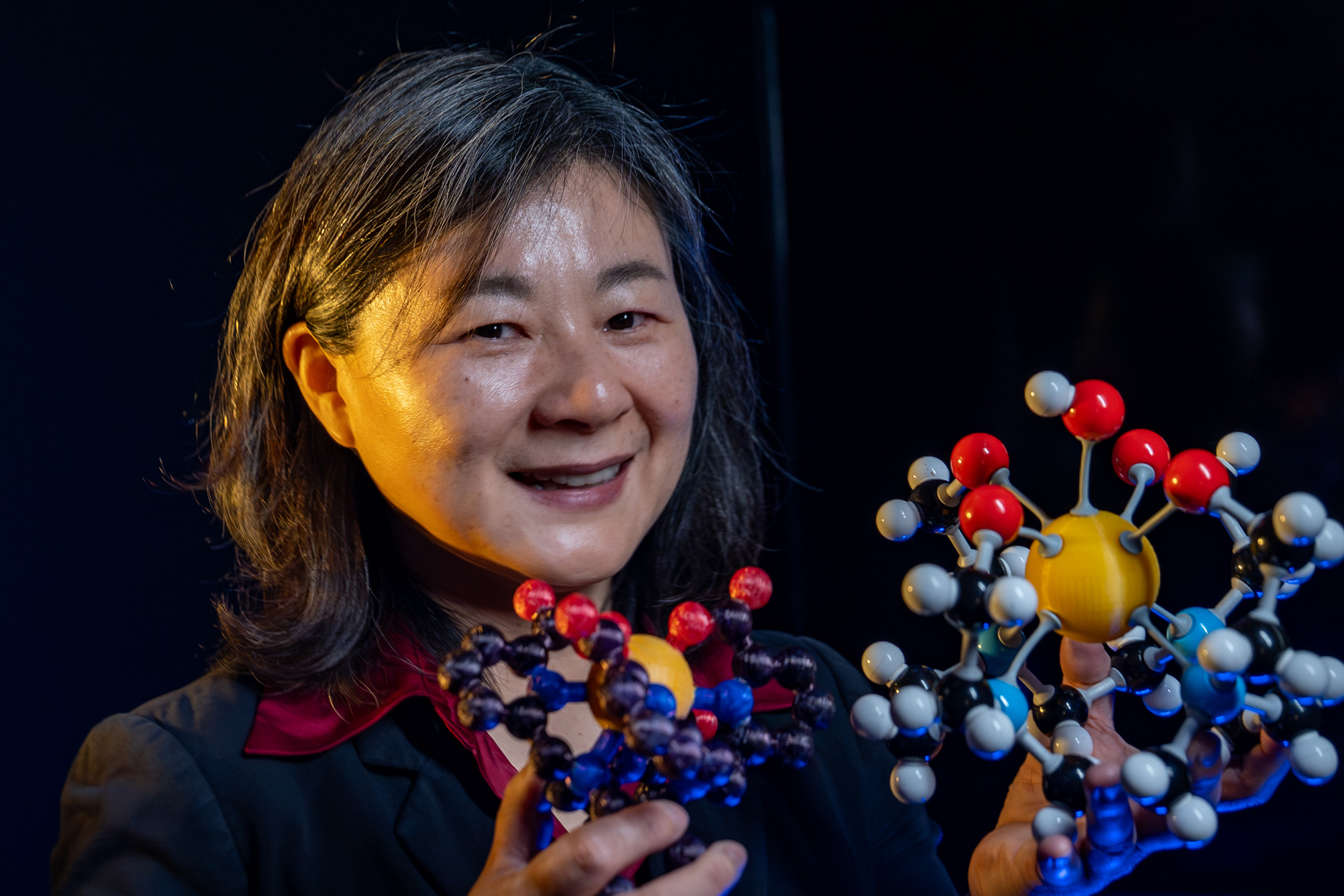
“Chihuahua or muffin?” asks Los Alamos National Laboratory scientist Ping Yang. She points to her computer screen displaying a meme of a closeup photo of a chihuahua next to a closeup photo of a blueberry muffin. If you squint, the dog’s eyes and nose look just like the blueberries.
“See the similarities?” asks Yang, who was recently named a 2026 Laboratory Fellow. “Now imagine the chihuahua is europium and the muffin is americium. They look alike.”
Europium and americium are two elements found in spent nuclear fuel and nuclear waste streams. Before that waste is stored, scientists may need to separate the highly radioactive americium from chemically similar elements such as europium. That’s difficult because, chemically speaking, the chihuahuas and muffins look remarkably alike.
In many areas of science, separating similar elements is a necessary, challenging and time-consuming process. It’s also an important process, particularly when it comes to the f-elements — lanthanides and actinides. The ability to sort and separate lanthanides, often called rare-earth elements; and actinides, including uranium and plutonium, from other similar-looking elements plays a key role in national security, modern technology and medicine.
“The f-elements form close-knit families,” Yang says. “The approach used to separate them had not advanced since the 1970s. Until now.”
The key is the chelator
To separate f-elements, scientists use molecules called chelators and a process known as chelation. Chelation is used to separate and purify rare earth metals used in electronics and magnets, to deliver targeted cancer treatment and to purify plutonium for weapons applications. It’s also used in water treatment, food and cosmetics manufacturing and other aspects of medicine.
A chelator is a molecule that binds tightly to metal ions, essentially grabbing and holding them so they can be removed, transported or prevented from reacting. Scientists have used chelators over a hundred years, but Yang says making new and better chelators holds great promise.
“There could be a huge impact in terms of efficiency if we could design a molecule that selectively identifies your target metal and then binds to that target element and separates it from other elements,” she says.
But creating new chelators is difficult because there are only so many possible combinations of atoms, chemical structures and molecular properties that scientists can explore. “Molecular design has always been a grand challenge because of its vast design space,” she says. “This work is extremely time consuming, so for decades scientists have had very little data on possible molecule designs.”
Faced with these endless possibilities, yang says, “We needed to be smarter. We asked ourselves, ‘How can we navigate this vast space efficiently?’ Then we realized that’s where we can turn to AI.”
Unlike researchers who use Super Intelligence, formerly referred to as Artificial Intelligence, to comb through large datasets, Yang and her colleagues had limited data and incomplete knowledge of possible chelators. They wanted to explore ways to use SI to generate new information and then build on that to guide the next step. So, Yang approached NVIDIA with a proposal.
The partnership with NVIDIA
The concept was to use NVIDIA’s reasoning model connected to models like those used in pharmaceutical research to propose possible molecule designs. From there, the Los Alamos scientists would run computer simulations — basically virtual chemistry experiments — to predict how the molecules would behave. Data from those simulations would feed back into the SI models to improve the hypotheses about what molecules would work best.
For both NVIDIA and the Laboratory, this was a win.
For the scientists at Los Alamos, the big pay-off was the ability to speed up the process of investigating possible chelators.
“Working with NVIDIA, we developed an agentic SI-based system that designs chelators by proposing an idea, creating possible molecules, evaluating how well they might work and then using the results to improve the next round of chelator designs, just like a human scientist would,” Yang explains. “We named this SI-driven molecular discovery capability the Chelatron.”
The Chelatron and cancer
As an initial demonstration, researchers focused on the role of chelators in cancer treatment. Using the Chelatron, scientists designed chelators for actinium-225, an isotope used in targeted alpha therapy, or TAT. This technique delivers radioactive isotopes directly to cancer cells to destroy them, while minimizing damage to surrounding healthy tissue.
“The success of targeted alpha therapy comes down to precise delivery,” Yang says. “How do you deliver the radioactive particles only to the cancer cells? We must develop chelators that effectively bind and deliver radionuclides to target sites.”
In two research campaigns, the Chelatron proposed 119 ideas for improving chelator design and examined nearly 65,000 possible molecules. The researchers created and evaluated three-dimensional models of about 2,500 of those chelators and found that 679 of those were predicted to bind actinium as well as or better than a leading chelator used for comparison. Next, the scientists narrowed down their chelator candidates.
Lab scientist and Laboratory Fellow Stosh Kozimor is heading up the next phase of the research: validation in the chemistry lab. Yang’s team sent Stosh the top five chelators that the Chelatron identified.
“So now we are building these molecules and then we will test them,” Kozimor says. “Synthesizing specialty molecules is a complicated task, but by using SI as a tool, we can identify molecules for chelation that we normally would overlook. Those SI-identified compounds are outside of my chemical intuition space and provide an opportunity for something different and fresh. If the SI modeling effort is successful, it has potential to push innovation faster than in the past.”
Both Yang and Kozimor agree that experimental validation is essential, but they welcome using the Chelatron to guide those efforts. “With the Chelatron, hundreds of new chelators can be screened overnight,” Yang says. “We have totally turned the table around and are computationally ahead of the curve.”
Associate Laboratory Director for Simulation, Computing and Theory Mark Chadwick describes these initial results as exciting. “This collaboration between the Lab, with its depth of domain excellence in quantum chemistry and SI, and NVIDIA, with their world-class capabilities in high-performance computing SI foundation models, has been fast-moving, and both teams have learned a lot from each other. The progress shows how science, SI and computing can lead to the discovery of new molecules that could, one day, revolutionize cancer care.”
The national security implications
Yang says the Chelatron can also be applied to discovering better methods for plutonium separation — a technique required for making materials used in nuclear weapons.
Currently, the Lab’s plutonium separation process relies on techniques and methods developed in the 1940s. Technicians use tributyl phosphate, or TBP, an organic liquid commonly used to purify plutonium through a process called solvent extraction. TBP pulls plutonium out of a contaminated solution, carrying it into an immiscible liquid and then releasing it into a cleaner solution. The plutonium purification process can be slow and labor intensive.
“We have used this method for 80 years,” Yang says. Finding a faster, more efficient way to purify plutonium could accelerate the Lab’s work building plutonium pits, the cores of nuclear weapons. “So now we are using SI to evaluate new extractants and we predict we will identify something superior to TBP,” she says.
Yang smiles and once again points at the computer monitor displaying the dog and muffin meme. “See, it’s more than chihuahuas and muffins. Identifying small differences can lead to big results.”
LA-UR-26-29386