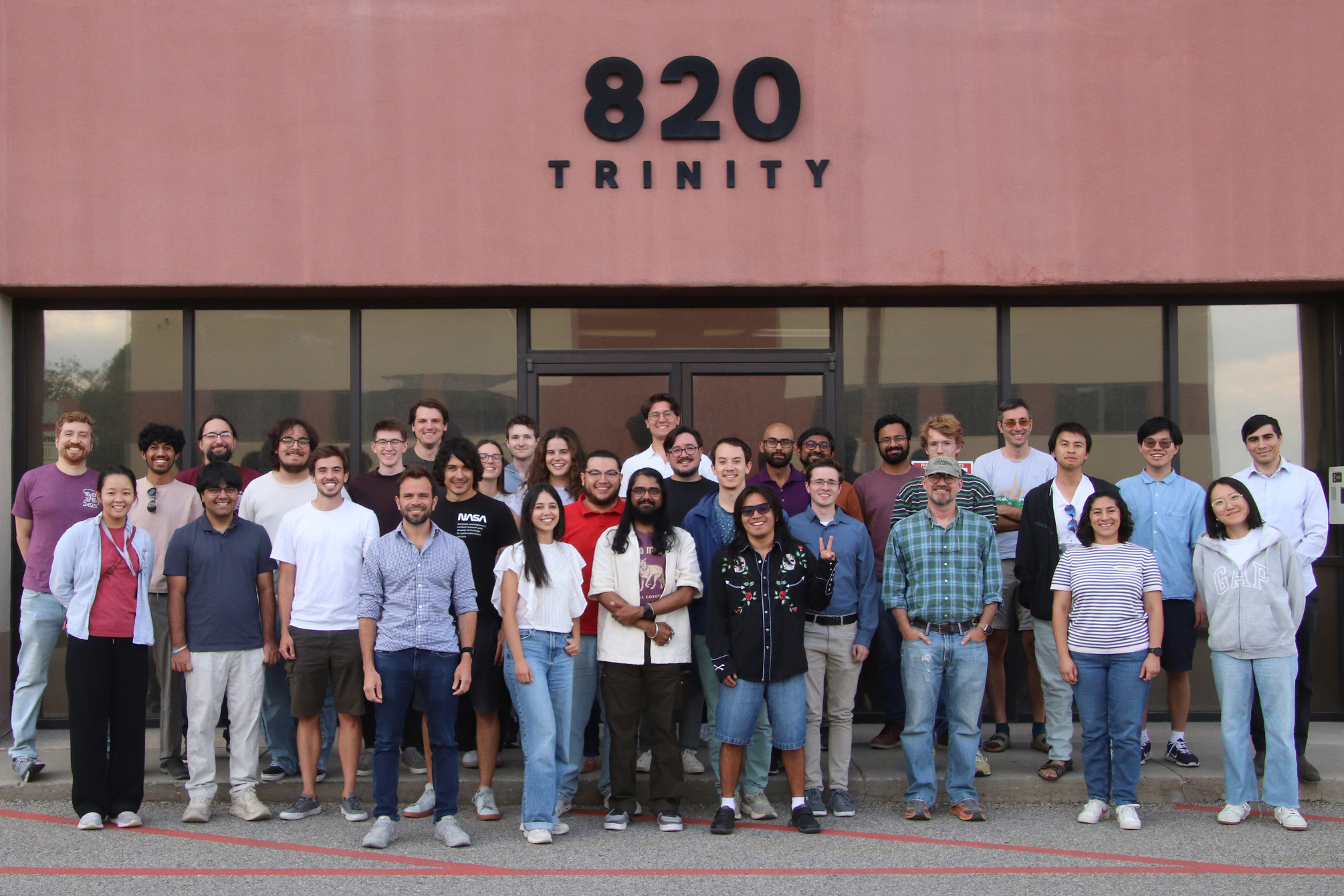
This past summer, 20 students selected from more than 1,000 applicants gained hands-on experience working with Los Alamos National Laboratory’s quantum computing experts on projects spanning quantum algorithms, simulation, sensing, chemistry and hardware implementation.
The Quantum Computing Summer School combines lectures by distinguished quantum experts from academia and industry with hands-on experience working on collaborative research projects closely integrated with ongoing mentor-led research at the Lab.
This year's school featured guest speakers representing leading academic and industry groups across quantum information science, including Xanadu scientists Torin Stetina and Vasilis Belis, whose teams are active Laboratory collaborators and co-mentors for summer students. Their talks highlighted first-quantized simulations of photoemission spectroscopy and the potential of quantum spectral methods for machine learning.
Ivan Deutsch, Distinguished and Regents Professor at the University of New Mexico and a longtime leader of the Center for Quantum Information and Control, presented the theory and applications of continuous quantum measurement. Milad Marvian, also from UNM, discussed approaches to suppressing and correcting quantum noise across the quantum-computing stack.
Former Los Alamos scientists Rolando Somma and Lorenza Viola, who maintain close scientific ties with the Lab, also returned as speakers. Somma discussed shadow Hamiltonian simulation as a compressed framework for addressing otherwise intractable simulation problems, while Viola presented algebraic methods for reducing complex open-system dynamics while preserving their essential physical structure.
New CQC enhances collaboration
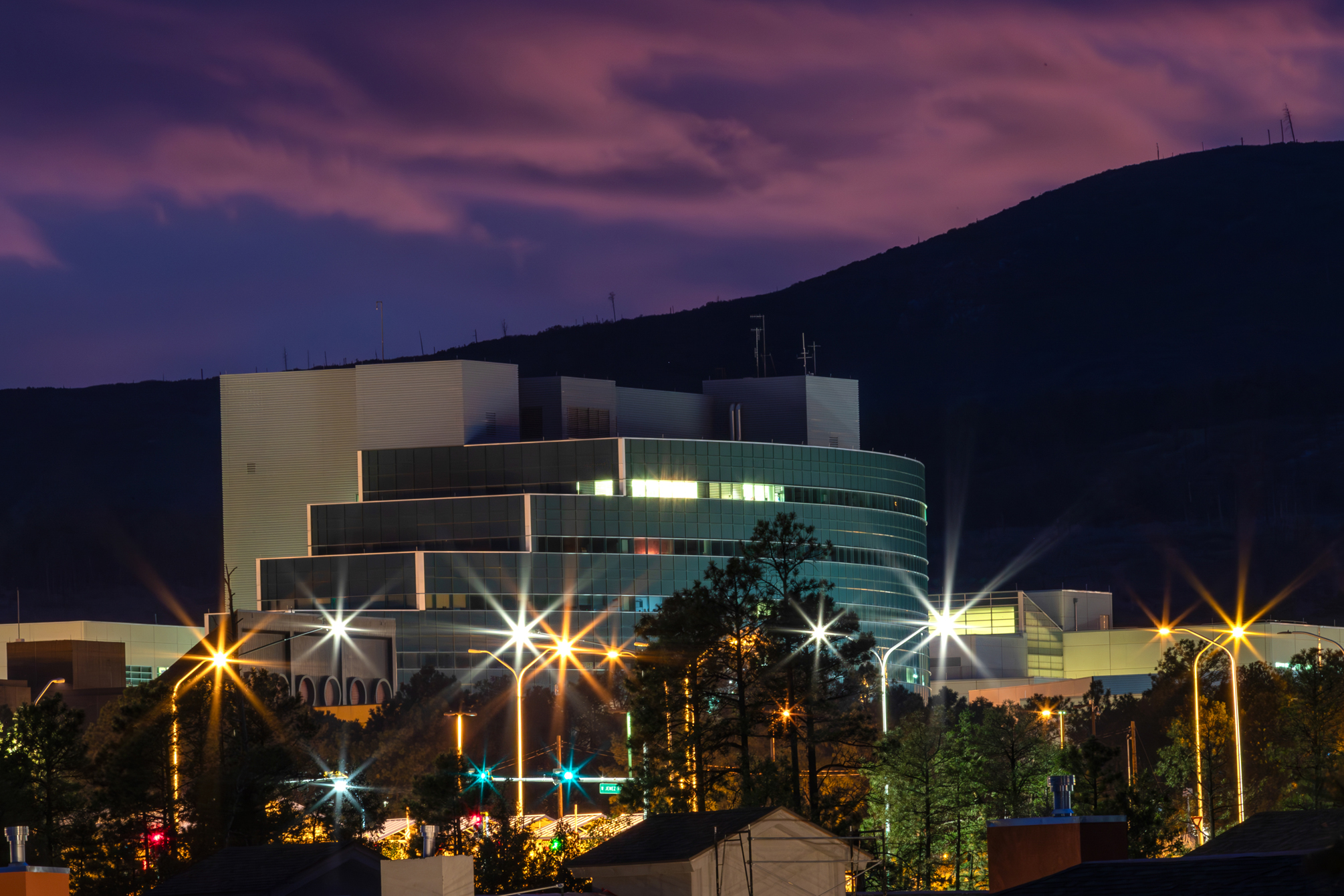
This year's QCSS was held in the new CQC building, providing students and mentors with a central hub to meet, work and exchange ideas throughout the summer.
Placing all 20 students together in an open-plan workspace encouraged spontaneous interactions across projects, while meeting areas and drop-in spaces allowed mentors to hold extended working sessions with students.
Organizers said the new space created an energetic, highly collaborative atmosphere and helped generate new collaborations among students working in different areas of quantum information science.
Student research this year covered a broad range of topics, including quantum phase estimation, quantum sensing, simulations of quantum spin liquids and lattice gauge theories, quantum machine learning, thermal sampling, nuclear-state preparation, circuit compilation and continuous quantum error correction.
Several projects were closely connected to ongoing Lab research.
Postdoctoral Research Associate Nahuel Diaz led work characterizing Lie-algebraic quantum resources in many-body fermionic systems, using algebraic resource measures to study quantum correlations and phase transitions in support of a Directed Research project. Another project, led by R&D Manager John Golden, focused on scalable quantum simulation of relativistic electronic-structure Hamiltonians, including methods for heavy-element systems with strong spin-orbit coupling.
The school also supported quantum error-correction research within the Beyond Moore's Law project through work led by Ichi Chen, a postdoctoral researcher investigating efficient magic state preparation through the phase kickback check.
Postdoctoral Fellow Sumner N. Hearth led work developing a framework that leverages prior information about a quantum state to improve the performance of classical shadow tomography even in cases where existing state-of-the-art methods fail.
Mentorship connects students to future opportunities
A key benefit of QCSS is the relationships students form with their mentors and other researchers — connections that can continue well beyond the summer.
For Jehu Martinez, a student at Illinois Institute of Technology, working alongside Laboratory researchers gave him the opportunity to take ownership of a research problem and explore how to put an idea into practice.
“What surprised me most was the deep intuition the researchers have for the quantum systems they work with,” Martinez said. “I was given the freedom to explore the problem and figure out how we could study it. I was able to get some meaningful results this summer, and we are now working on turning those results into a manuscript.”
Martinez’s project also closely connects with his work in an experimental quantum sensing group at his home institution, where researchers are interested in testing different sensing protocols. He said the work could eventually provide an opportunity to test the protocol he studied at the Laboratory experimentally.
“If everything works out, I could have the chance to see an idea go from theory and numerical work all the way into experimental practice,” Martinez said. “I think that is a really unique experience and is something that could be pivotal for me as I continue my research career.”
A highlight this summer was former QCSS student Kunal Sharma returning to share how mentorship and his experience at Los Alamos helped shape his career.
Sharma first came to Los Alamos as a student in the 2019 summer school while pursuing his Ph.D. at Louisiana State University. He later returned through a Graduate Research Assistant appointment before becoming a QuICS Hartree Postdoctoral Fellow in quantum information and computer science.
In 2022, Sharma joined IBM, where he is now a senior research scientist and manager for quantum algorithms, leading a newly established team in the company's Chicago office.
Sharma also presented his current research, showing how data from quantum experiments can be used to train models that predict ground-state observables across previously unseen Hamiltonian parameters.
"The Los Alamos Quantum Computing Summer School was instrumental in shaping my research taste and the way I approach quantum computing," Sharma said. "It taught me the value of debating ideas early and thinking carefully about what makes a good research paper."
His advice to this year's students was to use the summer to push beyond their existing areas of expertise.
"My advice is to use your time there to explore unfamiliar topics and work on challenging research questions with fellow students and Los Alamos researchers," Sharma said.
LA-UR-26-28126