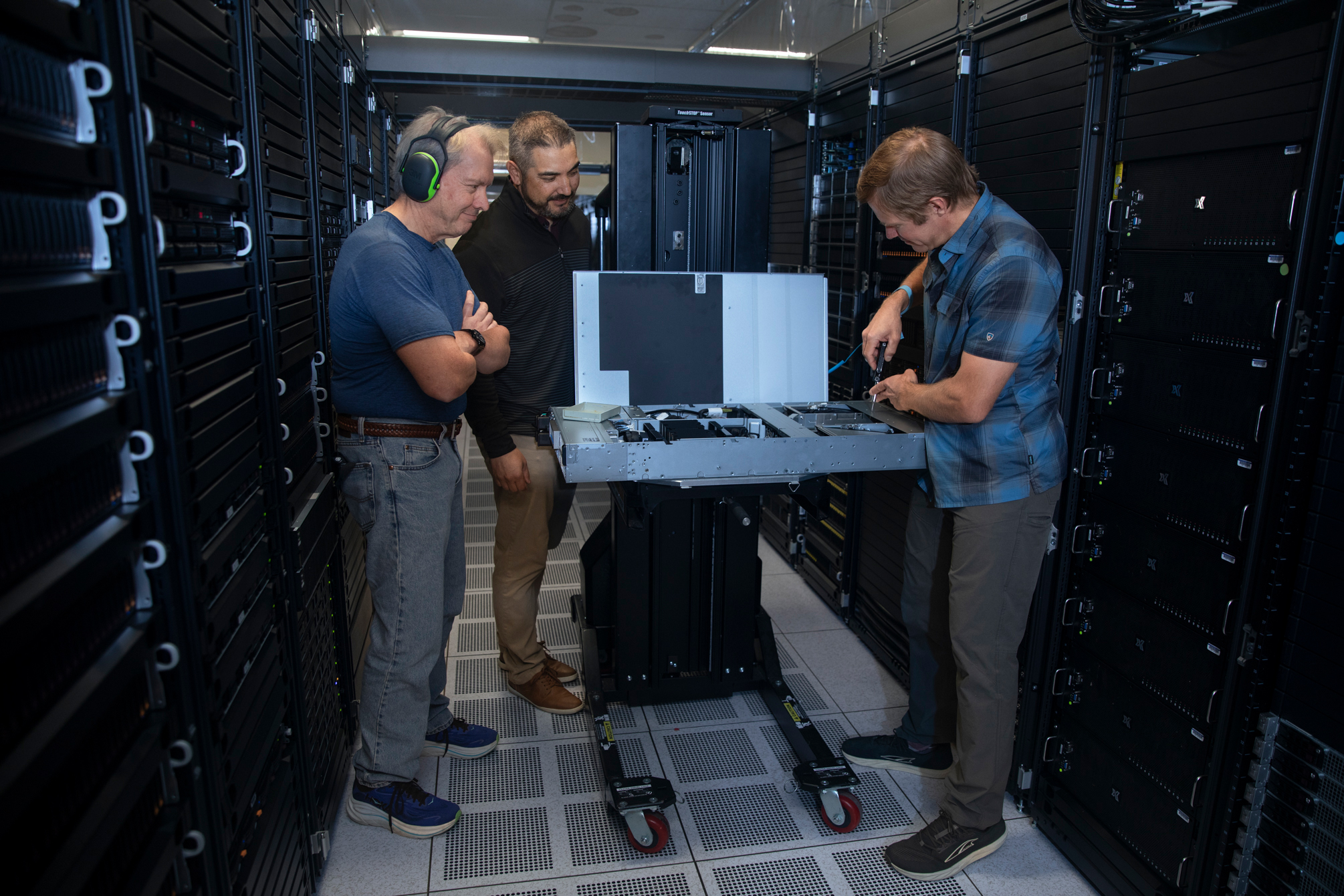
Los Alamos National Laboratory recently received its first NVIDIA Vera CPU systems, installing the components in the Laboratory’s Darwin testbed. The deployment is an important milestone in a long partnership on deep codesign with NVIDIA on high-performance CPU technologies and will enable the Laboratory’s work on software stack and application readiness for the forthcoming Mission, Vision and Veritas supercomputers.
“Los Alamos National Laboratory will be one of the first institutions to receive the Vera CPU technology during an ongoing, rigorous collaboration between the Laboratory and NVIDIA,” said Gary Grider, senior director for computing technology at Los Alamos.
The air-cooled MGX Vera CPU node combines two Vera CPUs with 88 high-bandwidth Olympus cores each in a two-socket server interconnected with the high-bandwidth NVLink Chip-to-Chip interface. The deployment of the Vera CPU node represents an important step in a deep hardware‑software co‑design initiative that has spanned more than a decade and builds upon the successful codesign of the Grace CPU that currently powers the Lab’s Venado supercomputer built by NVIDIA and HPE.
All three supercomputers — Mission, Vision and Veritas — will be powered by Vera CPUs and NVIDIA Rubin GPUs. Mission and Veritas will include Vera CPU partitions integrated with NVIDIA Vera Rubin NVL-4 and NVIDIA Vera Rubin NVL-72 partitions to support high-complexity modeling and simulation workloads and agentic AI.
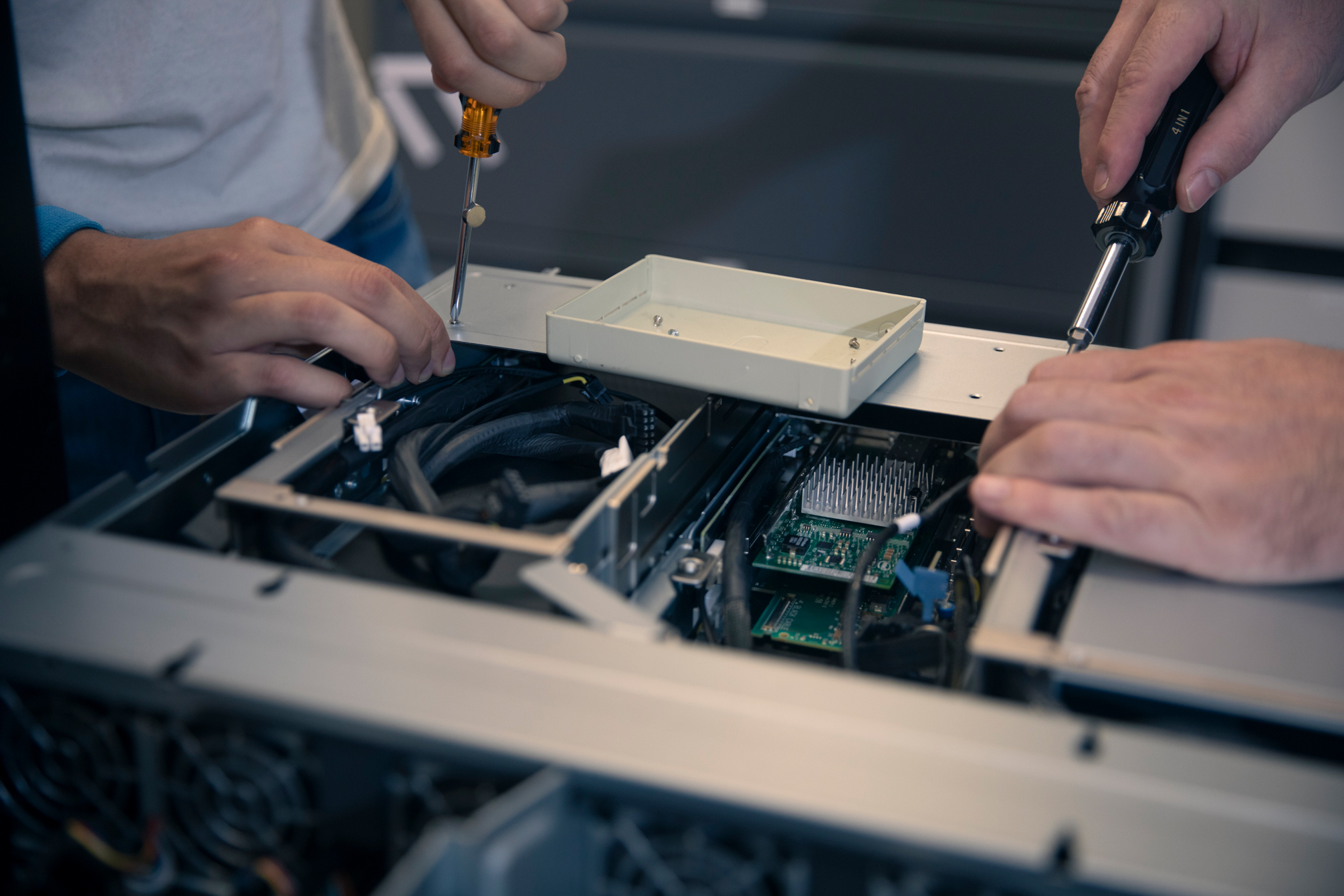
The MGX Vera CPU server was delivered to Los Alamos in August and the Darwin team (supported by the National Nuclear Security Administration’s Advanced Simulation and Computing Program) quickly installed and configured the system in the Darwin testbed. Software stack deployment was rapidly followed by performance and stability testing. The system is currently up and running, supporting benchmarking and application readiness activities.
Rigorous codesign leads to better performance
Reflecting the rapid diversification of computing technology to deliver performance improvements in the post–Moore’s law era, the forthcoming Mission system is the first NNSA Advanced Technology System with diverse, purpose-built technologies to support the NNSA’s most pressing workloads. Rather than a single, general-purpose architecture, Mission will be composed of three purpose-built partitions — Ranger (Vera CPU), Sandstone (Vera Rubin NVL-4) and Starlight (Vera Rubin NVL-72) — integrated with a flexible software environment and shared high‑performance storage optimized for AI-enabled modeling and simulation. In addition to the Mission Ranger partition, the Vera CPU nodes are also bound for the Veritas system.
“In its eventual deployment in Mission’s Ranger partition, the Vera CPU will support the NNSA’s highest complexity 3D multi-physics simulations and provide the technology foundation for Agentic AI powered workloads” said Galen Shipman, chief architect of advanced technology systems at Los Alamos. “Having collaborated with ARM, NVIDIA and HPE over many years on architectural specification and requirements definition, we are excited to have this Vera CPU in our testbed to further validate our codesign decisions and to continue to inform choices we make for our future systems.”
“The next era of scientific discovery will be powered by supercomputers that bring AI and simulation together,” said Ian Buck, vice president of hyperscale and HPC at NVIDIA. “Through our long partnership with Los Alamos, Vera CPUs and Rubin GPUs will power Mission, Vision and Veritas, creating a purpose-built foundation for the Laboratory’s goal of accelerating the combination of agentic AI with their most complex modeling and simulation workloads.”
The Ranger partition delivers high-frequency, high-bandwidth cores with large aggregate and per-core memory. The full, final Ranger partition will be installed in Mission in 2027 alongside the Sandstone partition. (The Mission-Starlight and Vision-Transformer partitions may be delivered as soon as late 2026 to the Laboratory.)
“At the Laboratory, we’ve concentrated on tailoring hardware technologies in Mission to address simulation characteristics that are not well represented in the broader cloud- and AI-driven market,” said Ben Santos, HPC Platforms program director at Los Alamos. “This focus on the unique characteristics of Laboratory applications has allowed our technology partners to address these unique needs with the latest highly impactful enhancements to their base technology portfolio. We work together through design, testing and evaluation to understand what applications require, what technologies are available, what optimal performance looks like, how workloads can be made scalable, and more.”
LA-UR-26-28276