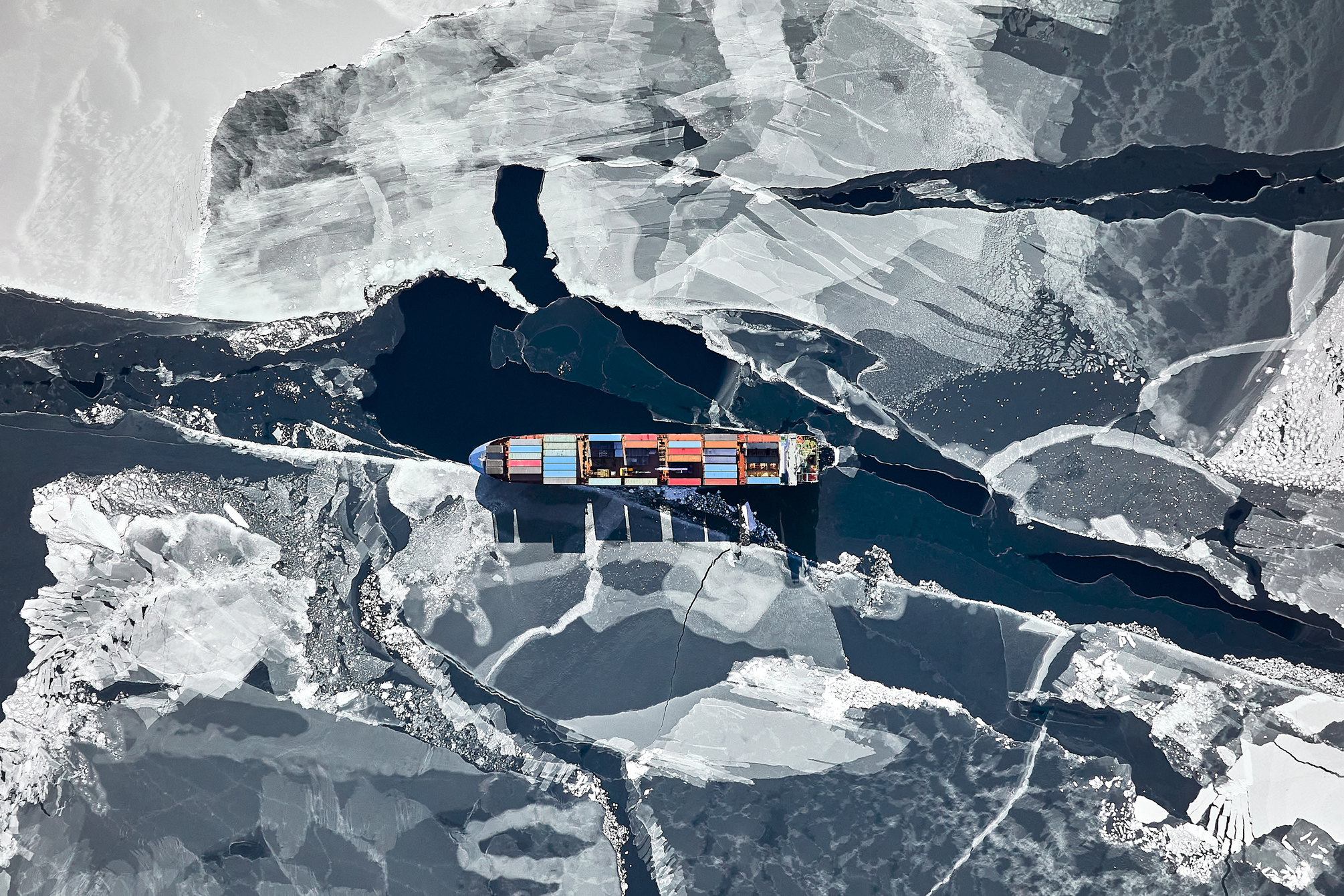
As Arctic sea ice retreats, new shipping routes, expanding resource development and growing geopolitical competition are transforming one of the world's least-monitored regions. Scientists at Los Alamos National Laboratory have established one of the first long-term acoustic baselines for the Arctic's underwater soundscape. This work strengthens the detection and interpretation of earthquakes, underwater and near-shore detonations, ship traffic and other events of national security interest.
"Before you can reliably detect something unusual, you have to understand what's normal," said Siobhan Niklasson, a scientist at Los Alamos National Laboratory who is the lead author on the study that established the baseline. "Long-term, continuous acoustic records from the Arctic are extremely rare. This dataset lets us understand how the soundscape changes throughout the year and what kinds of events we can realistically detect under different conditions."
Published in the Journal of the Acoustical Society of America, the study analyzes seven years of continuous recordings from a hydrophone deployed 500 meters below the Beaufort Sea. The data, collected by one of 12 acoustic sensors in the National Oceanic and Atmospheric Administration’s Ocean Noise Reference Station Network, reveals how the Arctic's underwater soundscape changes through the seasons—and how those changes affect scientists' ability to detect important events.
Unlike land and space, the world's oceans remain sparsely instrumented and comparatively poorly understood. Scientists know relatively little about how underwater background noise varies from place to place or season to season, making it difficult to determine how sensitive ocean-based monitoring systems can be.
Hydrophones detect sound traveling through seawater, where sound can propagate great distances under the right ocean conditions. Every measurement is influenced by underwater topography, waves, sea ice, wind, marine mammals, ships and other human activity.
The researchers found that the Arctic soundscape changes dramatically with the seasons. During summer, ocean waves dominate the acoustic environment. During winter, moving and deforming sea ice becomes the primary source of underwater noise. Seismic surveys that rely on air guns to map geology beneath the seafloor for scientific research and offshore resource exploration also contribute to the region's acoustic environment. Understanding these patterns helps scientists distinguish routine background sounds from signals that warrant closer investigation.
Paper: “Evaluation of geophysical and anthropogenic sources of hydroacoustic noise in the Alaskan arctic.” The Journal of the Acoustical Society of America. DOI: 10.1121/10.0044094
Funding: This Nuclear Test Detonation Detection research was funded by the National Nuclear Security Administration Office of Defense Nuclear Nonproliferation Research and Development and Los Alamos National Laboratory’s Laboratory Directed Research and Development program.
LA-UR-26-27653