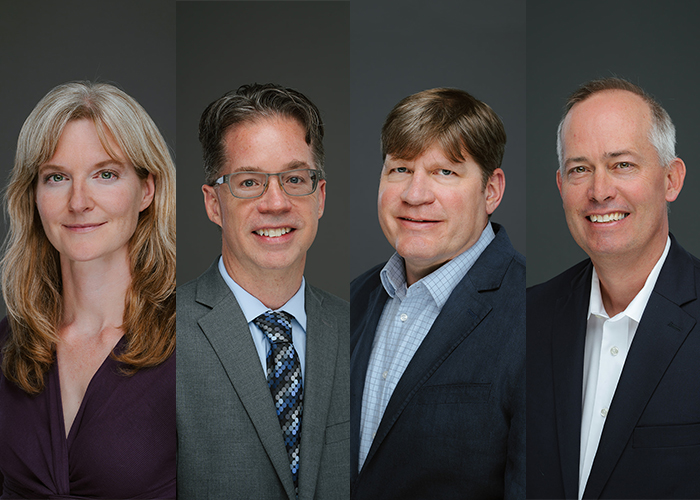
Los Alamos National Laboratory will award its highest honor, the Los Alamos Medal, to three of its premier staff members for their contributions to science and the Laboratory’s mission. The winners are Mike Gittings, Christopher Morris and Bob Weaver.
Morris was nominated for his field-defining contributions to stockpile stewardship and modernization physics; Weaver and Gittings were nominated jointly for their contributions to high-performance computing, and stockpile stewardship and weapon modernization, enabling Los Alamos and the Nuclear Security Enterprise to accomplish its mission.
“Mike, Christopher and Bob have dedicated their careers to improving national security,” Laboratory Director Thom Mason said. “Their work played a vital role in ensuring the safety, security and reliability of the U.S. nuclear arsenal, and they pioneered methods used to certify its continued performance. I congratulate them on this well-deserved recognition.”
Mike Gittings
Mike Gittings is a guest scientist in the Integrated Design and Assessment group at Los Alamos. Before his distinguished tenure at the Laboratory, Gittings earned recognition as a uniquely talented code architect. With a background in mechanical engineering, Gittings demonstrated exceptional skill in developing robust computational methods for modeling multiphysics systems. His innovative approaches have consistently advanced the precision and efficiency of complex system simulations. Gittings’ Radiation Adaptive Grid Eulerian Multiphysics hydrodynamics codes have been adopted across private industry, academia, and the Nuclear Security Enterprise for decades.
Together, Gittings and Weaver’s work in adaptive mesh refinement hydrodynamics and full-system modeling revolutionized computational multiphysics simulations in fields such as inertial confinement fusion, astrophysics and planetary defense. Their methods set an enterprise for simulating complex systems.
Christopher Morris
Christopher Morris, a Laboratory Fellow and scientist in the Dynamic Imaging and Radiography group, received the Los Alamos Medal for his contributions to stockpile stewardship and modernization, and to the Los Alamos Neutron Science Center. Morris has made transformative advances in basic science and global security. His research has had a lasting impact on areas including pion physics, proton radiography, fundamental neutron physics and muon tomography.
Among his achievements, Morris developed a flash-radiographic technique using high-energy protons and magnetic lenses. He also created the world’s most intense ultracold neutron source, using a solid-deuterium converter, and enabled the most precise neutron lifetime measurement to date. Additionally, Morris invented muon tomography techniques that have significantly enhanced homeland security and nonproliferation efforts.
Bob Weaver
Bob Weaver is a Laboratory Fellow in the Integrated Design and Assessment group at Los Alamos. Weaver has made foundational contributions to science and the nuclear weapons program. His highly cited journal articles span topics including astrophysics, radiative transfer and computational physics. He has authored many seminal publications that are essential to thermonuclear design physics.
Weaver’s expertise in weapons design guided the Laboratory’s secondary design community in stockpile stewardship and modernization. He advanced the physics of thermonuclear weapons and is recognized as a national authority on weapons outputs and effects.
The partnership between Weaver and Gittings transformed weapons computational physics, leading to the first three-dimensional, full-system nuclear simulations and establishing end-to-end modeling as the standard for the Nuclear Security Enterprise.
LA-UR-26-27807