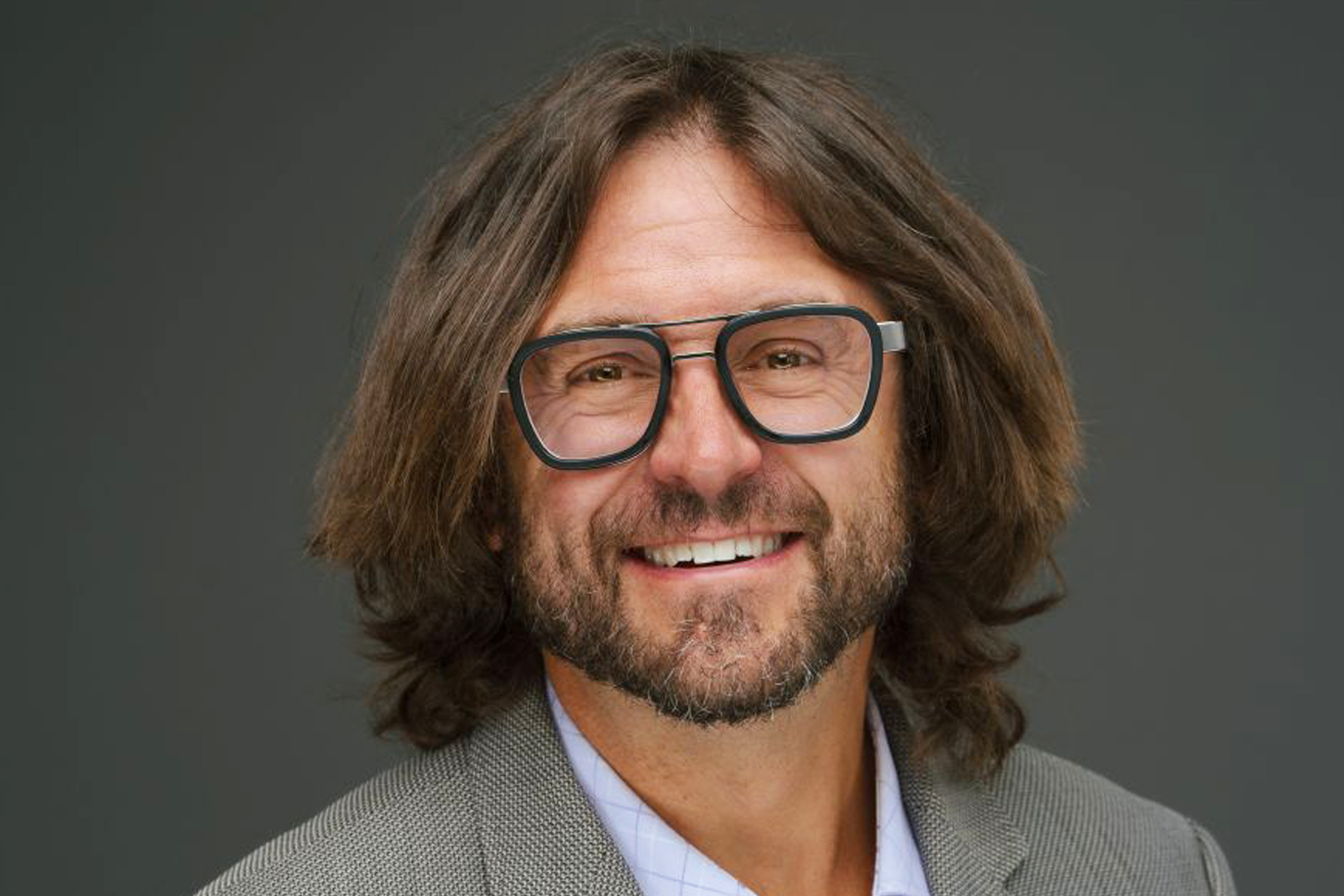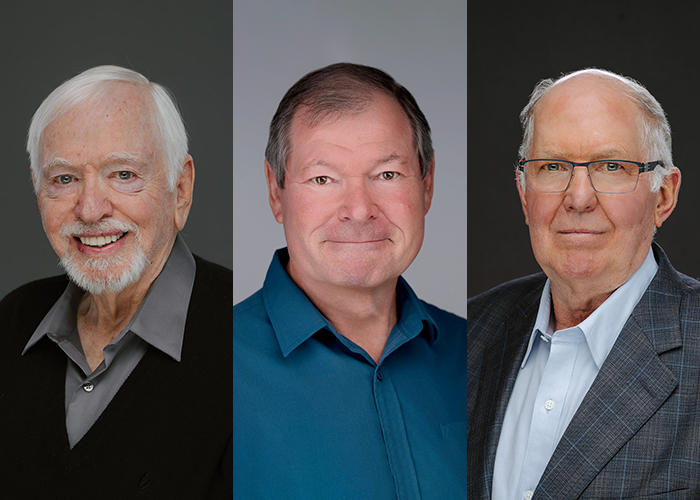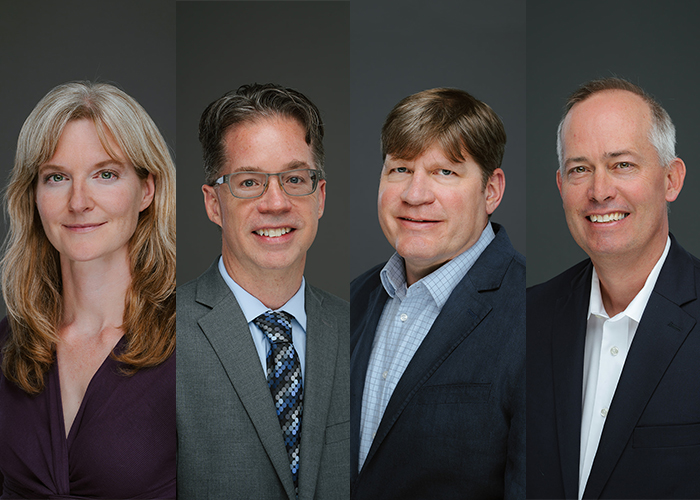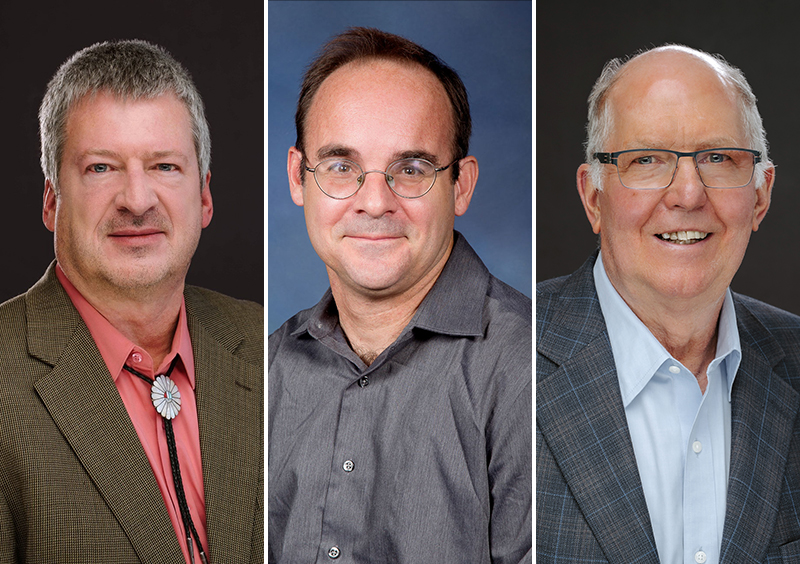
Three Los Alamos National Laboratory scientists have received prestigious recognition from the American Physical Society. Larry Glenn Hill was elected as a fellow of the society, Christopher Fryer was awarded the 2026 Hans A. Bethe Prize, and Christopher Morris received the 2026 Tom W. Bonner Prize in Nuclear Physics.
“This American Physical Society recognition reflects the broad-ranging and impactful work in which our Los Alamos scientists excel,” Laboratory Director Thom Mason said. “We’re proud of the pioneering accomplishments in national security science, in neutron physics and computational physics, all of which drive mission-essential success as well as fundamental scientific progress.”
Larry Hill named APS fellow
A senior scientist and high-explosives subject matter expert, Hill been named a 2025 American Physical Society Compression of Condensed Matter Fellow. This fellowship recognizes Hill’s “groundbreaking contributions to the innovative design and execution of shock physics experiments involving energetic materials, pioneering insights into the microstructural effects of high explosives, and significant advancements in the theoretical understanding of shock and detonation physics.” The fellowship honors “APS members who have contributed to the advancement of physics by independent, original research to the cause of the sciences.”
Hill is an internationally recognized authority on the experimental and theoretical behavior of high explosives. Over the past 33 years, his work has advanced research in areas ranging from process–structure–performance relationships in next-generation high-explosive formulations to cutting-edge, physics-based experiments that enhance understanding and characterization of detonation phenomena.
After receiving a bachelor’s degree from the University of Michigan, Hill did graduate work with the Graduate Aeronautical Laboratories at the California Institute of Technology in 1990, the forerunner of the Jet Propulsion Laboratory, graduating with a doctorate in aeronautics. He joined Los Alamos National Laboratory in 1992.
Christopher Fryer earns Hans A. Bethe Prize
Fryer has been awarded the prestigious 2026 Hans A. Bethe Prize, which recognizes “outstanding work in theory, experiment or observation in the areas of astrophysics, nuclear physics, nuclear astrophysics or closely related fields.” Fryer has received the prize on the basis of his “broad and pioneering contributions to our understanding of stellar collapse, supernovae, and compact object formation, and for leadership in the field of time-domain multi-messenger nuclear astrophysics.”
Fryer is the first Los Alamos scientist to receive the Hans A. Bethe Prize.
A computational physicist and the director of the Center for Nonlinear Studies at Los Alamos, Fryer has contributed deeply to the understanding of supernovae, gamma-ray bursts and binary stellar evolution. He studies a broad range of computational physics problems in turbulence, radiation hydrodynamics, nuclear physics and plasma physics.
Fryer joined Los Alamos National Laboratory in 2000. He holds a doctorate in astronomy from the University of Arizona and a degree in mathematics and astronomy from the University of California, Berkeley. Freyer is a Laboratory Fellow, as well a fellow of the APS and the American Association for the Advancement of Science. In 2024, he was recognized with APS’ Marcel Grossmann Award for Relativistic Astrophysics.
Christopher Morris selected for Tom W. Bonner Prize
Morris has been named the recipient of the 2026 Tom W. Bonner Prize in Nuclear Physics, which “recognizes outstanding experimental research in nuclear physics, including the development of a method, technique or device that significantly contributes to nuclear physics research.” A nuclear physicist who advanced ultracold neutron physics, Morris was awarded the prize “for pioneering work to develop an ultracold neutron source and establish ultracold-neutron-based physics research in the U.S., and for leadership in measuring the free neutron lifetime to unprecedented precision using a magneto-gravitational trap and in-situ detection of neutrons.”
Morris is the second Los Alamos scientist to be awarded the Tom W. Bonner Prize, and the first since 1998.
Morris studied the science of ultracold neutron production in solid deuterium, research that led to the development and construction of the most intense ultracold neutron source in the world, the Ultracold Neutron Facility at the Los Alamos Neutron Science Center. Ultracold neutron experiments have delivered physics breakthroughs such as the most precise measurement of the neutron lifetime and important measurements related to neutron beta decay and the neutron electric dipole moment.
Morris received a bachelor’s degree from Lehigh University and a doctoral degree in physics from the University of Virginia. He joined the Laboratory in 1973. Morris is an APS fellow and a Laboratory Fellow.
LA-UR-26-20048