DOE/LANL Jurisdiction Fire Danger Rating:
  1. LANL Home
  2. engage
  3. collaboration
  4. feynman center
  5. tech and capability search
  6. glowtag

Making industry-ready enzymes that operate at high temperatures

Optimized enzymes for national security bioconversion applications

technology Snapshot

Overview

Scientists at Los Alamos National Laboratory engineered a “fluorogenic reporter” protein that works at high temperatures such as 70 degrees Celsius (158 degrees Fahrenheit) and signals its function by emitting a green glow. Researchers can evaluate the stability or function of enzymes by tagging them with this green-glowing reporter.

The reporter, Thermostable GlowTag, makes it easy to screen large libraries of proteins quickly for specific, industry-relevant characteristics such as a long shelf life or retained activity at high temperatures. The team took advantage of thermophilic microbes — microorganisms that naturally thrive in hot environments — as hosts to produce these proteins.
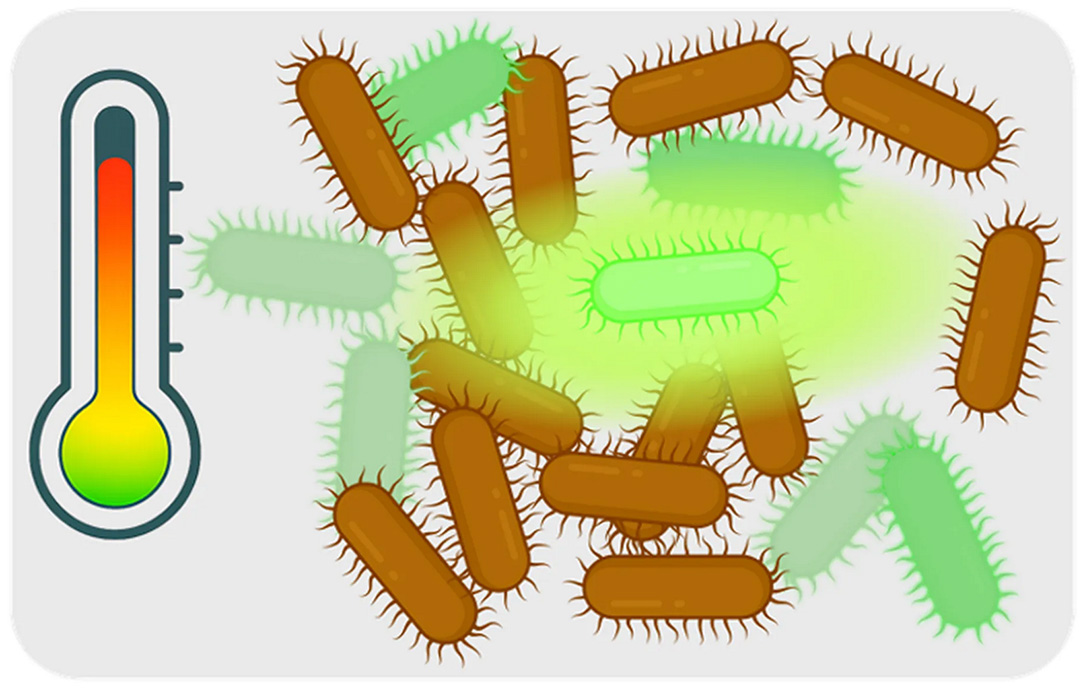
Caption: This illustration shows how a fluorogenic protein developed at Los Alamos makes its bacterial host glow green when the protein is produced properly, even at high temperatures. Credit to: Sang-Min Shin, LANL, created with BioRender.com.

Advantages

Proteins have a wide range of biotechnological applications. They can be used as therapeutic agents, antibodies, reagents for research and diagnostics, and as functional catalysts for biomanufacturing.

  • The challenge is that many proteins need cold storage and can also rapidly lose function at the high temperatures needed for certain industrial processes.
  • Some proteins naturally function at high temperatures, but finding and studying them requires working with a host organism that can also survive at high temperatures conditions.

The advantages of Thermostable GlowTag (YFAST) include: 

  • Enables rapid, high-throughput screening at high temperatures.
  • Introduces a thermostable fluorogenic reporter that provides an optical response that correlates to the quantity of the protein it is fused to.
  • Improves screening accuracy by using direct selection rather than elimination-based methods, reducing false positives.
  • Expands access to thermostable enzymes by allowing common mesophilic enzymes to be engineered for heat resistance.
  • Allows for screening and optimization of proteins from thermophilic sources.
    Reduces storage and operational costs by producing enzymes that remain stable without refrigeration.

Technology Description

The Los Alamos team computationally designed libraries of variants of a low temperature fluorogenic reporter, YFAST, with thermostability in mind and directly screened the variants in a thermophilic microbial host that thrives in extreme heat. 

  • Through this process, the team developed a fluorogenic protein called hsFAST or Thermostable GlowTag. 
  • hsFAST can now be used as a “fluorescent tag” to screen thermostable variants of other industrial proteins for biological applications.
  • hsFAST is also useful a tag to report other conditions inside a microbial host cell.

Contrary to some other thermostable fluorescent reporters such as TGP (thermal green protein, also developed at the Lab), the new reporter hsFAST can function in an oxygen-free environment, a characteristic highly relevant for applications in thermophiles, which mostly exist in anaerobic conditions.

Market Applications

  • Biofuels
  • Waste Management
  • Chemical and Pharmaceutical Manufacturing
  • Food and Beverage Processing
  • Textiles and Detergents

Next Steps

By allowing mesophilic enzymes to be re-engineered for high-heat environments, reducing reliance on cold storage, and streamlining the screening process with direct fluorescence-based selection, this technology overcomes key bottlenecks in enzyme development and opens the door to more robust, cost-effective and versatile enzymes for industrial and environmental applications.

On This Page

Overview

Advantages

Technology Description

Market Applications

Next Steps

Published: 2026-01-23

LA-UR-25-32018

Application Area

Sectors:Biotech, Life Sciences & Healthcare

Areas:Food and Beverage

Industries:Pharmaceuticals, Waste Management

Partnership Opportunities

LANL is seeking a partner to commercialize Thermostable GlowTag (YFAST) through a technical collaboration under a CRADA or a license agreement to develop a commercial prototype and leverage LANL’s intellectual property.

  • Cooperative Agreement
  • License

Technology Readiness Level:

2 - Concept Formalized

IP Information

Patent Number: Patent Pending 19/284504

Download PDF