Maximum Length Sequence Phase Encoding for Quantum Sensor Readout
A correlation-based method for interference-resistant detection in quantum sensing systems
technology Snapshot
Overview
Quantum sensors can detect extremely small electromagnetic and magnetic signatures, which makes them powerful tools for geophysical analysis, materials detection, environmental monitoring, and scientific research. Their sensitivity also makes them vulnerable to interference from ambient RF sources, electrical noise, and outdoor or industrial environments. Traditional readout methods attempt to preserve the phase of the sensor or allow it to evolve uniformly, but these approaches can produce ambiguous results or false positives when exposed to strong interference.
Los Alamos researchers developed a pseudorandom phase-encoding method that allows a quantum sensor to distinguish true target signals from substantial background noise. By applying a maximum length sequence, also called an msequence, the sensor’s phase is flipped by 180 degrees according to a designed pattern. The resulting measurement is analyzed using correlation against the known sequence, enabling accurate extraction of the intended signal even when conventional methods fail to differentiate between interference and true sensor output.
Advantages
- Improves quantum sensor performance in noisy outdoor and industrial settings
- Distinguishes true sensor signals from interfering or spurious noise
- Reduces false positives without added shielding or multichannel detection
- Integrates into existing measurement protocols with minimal modification
- Compatible with a range of quantum sensing platforms, including magnetic and electromagnetic
systems
Value Proposition
This technology improves the reliability of quantum sensors in environments where interference normally overwhelms the measured signal. By introducing a controlled pattern into the sensor response and analyzing it through correlation methods, the approach separates real signals from background noise. This enables clearer, more dependable measurements in conditions where conventional quantum readout techniques commonly struggle.
Technology Description
The method embeds a defined sequence of phase inversions into the quantum sensor. Target signals track this imposed pattern because they arise from the controlled experiment, while interfering signals do not. This inherent separation allows correlation-based processing to highlight coherent responses and suppress background noise.
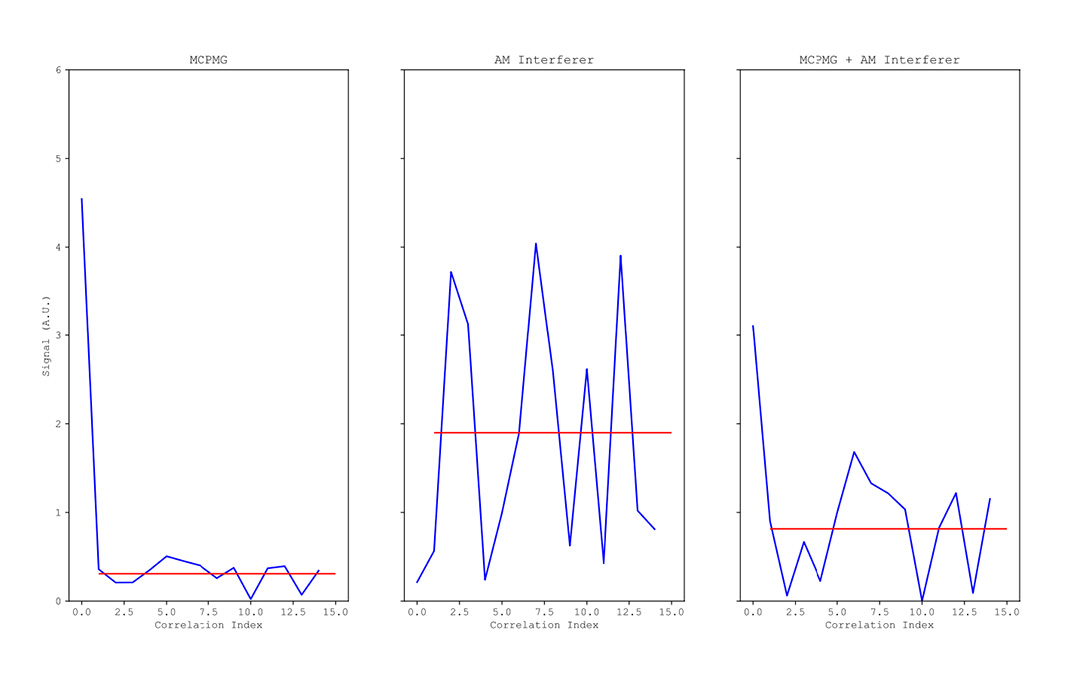
Demonstrations using low field nuclear magnetic resonance (NMR) show that both traditional CPMG-style readouts and the m-sequence-based readout detect the intended signal under ideal conditions. However, when only interference is present, the traditional readout cannot reliably separate interference from the target signal, while the m-sequence method correctly rejects the interferer. Experimental data also show strong correlation peaks for the encoded measurement and minimal correlation for AM or broadband interferers, confirming the method’s robustness in realistic outdoor and industrial noise environments.
Market Applications
This phase-encoded readout method supports sensing platforms in which interference can obscure weak or transient signals. Its characteristics make it relevant to a wide range of technologies, including:
- subsurface imaging and resource characterization in geophysical exploration
- quantum sensing systems deployed near infrastructure such as roads, power lines, or industrial equipment
- environmental and geophysical platforms that integrate seismic, muon, magnetic, or other sensing modalities
- detection systems that require high confidence in distinguishing real signatures from environmental noise
These and related applications benefit from enhanced robustness and improved discrimination of true signals in field environments.