The AirWave technology uses gentle sound vibrations, tuned to each person’s lungs, to shake loose stubborn mucus that makes breathing difficult. Unlike current methods, it can target problem spots deep in the airways with precision, offering a faster and more effective way to help patients with conditions like COVID-19, pneumonia, or chronic lung disease breathe easier. It’s a personalized, non-invasive solution with strong potential for hospitals and respiratory care.
AirWave
Acoustic excitation of airway for enhanced mucus clearance
technology Snapshot
Overview
Advantages
- Patient-specific customization – CT scans and modeling allow vibration frequencies to be tailored to each person’s lung anatomy.
- Targeted therapy – Specific problem areas in the lungs can be precisely reached, improving effectiveness where it’s most needed.
- Higher efficiency – Uses higher-frequency sound waves than current methods, producing stronger airway vibrations to loosen mucus more effectively.
- Non-invasive approach – Delivers therapy without surgical procedures or invasive devices.
- Multiple delivery methods – Can be applied through the mouth or externally using acoustic transducers, speakers, or shakers.
- Improved patient outcomes – Helps clear mucus faster, eases breathing, and reduces complications from respiratory illnesses.
- Broad clinical applications – Useful for conditions like COVID-19, pneumonia, and chronic lung diseases, making it valuable across healthcare settings.
- Commercial potential – Scalable solution for hospitals and respiratory care providers worldwide
Technology Description
How it Works
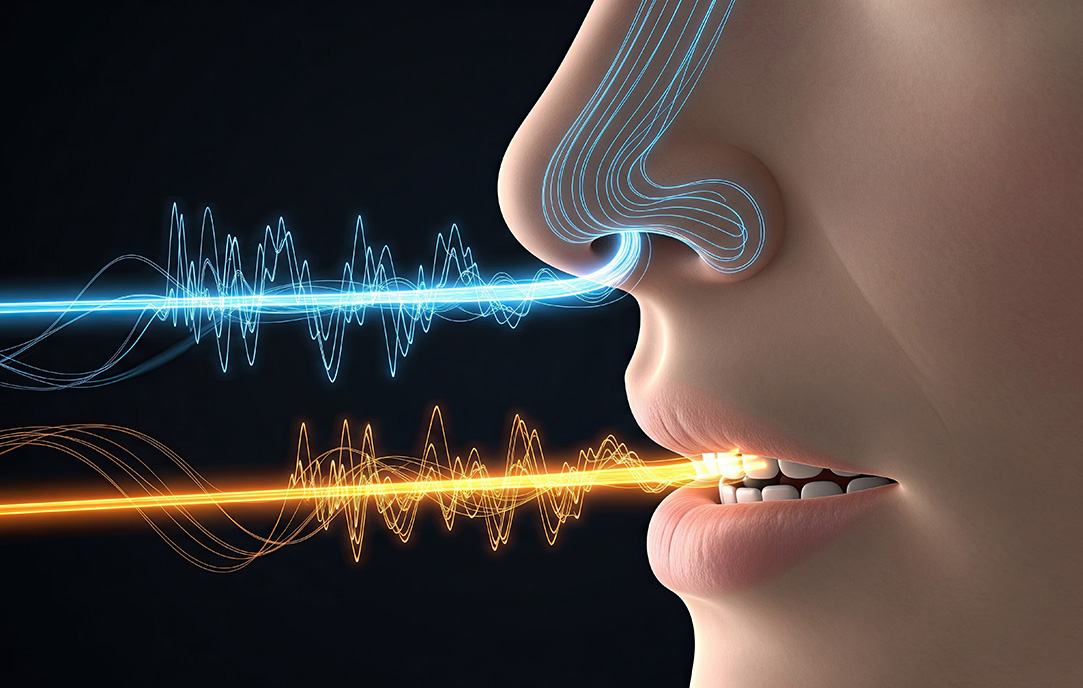
This technology uses sound waves to gently vibrate the lungs and airways, helping loosen and clear mucus that makes breathing difficult. What makes it unique is the ability to tune these sound waves specifically for each patient:
- A CT scan of the lungs is used to build a model of the patient’s airway structure.
- Computer modeling determines the exact sound frequencies that will produce the strongest vibrations in problem areas.
- The selected frequencies are then applied either through the mouth (using acoustic waves) or from outside the body (using devices like speakers or transducers).
- These targeted vibrations “shake loose” mucus deep inside the lungs, making it easier to clear and improving airflow.
This personalized approach makes the therapy more effective, more comfortable, and adaptable for a wide range of respiratory conditions.
Market Applications
- Hospitals and healthcare systems – For treating patients with pneumonia, COVID-19, COPD, cystic fibrosis, and other respiratory conditions.
- Medical device manufacturers – Companies developing respiratory care devices (ventilators, airway clearance systems, acoustic or vibration-based therapies).
- Pulmonary rehabilitation centers – Clinics specializing in long-term care for patients with chronic lung diseases.
- Home healthcare providers – Potential adaptation for at-home respiratory therapy, especially for chronic conditions.
- Critical care and emergency medicine – Integration into ICUs and ERs to assist patients with severe breathing difficulties.
- Telehealth and remote monitoring companies – Future integration with connected respiratory care solutions for patient monitoring.
- Pharmaceutical and biotech firms – As a complementary therapy alongside respiratory drugs or inhaled treatments.
- Military and government health agencies – For treating respiratory distress in high-risk environments or pandemic response.
Next Steps
AirWave is advancing toward clinical readiness, with development now focused on translating its targeted acoustic-excitation method into a commercially deployable medical device. Upcoming work will prioritize demonstrating clear performance gains in mucus clearance, validating patient-specific treatment capabilities, and preparing the technology for regulatory pathways.
LANL is seeking industry and clinical partners to accelerate commercialization. Key near-term objectives include:
- Integrating AirWave into existing respiratory therapy systems to streamline adoption in hospital settings.
- Executing focused pre-clinical and clinical studies with medical research partners to confirm efficacy, safety, and scalability across patient populations.
- Pursuing licensing and co-development opportunities with medical device manufacturers to bring AirWave to market as a novel solution for respiratory distress and impaired mucus clearance.
These steps position AirWave to enter high-value healthcare markets where improved pulmonary function can significantly impact patient outcomes.
Published: 2025-12-10
LA-UR-25-30102
Application Area
Sectors:Biotech, Life Sciences & Healthcare
Industries:Pharmaceuticals, Devices and Instruments
Technology Readiness Level:
3 - Component Prototypes Built and Proof-of-Concept Testing Completed
IP Information
Patent Number: Pending
S Number: 167761
Contact
- Licensing
- Los Alamos National Laboratory
- licensing@lanl.gov

Connect With Our Innovators

Access Our Technical Expertise
