Los Alamos National LaboratoryGo to the Lab's home pageSearch for people in the Lab's phone book
     
  logo

Contour Method: Principle

 
transparent spacer
 
HOME
> Principle
   - make cut
   - measure surface
   - calculate stress
Validations
Applications
   - bent beam
   - weld plate
   - quenched steel
   - impacted plate
   - alum. forging
   - friction stir weld
   - Ti FSW
   - Railroad rails
Publications
More info
 
Residual Stress
Conferences
Vertical Linetransparent spacer
(See 2nd and 3rd paper on publications page for two ways to measure multiple stress components:
1) With multiple cuts and 2) Using one cut, multiple techniques, and superposition)


The Contour Method is Based on an Elastic Superposition Principle:

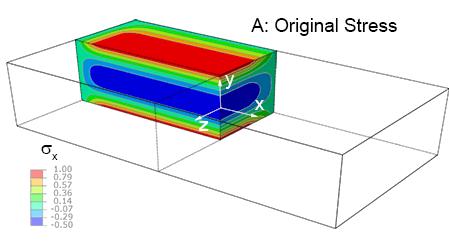
initial, unknown residual stress
Start with your part. These are the residual stresses that you would like to measure

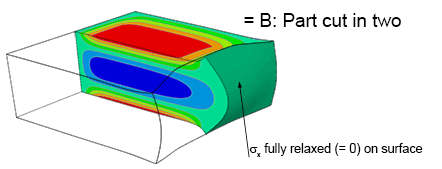
Experimentally cut the part in two. The part will deform from the release of the stresses

Then experimentally measure the contour, or shape, of the newly created surface

deformed shape after cutting

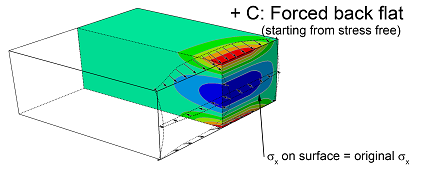
Now analytically force the cut surface back flat. This gives the original residual stresses normal to the cut plane! cut surface returned to original state

It really is simple, but gives you a full 2-D map of the original residual stresses over the cross-section of the part!
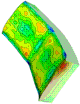
stress map

Details:


transparent spacer       transparent spacer
   

Operated by Los Alamos National Security, LLC for the U.S. Department of Energy's NNSA
contact: Mike Prime at prime@lanl.gov | Copyright & Disclaimer
U.S. patent 6,470,756 | Last Modified: October 27, 2011

spacer spacer spacer spacer